Almudena Festival Cusco: Virgin of Nativity Guide, September 8
The Almudena festival in Cusco: eve on September 7, main day September 8. Masses, procession, dances, food, where to watch and Cusco's festival calendar.
The festival of the Virgin of Nativity, which people in Cusco call the Almudena festival, peaks every September 8 at the Almudena church, in the Santiago district, about 1.5 km from the historic center. The eve, September 7, brings the entry of donations and dance groups into the streets. On the main day the 2026 program had the central Mass at 10:00 and the procession from about 13:00, and the image they call "mamá Nati" was carved by the Cusco artist Juan Tomás Tuyro Túpac in the late 1600s. In 2027, September 8 falls on a Wednesday.
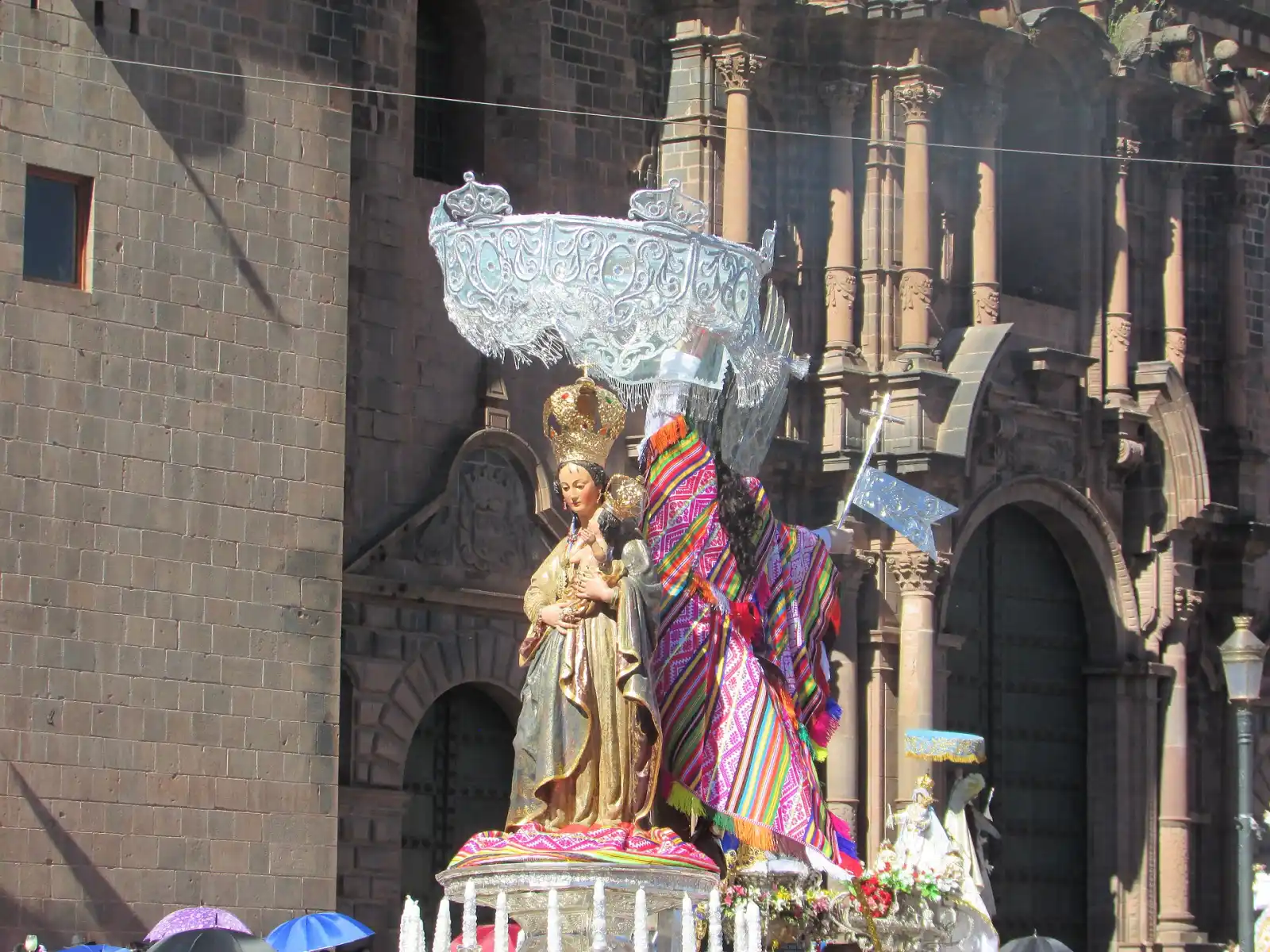
The Virgin of Nativity of the Almudena parish in Cusco's historic center. The camera dated the photo May 26, 2016, the day of Corpus Christi that year, a feast she also attends. Photo: Nakimpo2016, CC BY-SA 4.0
The short version
- When: September 8 is the main day and September 7 is the eve. The season of the feast runs from early August to the Sunday after the 8th.
- Where: the Almudena church (Templo de la Almudena) on the Plazoleta de la Almudena, Santiago district, Cusco.
- What you will see: Masses from before dawn, a long procession of the image, and dozens of dance groups in costume, called comparsas.
- Who she is: a copy of the Virgin of Almudena of Madrid, carved in Cusco by Juan Tomás Tuyro Túpac. Locals call her "mamá Nati" or "Mamita Natividad".
- Times: they change every year. In 2026 the Mass was at about 10:00 and the procession left at about 13:00.
- Cost: it is a street and church festival. No source we read mentions tickets.
What is the festival of the Virgin of Nativity in Cusco?
September 8 is the feast of the Nativity of Mary, the day the Catholic Church celebrates the birth of the mother of Jesus. In Cusco the date belongs to one image above all: the Santísima Virgen Natividad Real de La Almudena, patroness of the Almudena parish. Her people treat the day as a birthday. Father Hugo Condori Valero, the parish priest, told Andina in August 2026 that the predawn procession invites the city to wake up because "mom's birthday is coming," and that women are the first to commit to it, while "we men are a bit dry."
That affection explains the nicknames: "mamita Nati" and "mamá Nati" in Andina, "Mamita Natividad" in Diario Correo. In 2011 the district named her "Alcaldesa Vitalicia," mayor for life, of Santiago, according to Correo, and the 2024 program still included a solemn session in her honor.
The parish organizes the feast with the district municipality, a brotherhood (hermandad) and the mayordomos, the families who take on the cost and organization for a year. "Everyone makes a sacrifice from a year before," Father Condori told Andina in 2024. You see that year of work on the 8th, in the new costumes, the brass bands and the flowers on the platform.
The image and the Almudena church: a short history
The Almudena church was finished in 1698, sponsored by the family of Manuel de Mollinedo y Angulo, bishop of Cusco from 1673 to 1699. The bishop also asked the Cusco artist Juan Tomás Tuyro Túpac to make a replica of the Virgin of Almudena of Madrid. That is how the patroness of the Spanish capital ended up with a church in the Andes.
The date of the image depends on the source. Andina, in 2015, says Tuyro Túpac carved it in 1683 over remains of a Virgin of Almudena sent from Spain. Spanish Wikipedia gives 1699. We show you both because they do not match.
The church came with a hospital, run by the Bethlemite brothers from 1689 for sick priests and Indigenous people, and the old building still stands on the plaza. Before all this the place was called "La Chimba," a stop for muleteers. The General Cemetery of La Almudena opened next door in 1845, and from then on the church became the city's main stage for funerals. The 1950 earthquake brought down the top of the bell tower and sank the brick vault over the high altar, and Correo adds that the image itself was damaged. Since 1983 the church has been part of the historic center that UNESCO lists as World Heritage.
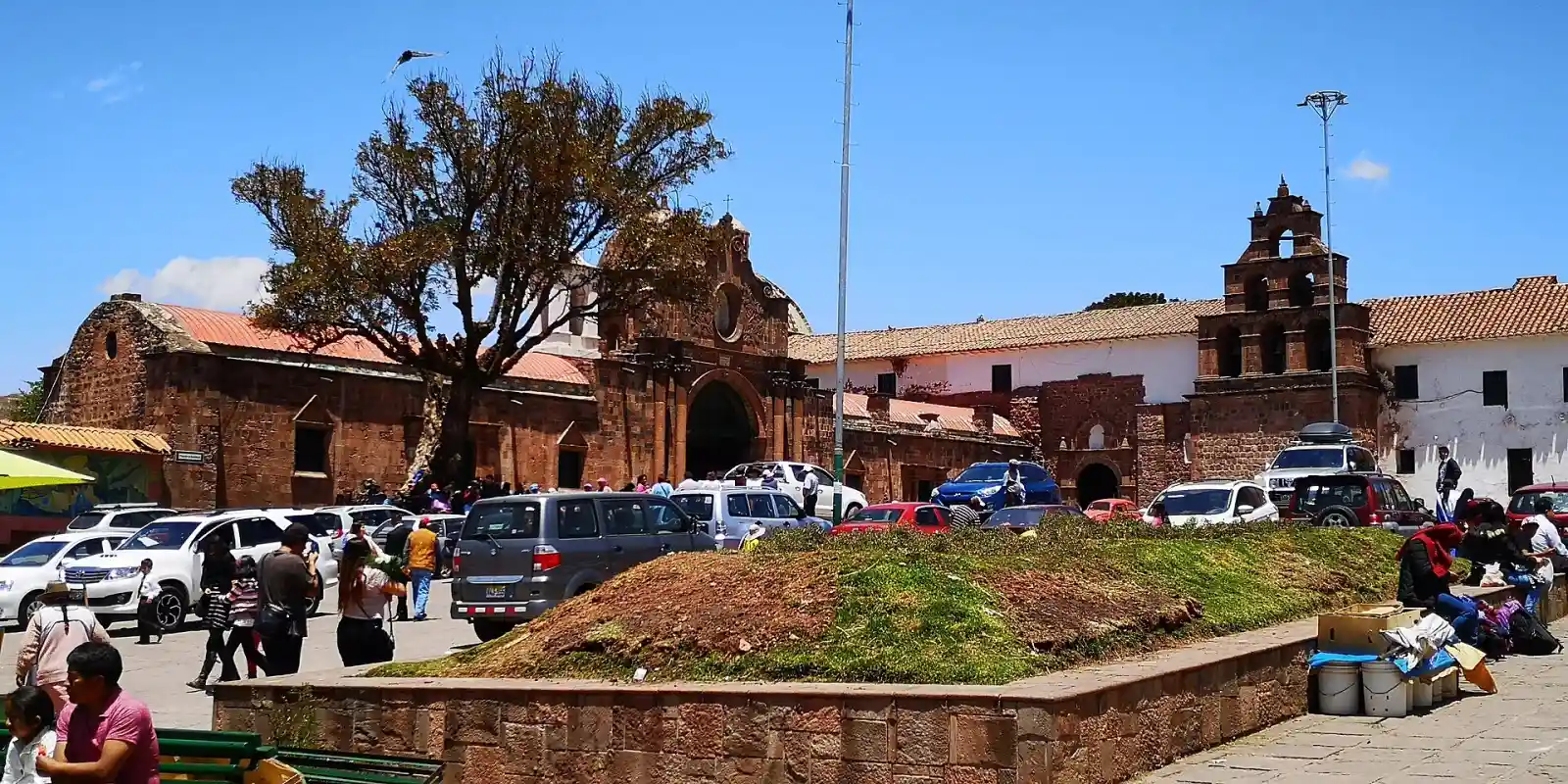
The Plazoleta de la Almudena on September 29, 2019, three weeks after the feast. The church is on the left. In early September this square fills with dancers. Photo: Chalisimo5, CC BY-SA 4.0
The Almudena festival in Cusco, day by day
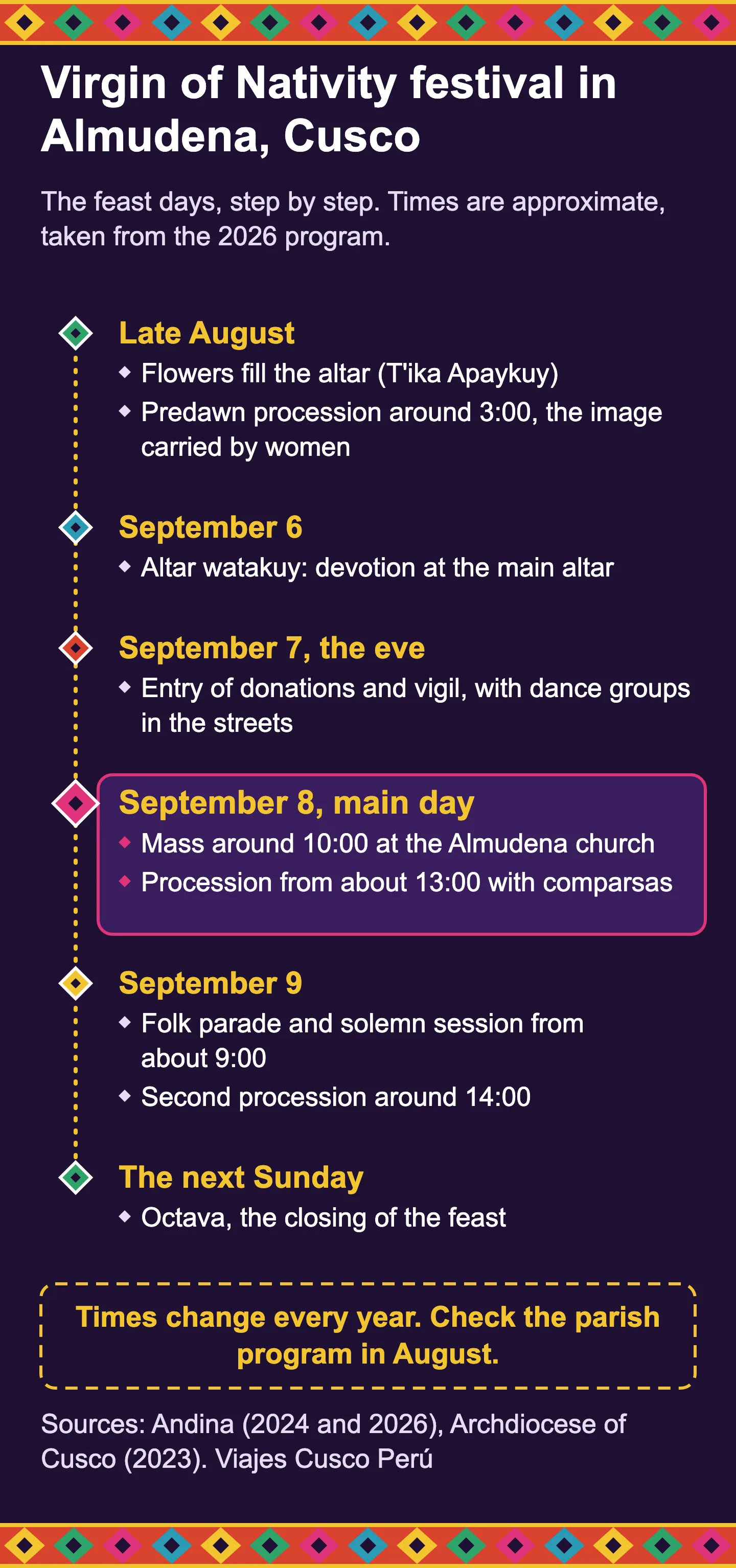
The feast step by step, based on the 2026 program. Times are approximate and change every year. Free to share with a link to this page. Infographic: Viajes Cusco Perú
The parish publishes a new program every year, so read the table as the rhythm of the feast, not as a timetable. It combines the programs Andina published in 2024 and 2026.
| Day | What happens | Times reported |
|---|---|---|
| Early August | "Bajada de trono": the image comes down from her throne | 2024: Sunday, August 4 |
| A Sunday in August | Cultural day: the dance groups parade through the plaza | 2024: August 11, 29 groups |
| Late August | T'ika Apaykuy: flowers fill the altar | 2026: from the afternoon of August 28 |
| The next predawn | Riqch'achikuy, the "waking" procession: women carry the image to the center and back | 2026: shortly before 3:00 |
| September 6 | Altar watakuy, devotion at the main altar | 2024 and 2026 |
| September 7 | Entry of donations and the eve (víspera) | 2026: Monday |
| September 8 | Masses from dawn, central Mass, procession | 2024: Masses at 5:00, 6:00, 8:00 and 10:00. 2026: Mass at 10:00, procession from 13:00 |
| September 9 | Folk parade, solemn session, second procession | 2026: from 9:00, procession at 14:00 |
| Following Sunday | Octava, the closing day, with a farewell called kacharpari | 2024: September 15. 2026: September 13 |
The eve, September 7
In Cusco the eve, la víspera, is part of the feast. The 2026 program made it the day of the entry of donations, when mayordomos and devotees bring their offerings, and of the vigil. Correo placed the start of that entry of offerings and dances at the Plaza de Armas. Andina, in 2015, called the eve the most crowded day: the image left her church in the afternoon for the historic center, a Mass was said at the Santa Teresa church, and she went back with the Cusco dances leading and the costumed altiplano dances behind. If you are in town on the 7th, keep the afternoon and evening free.
September 8: Masses, procession and comparsas
The main day starts in the dark. In 2024 Andina reported that the faithful and the mayordomos would gather from 4:00, with a Misa de Gallo at 5:00, the Misa de Ch'ayñas at 6:00, a Communion Mass at 8:00 and the central Mass at 10:00.
The procession is what most visitors come for. The platform, heavy with silver, flowers and candles, moves slowly on the shoulders of the bearers. In the 2024 program it went toward the historic center and returned along Santa Teresa and Meloq streets, where the image met Saint Anne, whom devotees call "la abuelita," the grandmother. In the story of the feast it fits: Saint Anne is the mother of Mary.
The dances. Andina counted 28 comparsas in 2015, more than ten from Cusco, and the parish spoke of 29 groups in 2024, with delegations expected from Puno and from Jauja, in the Junín region. These are the dances Andina named:
| From Cusco | From the altiplano |
|---|---|
| Qhapaq Qolla, Qhapaq Negro, Negrillos, Tupay, Teralas, Saqra | Morenada, Diablada, Saya |
The altiplano groups bring bands like those of the Virgin of Candelaria in Puno, Andina noted, and visitors from the United States, Argentina, Italy and Bolivia were in the crowd, some of them dancing. When locals say the dances "compete," they mean it: Correo reported a dance contest on the day after the feast.
Food on the feast day
The only source we found that lists the food of this feast is Diario Correo, in 2012: chiri uchu, chicharrón, lechón and chairo.
- Chiri uchu: the cold plate of Corpus Christi, with guinea pig, tortillas, seaweed, cured meat, rocoto pepper and corn, as Andina described it in 2016.
- Chicharrón: fried pork.
- Lechón: roast suckling pig.
- Chairo: a hearty soup.
Look for the stalls around the plaza. The cargo wasis, where each mayordomo receives guests, are private houses, so go only if someone invites you. For the rest of your meals, see where to eat in Cusco.
Where to watch and how to get there
- The Plazoleta de la Almudena: the church door, the departure and return of the image, the dance groups. It is packed around the central Mass and the start of the procession.
- The streets toward the center: stand a few blocks from the plaza and you will see the image pass with more room.
- The Plaza de Armas on the eve, for the entry of offerings and dances.
From the Plaza de Armas you can walk to the Almudena along what Cusco calls its processional axis: Santa Clara, San Pedro and Hospital streets, then over the Almudena bridge, about 1.5 km in all. It follows an old Inca road. On procession days a taxi may not get close, so plan to walk the last blocks.
Etiquette: how to respect the devotion
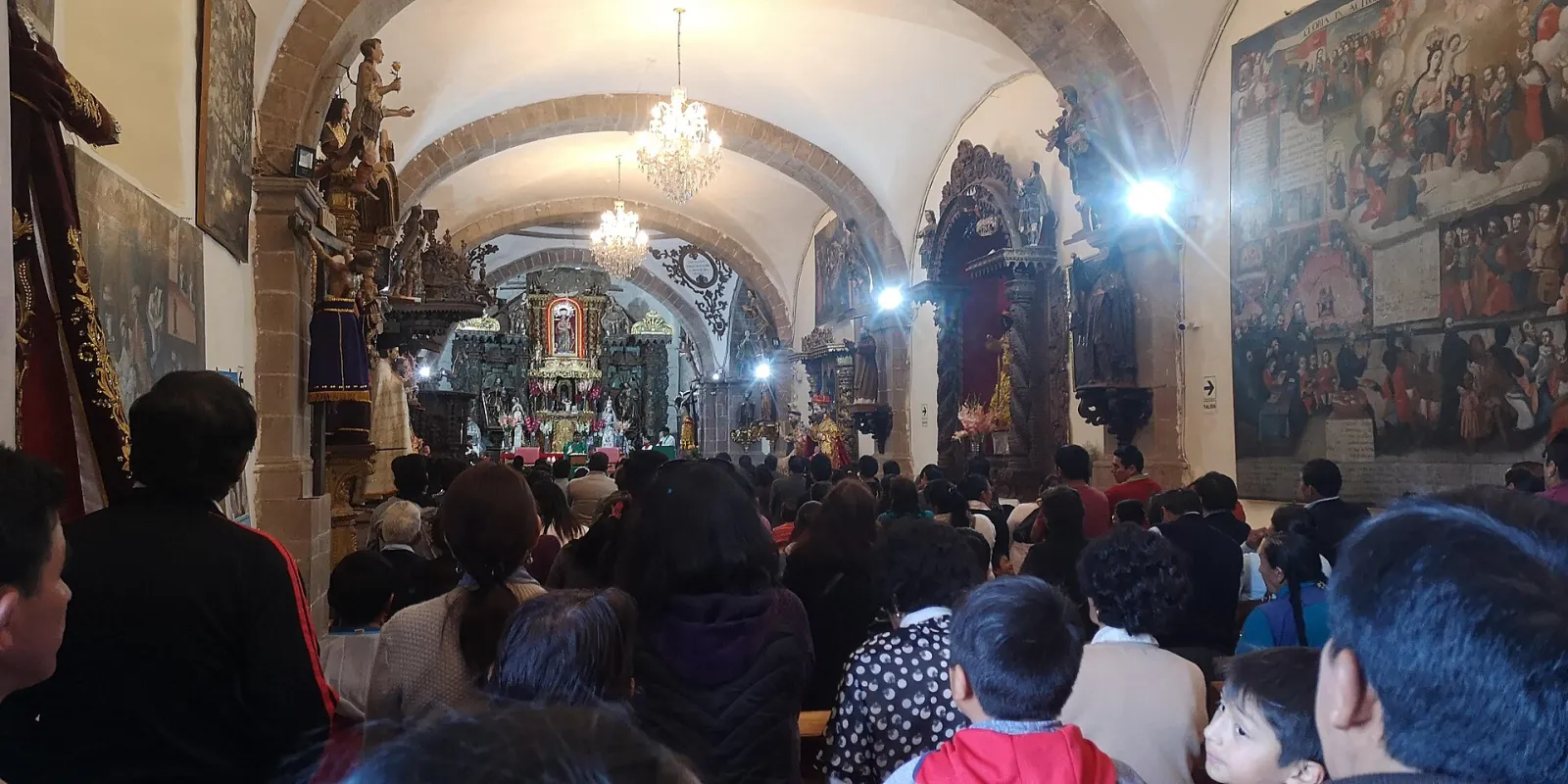
A Sunday Mass in the Almudena church, September 29, 2019. During the feast the nave fills from before dawn. Photo: Chalisimo5, CC BY-SA 4.0
This is a religious feast first and a show second.
- Inside the church: take your hat off, silence your phone, and do not walk around or use flash during Mass.
- Never cross in front of the platform or between the image and the bearers. If the procession stops in front of you, step back.
- Ask before photographing a dancer up close, especially when they are resting or eating.
- Do not touch the image or its decorations.
- Drink moderately or not at all. The parish priest himself asked for moderation in 2024.
Safety in the crowds
Crowds are dense at the plaza, the church door and the narrow return streets. Keep your phone and wallet in a front pocket or a zipped bag and carry only the cash you need. Fireworks and bombardas, loud firecrackers, go off during the processions, as Andina reported for the 2026 predawn walk, so keep children close. In 2024 the mayor of Santiago said security would be coordinated with the National Police. For general advice, read is Peru safe for tourists.
Cusco sits at 3,399 m, according to Peru's weather service, SENAMHI. Hours on your feet in the sun and then in the evening cold are tiring if you just arrived, so plan the festival for your third day or later.
Fitting the festival into a September trip
The feast takes a morning and an afternoon, so the rest of your days can go to the classics:
- On September 7 or 9, take a Cusco city tour (from US$87 per person) or our walking tour (from US$27). Both help you read the churches and Inca walls the procession passes.
- Give another day to the Sacred Valley full day, from US$127.
- For the whole trip, our Machu Picchu and Cusco tour in 4 days, from US$774, leaves evenings free in the city. To compare September with other months, see the best time to visit Machu Picchu.
Our tours do not include the festival itself. It is a free public celebration.
Cusco festival calendar at a glance
September 8 is a Marian feast across the region, so the Almudena is not alone that week. Here is the year in one table.
| Month | Festival | Dates |
|---|---|---|
| March or April | Señor de los Temblores, patron of Cusco, procession on Holy Monday | Moves with Easter. 2027: March 22 |
| Late May or June | Qoyllur Rit'i pilgrimage, Ocongate, one week before Corpus Christi | Moves each year |
| May or June | Corpus Christi, with 15 saints and virgins, the Virgin of Nativity among them | 2027: May 27 |
| June | Inti Raymi at Sacsayhuamán | June 24 |
| July | Virgen del Carmen in Paucartambo, 110 km from Cusco | July 15 to 18 |
| September | Virgin of Nativity at the Almudena, and the same feast in Chinchero | September 8 |
| September | Virgin of Nativity of Huayllabamba, Urubamba, National Cultural Heritage since 2022 | September 7 to 15, main day the 9th |
| September | Señor de Huanca, with an overnight pilgrimage from San Jerónimo on the 13th | September 14 |
| December | Santurantikuy market in the Plaza de Armas | December 24 |
Frequently asked questions
When is the Virgin of Nativity festival in Cusco? The main day is September 8 and the eve is September 7. In 2027 the eve is a Tuesday and the main day a Wednesday.
Where is the Almudena festival held? At the Almudena church on the Plazoleta de la Almudena, Santiago district, about 1.5 km from the Plaza de Armas, with processions toward the historic center.
What time is the procession on September 8? It changes every year. In 2026 the Mass was at 10:00 and the procession started at about 13:00, so check the parish program in August.
Do I need a ticket to see the festival? No source we read mentions tickets. The Masses are open and the procession and dances happen in public streets.
Who made the image of the Virgin of Almudena in Cusco? The Cusco artist Juan Tomás Tuyro Túpac, as a replica of the Virgin of Almudena of Madrid, for Bishop Manuel de Mollinedo. Sources give 1683 or 1699.
What dances can I see at the Almudena festival? Andina named Qhapaq Qolla, Qhapaq Negro, Negrillos, Tupay, Teralas and Saqra from Cusco, plus Morenada, Diablada and Saya from the altiplano.
Plan your September in Cusco with us
Tell us your dates and we will fit your tours around the feast. Take a Cusco city tour or the walking tour on the eve, add the Sacred Valley on another day, or book the Machu Picchu and Cusco tour in 4 days and keep September 8 in the city.
Updated November 2026. Dates, program and history checked on November 4, 2026, against Andina (2014, 2015, 2016, 2017, 2024 and 2026), Diario Correo (2012), Peru's Ministry of Culture (2022), SENAMHI and Spanish Wikipedia.