Huayna Picchu vs Machu Picchu Mountain: Which to Climb
Summit height, climb, time, exposure, route 3-A vs 1-A and price: a side by side comparison to choose your Machu Picchu mountain.
Huayna Picchu tops out at about 2,720 meters, roughly 290 meters above the citadel, on a short, steep staircase with cables in the steepest parts. Machu Picchu Mountain reaches about 3,082 meters, some 650 meters above the citadel, on a longer and wider trail that takes around two hours up. Huayna Picchu is route 3-A with up to 6 hours on site. Machu Picchu Mountain is route 1-A with up to 7 hours. Both cost the same, both have a small daily quota, and the mountain checkpoints give no grace period if you are late. The right one depends on how you handle steep drops, how much climbing you want and which part of the Inca city you want to walk through.
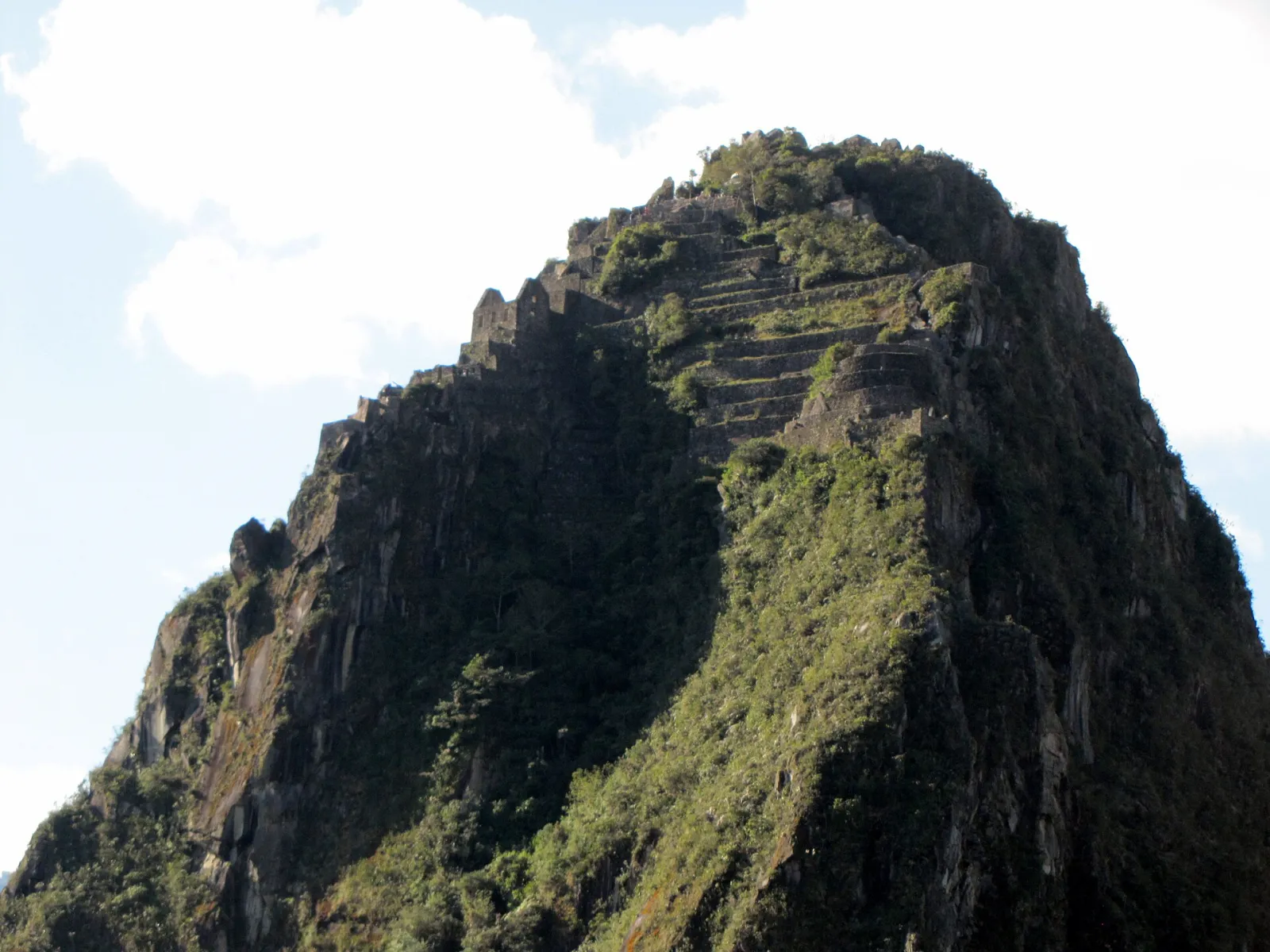
Huayna Picchu seen from below, with Inca terraces just under the summit. Photo: David Berkowitz, CC BY 2.0
The short version
- Huayna Picchu (Waynapicchu), route 3-A: summit about 2,720 m, short and steep, stone steps with steel cable handrails in the steepest sections, up to 6 hours on site.
- Machu Picchu Mountain, route 1-A: summit about 3,082 m, longer and higher, a wider path with less exposure, about two hours up, up to 7 hours on site.
- Price: the same for both. A foreign adult pays S/200 plus the S/11 conservation fee, so S/211.
- Quota: small on both. Huayna Picchu has the smaller one and sells out first.
- Timing: the mountain checkpoints have no tolerance. Arrive late and you do not climb.
- The citadel part: 3-A walks the lower and royal sector. 1-A only covers the upper platforms. Neither includes the classic walk through the center of the city.
- Closures happen: Huayna Picchu was closed for maintenance from June 1 to 30, 2026, and reopened on July 1.
Huayna Picchu vs Machu Picchu Mountain at a glance
| Huayna Picchu (3-A) | Machu Picchu Mountain (1-A) | |
|---|---|---|
| Summit altitude | about 2,720 m | about 3,082 m |
| Climb above the citadel (2,430 m) | about 290 m | about 650 m |
| Time to the top | 1.5 to 2 hours | about 2 hours |
| Trail | Narrow Inca stairs, steep, exposed in places, steel cable handrails | Wider stone path, long and steady, less exposed |
| Circuit | Circuit 3, royalty | Circuit 1, panoramic |
| Citadel section included | Lower town and royal sector, out by the Sacred Rock | Upper platforms only |
| Maximum time on site | 6 hours | 7 hours |
| Price for a foreign adult | S/200 + S/11 | S/200 + S/11 |
| Daily quota | Smallest of all routes | Small, but sells out later |
| Best for | Hikers comfortable with drops who want the famous peak | Hikers who want the big view and a longer walk, with fewer steep edges |
Summit altitudes and climbing times come from Inca Rail; the time limits come from the official route maps of the Ministry of Culture.
Huayna Picchu: the peak in every postcard
Huayna Picchu is the sharp green cone behind the classic Machu Picchu photo. The Ministry of Culture spells it Waynapicchu, and that is the name you will see on the ticket and on the checkpoint sign.
The trail is short and it goes straight up. Inca Rail puts the ascent at 1.5 to 2 hours on the short trail, about 2 km. Most of it is stone steps, some of them narrow and worn, with the slope falling away on one side. In places the stairs pass through gaps in the rock, and near the summit they reach terraces built by the Incas. From there the citadel sits below you like a model, with the Hiram Bingham road zigzagging down to the river.
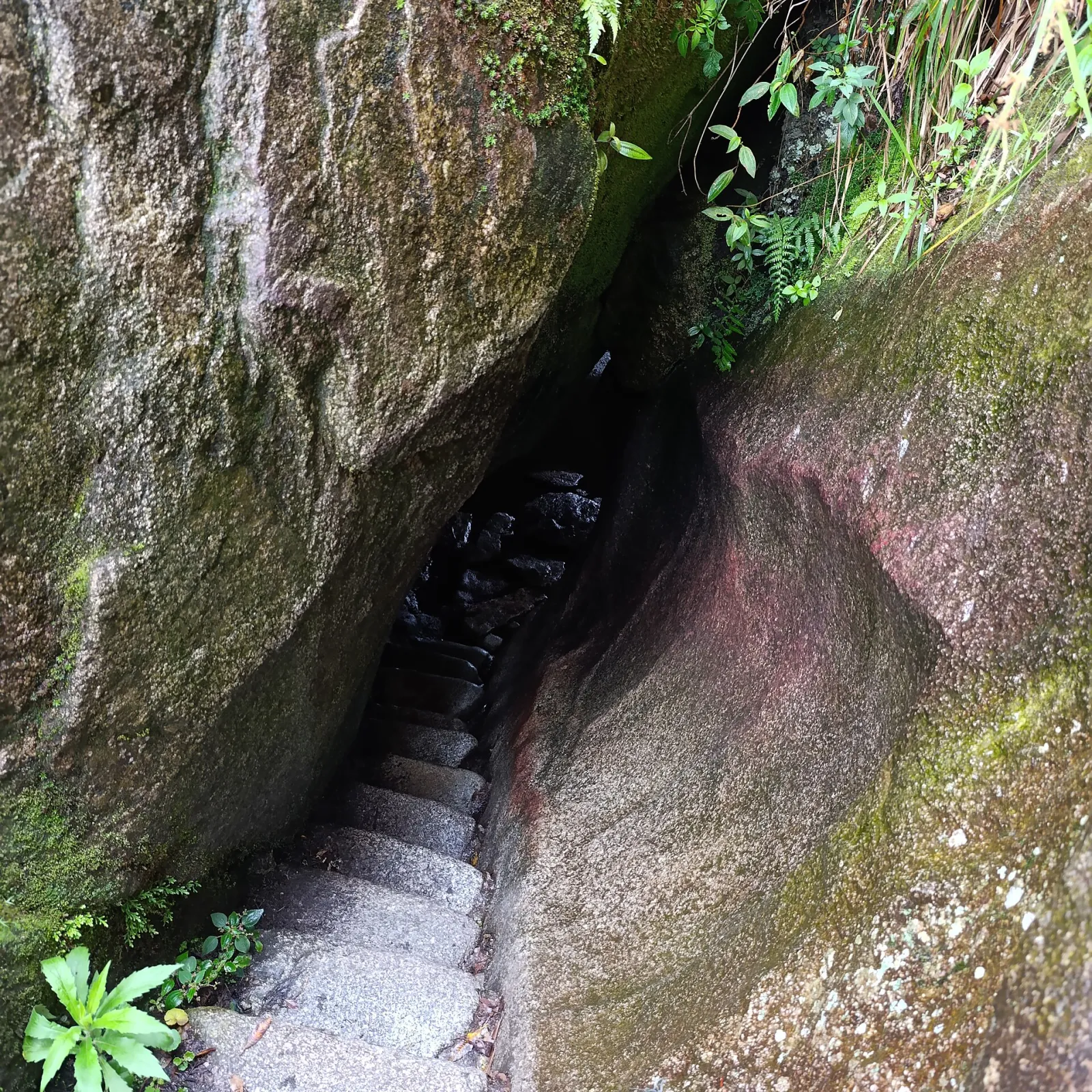
Stairs through a cleft in the rock on Huayna Picchu, January 2026. Photo: Ordzonhyd Rudyard Tarco Palomino, CC BY-SA 4.0
The trail has been worked on recently. In April 2025 it reopened after heavy rain made part of the access path slide; the park built a retaining wall and installed steel cable handrails, and the first day back had two entry shifts, at 7:00 and 9:00. From June 1 to 30, 2026, the Ministry of Culture closed it again for maintenance from the checkpoint to the summit: repairing the Inca stairs and drainage, clearing roots and moss, and adding more cable handrails on the steepest sections. It reopened on July 1, 2026.
Who it suits. People who are steady on stairs and do not freeze when the ground drops away beside them.
Who should skip it. Anyone with a real fear of heights or bad knees. The way down is harder on the legs than the way up, and the steps are uneven. If you hesitate, choose Machu Picchu Mountain or route 3-D to Huchuy Picchu, a much shorter climb that is only sold in high season.
Machu Picchu Mountain: higher, longer, calmer
Machu Picchu Mountain rises on the opposite side of the citadel, to the south. At about 3,082 meters it is the higher of the two by more than 350 meters. Inca Rail describes the climb as less steep and less demanding than Huayna Picchu, though the altitude still makes it a real effort, and puts it at about two hours to the summit.
The path is an Inca stairway too, but wider, with fewer places where the edge is right beside your feet. You gain height steadily and the view opens up as you go: first the citadel, then Huayna Picchu, which from here looks small, then the Urubamba river looping around the ridge.
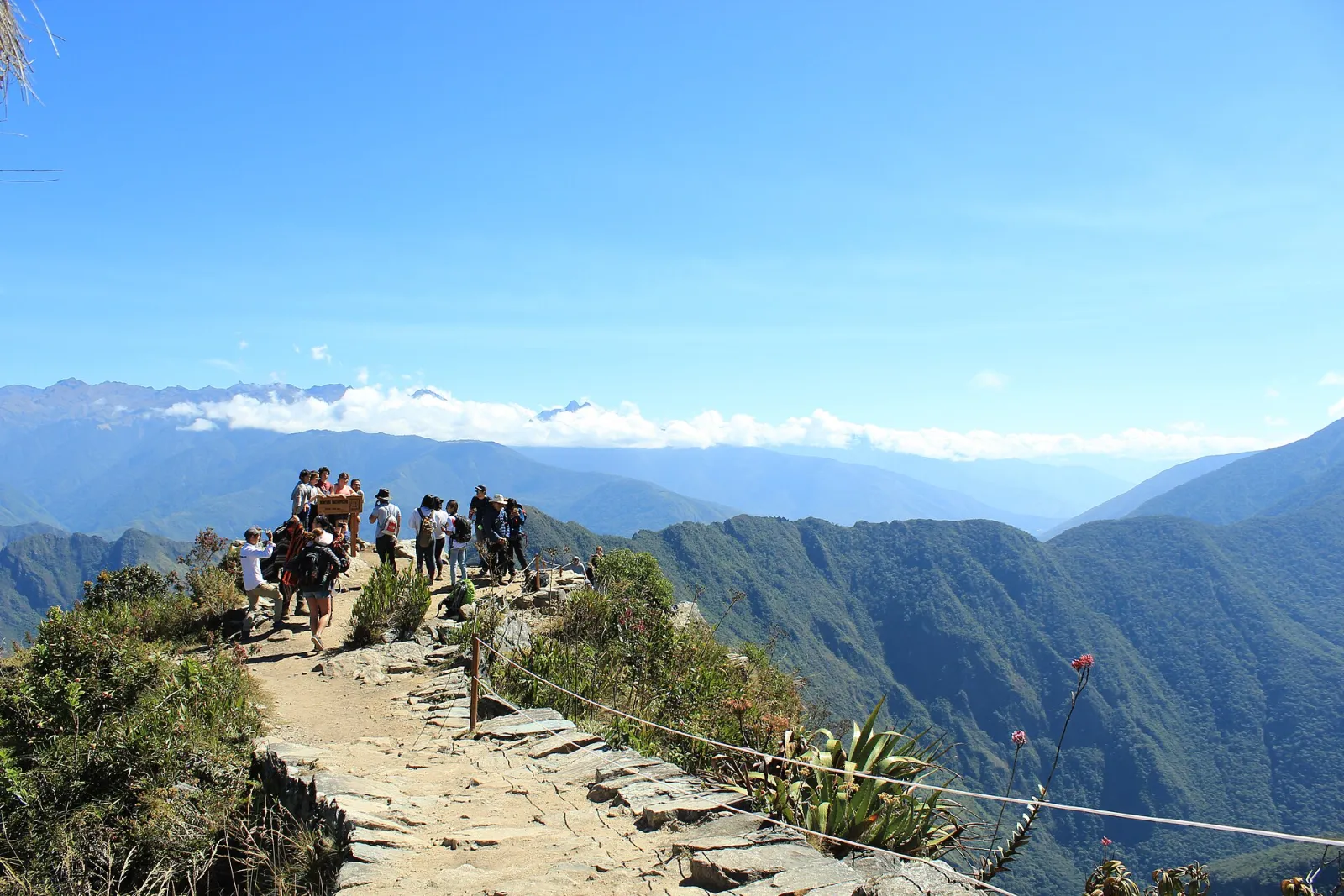
The top of Machu Picchu Mountain. Wider, with more room to stop than on Huayna Picchu. Photo: Daniela Snow, CC BY 2.0
Who it suits. Fit walkers who want the biggest view of the sanctuary and a proper hike, but are less comfortable with exposed stairs. It is also the better backup when Huayna Picchu is sold out.
Who should skip it. Anyone short on time or energy: it is a long climb, and the descent takes almost as long. If all you want is the postcard view, route 1-B to the upper terrace gives it with no hike at all.
What each ticket lets you see in the citadel
This is the detail most people miss. A mountain ticket is not an extra on top of a normal visit. Each is its own one-way route with a fixed citadel section.
Route 3-A (Huayna Picchu) belongs to circuit 3. On the official map it goes through the lower part of the city: past the Temple of the Condor, the Plaza of the Pisonay, the eastern storehouses and the Twelve Doorways, then out by the Sacred Rock to the Huayna Picchu checkpoint.
Route 1-A (Machu Picchu Mountain) belongs to circuit 1. The official map shows it climbing to the lower and upper platforms, the high terraces where the postcard photo is taken, and then turning off toward the mountain. It does not go down into the city.
So neither ticket gives you the classic circuit 2 walk past the Temple of the Sun lookout, the Plaza of the Temples and the Intihuatana. If seeing the center of the city matters, buy a second ticket for another day or another time slot. Our Machu Picchu tickets guide explains the ten routes, and our guide to the Machu Picchu circuits compares them by view and effort.
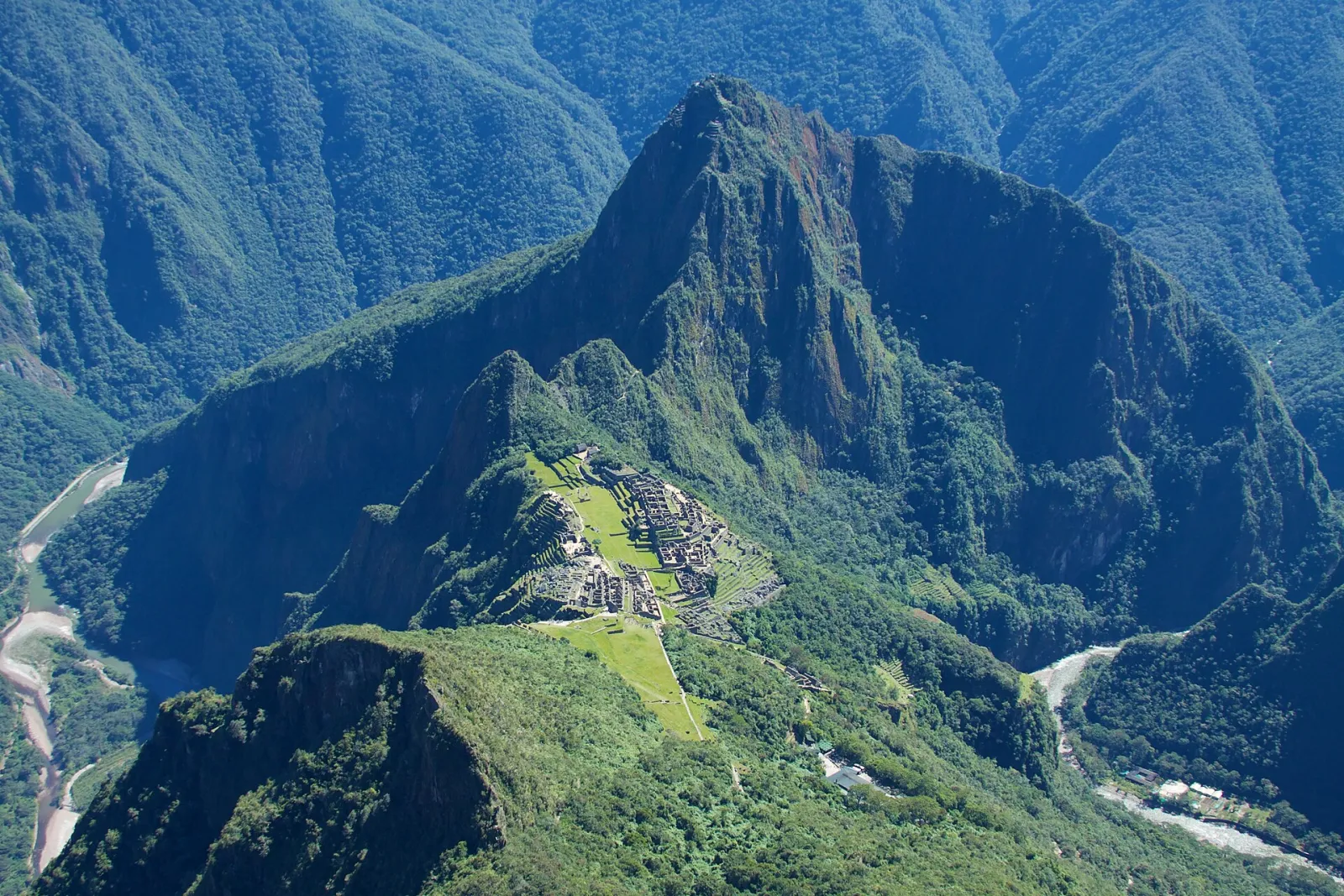
From Machu Picchu Mountain, the citadel and Huayna Picchu sit on one ridge above the river. Photo: McKay Savage, CC BY 2.0
Entry times, tolerance and how long you can stay
The citadel opens at 6:00 and the last entry is at 15:00. At the main gate there is a grace period: 30 minutes in regular months and 45 minutes in the busiest months, which the Ministry of Culture sets as June 1 to October 15 plus December 30 and 31.
At the mountain checkpoints there is none. The official schedule says it plainly: entry at the Machu Picchu, Huayna Picchu and Huchuy Picchu controls has no tolerance. In practice that means an early bus up from Aguas Calientes and no photo stops on the way to the checkpoint.
Once inside, the clock runs: 6 hours maximum on route 3-A and 7 hours on route 1-A. That covers the climb and the citadel section, but not a slow day with long breaks.
Price, quota and how far ahead to book
Both mountains cost the same. A foreign adult pays S/200 plus the S/11 conservation fee that SERNANP has charged since May 1, 2026, so S/211. A standard route costs a foreign adult S/163. The Machu Picchu trip cost guide puts the ticket next to the train, the bus and the hotel.
The daily quotas are small. Published numbers differ between sources, so we will not quote one, but the rule is consistent: Huayna Picchu has the smallest quota of all ten routes and sells out first, and Machu Picchu Mountain goes later. For June, July and August, book as soon as your dates are fixed. The total daily cap for the site in 2026 is 5,600 visitors in high season and 4,500 in low season, set by Ministerial Resolution 000285-2025-MC.
Before you pay, check that the passport number is exact and the entry time fits your train. Our guide to the Machu Picchu trains has the schedules, and the best time to visit Machu Picchu weighs crowds against rain month by month.
Altitude, weather and what to carry
Both climbs start at 2,430 meters, which is lower than Cusco, but you will be climbing hard. The CDC notes that physical fitness does not protect against altitude illness. Spend at least two nights in Cusco or the Sacred Valley before the climb. Our Cusco altitude guide explains how to pace those days.
In the rainy months the steps are wet and the summits are often in cloud. The site rules apply on the mountains too: bags up to 40 x 35 x 20 cm, no walking sticks, no food, no umbrellas, and no hard-soled shoes. Wear shoes with good grip, carry water and a rain jacket, and keep your passport with you. Our Peru packing list covers the rest.
Which one should you choose?
- Choose Huayna Picchu if you want the famous peak, you are fine on steep exposed stairs, and you are booking early.
- Choose Machu Picchu Mountain if you want the higher viewpoint, a longer hike and less exposure, or if Huayna Picchu is already sold out.
- Choose neither if you have only one visit and have never seen the citadel. Take circuit 2, route 2-A, for the walk through the center of the city, and add a mountain on a second day if you are staying in Aguas Calientes.
Frequently asked questions
Which is harder, Huayna Picchu or Machu Picchu Mountain? Huayna Picchu is steeper and more exposed but shorter. Machu Picchu Mountain climbs more than twice as many meters and takes longer, on a wider path.
Which mountain has the better view? Machu Picchu Mountain is higher and shows the whole sanctuary with Huayna Picchu below. Huayna Picchu gives the closer, more dramatic look down onto the citadel.
How much is the Huayna Picchu ticket in 2026? For a foreign adult, S/200 plus the S/11 conservation fee, so S/211. Machu Picchu Mountain costs the same.
Can I do both mountains on the same day? Not with one ticket. Each mountain is its own route in a different circuit, so you need two tickets, and the time limits make doing both in one day impractical.
What happens if I arrive late to the mountain checkpoint? You are not allowed to climb. The mountain checkpoints have no tolerance, unlike the main gate.
Is Huayna Picchu open all year? It is sold all year, but it closes for maintenance from time to time, as it did from June 1 to 30, 2026. Check availability on tuboleto.cultura.pe before planning around it.
Climb it with us
A mountain day needs the right route, an early entry that fits the train, two days of acclimatization and a booking made before the quota runs out. At Viajes Cusco Perú, the Cusco tour operator behind this blog, we plan that for our travelers. The three-day Cusco and Machu Picchu tour is the shortest way to do it; tell us which mountain you want when you book and we will check the quota for your date. The two-day Machu Picchu tour by train includes a night in Aguas Calientes, which makes an early slot easy, and the four-day Cusco and Machu Picchu tour gives more time to acclimatize. Hikers can arrive on the classic four-day Inca Trail. Everything else is on our Machu Picchu tours page, and if you are still deciding whether the trip is for you, read is Machu Picchu worth it.
Routes, times, prices and closures checked on October 15, 2026, against machupicchu.gob.pe, the official route maps and entry schedule of the Ministry of Culture, El Peruano, Inca Rail and the CDC. Confirm availability and the final price on tuboleto.cultura.pe.