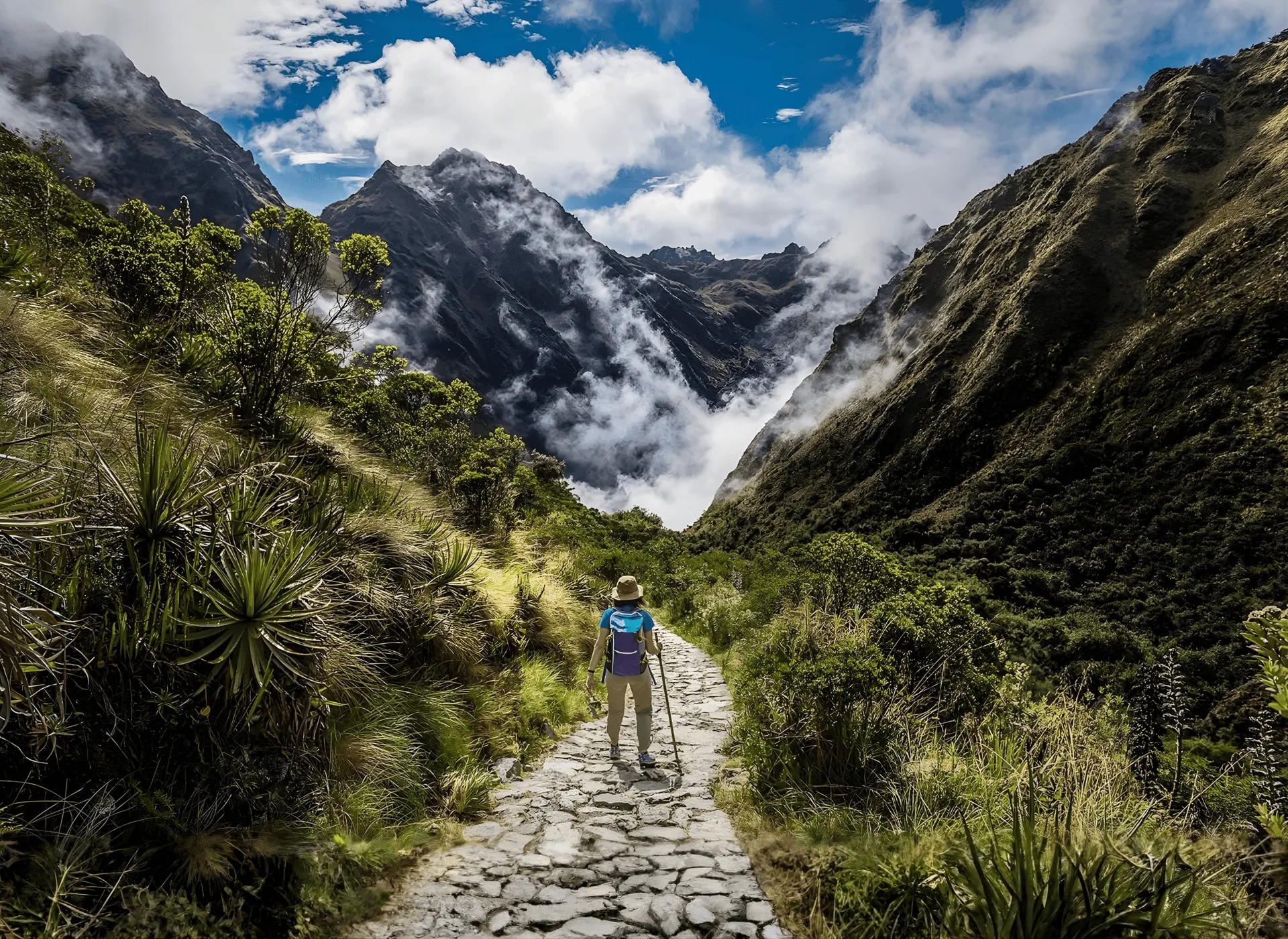
From US$797 per person.
Classic Inca Trail 4 Days to Machu Picchu
- 43 km over four days, with the high point at Warmiwañusca, 4,215 m, on day two.
- Five Inca sites reachable only on this trail: Llactapata, Runkurakay, Sayacmarca, Phuyupatamarca and Wiñay Wayna.
- Arrival at Machu Picchu on foot through Inti Punku, the Sun Gate, at dawn on day four.
- 500 permits a day including staff, so about 200 for hikers. Passport number printed on the permit, not transferable.
- Closed for all of February. Permits for 2027 go on sale the first week of October 2026 and the best dates go in days.
- Porters carry 5 to 7 kg for you. Tents, meals, licensed guide and the Machu Picchu ticket are included.
Four days, 43 kilometres, and one pass at 4,215 m that most people find the hardest thing they do in Peru. You walk on the road the Incas built, sleep in tents at 3,000 m and then at 3,600 m, and arrive at Machu Picchu on foot through the Sun Gate on the fourth morning. There are 500 permits a day including guides, cooks and porters, which leaves roughly 200 for hikers, and they sell out months ahead.
Day by day, with the altitude that decides how you feel. Day one goes from Km 82 at 2,600 m to Wayllabamba at 3,000 m, and it is the gentle one. Day two climbs from 3,000 m to Warmiwañusca at 4,215 m, the pass they call Dead Woman, and drops to Pacaymayo at 3,600 m. Day three is the long one, crossing two more passes and the sites at Runkurakay, Sayacmarca and Phuyupatamarca before camp at Wiñay Wayna. Day four starts before dawn for the last hour to Inti Punku, where Machu Picchu appears below you all at once.
What you cannot get any other way. Llactapata, Runkurakay, Sayacmarca, Phuyupatamarca and Wiñay Wayna sit on the trail and nowhere else. There is no road to any of them. Either you walk this route or you do not see them, and that is the actual reason to choose the Inca Trail over Salkantay.
Do this trek if you can walk uphill for six hours on the hardest day, you have spent at least two days acclimatising in Cusco, and you can book five to twelve months ahead. Choose Salkantay instead if you are deciding within a few months, or if thousands of stone steps are a problem for your knees. Steps punish knees in a way a dirt path does not, and days two and three are full of them.
The permit rules, because they catch people out. Your passport number is printed on the permit and it is not transferable: if you change passports between booking and travelling, bring both. The trail closes for the whole of February every year for maintenance. Permits for 2027 go on sale in the first week of October 2026, and June, July and August go within days. There is no waiting list.
What is different about doing it with us. Small groups, licensed guides who live in the region, porters carrying between 5 and 7 kg of your gear so you walk with a day pack, and tents, meals and the Machu Picchu entrance ticket included. Sleeping bags are not included and can be hired. Walking poles must have rubber tips; metal tips are not allowed on the trail.
The price of US$797 covers everything that the permit system fixes, which is most of it. There is no cheap version of the Inca Trail, because permit, porter and camping costs are set by regulation, and an operator who undercuts them is cutting somewhere you would not want.
At a glance
- Days: 4
- Highest point: 4215 m
- Price: From US$797 per person
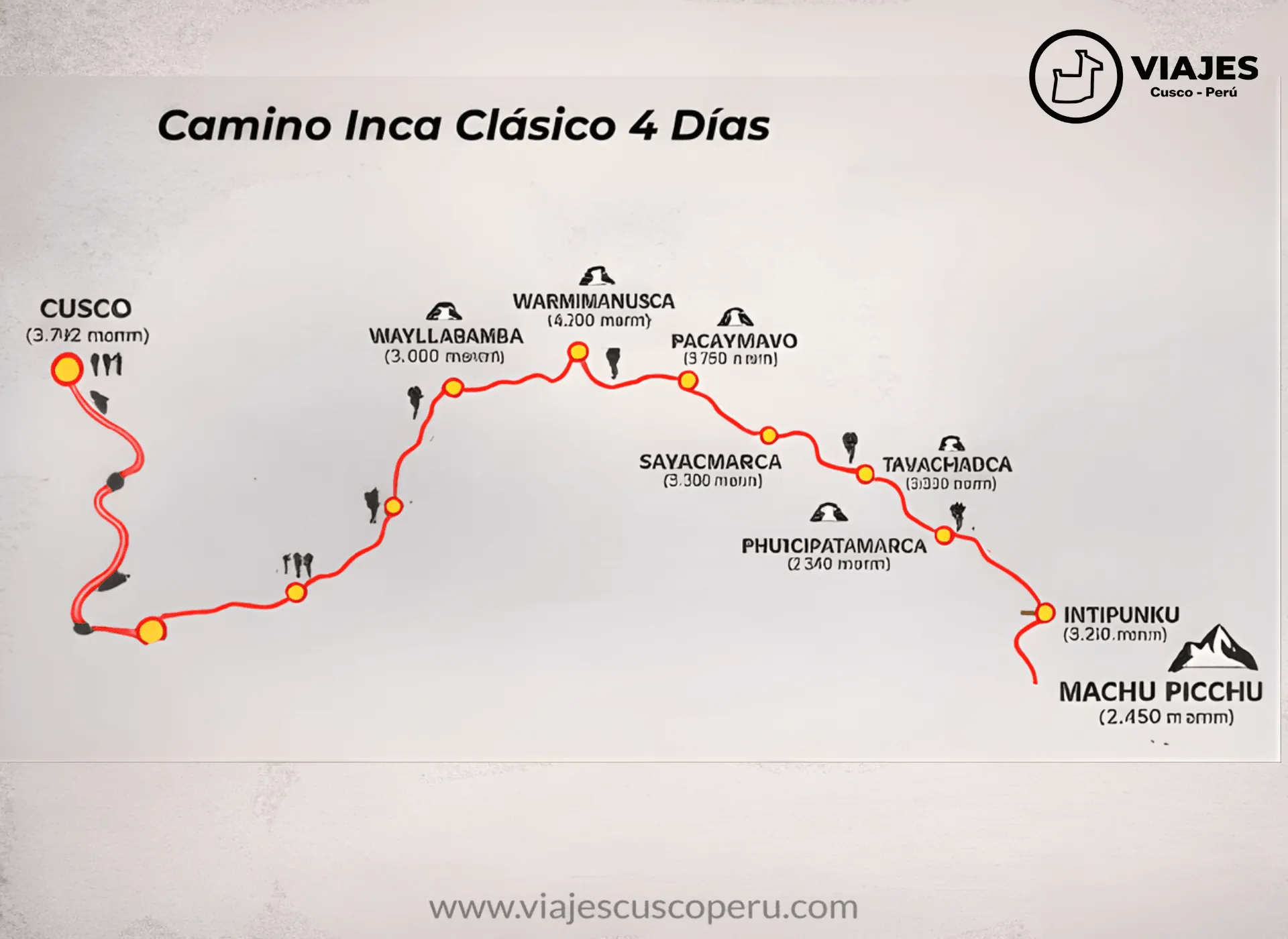
Itinerary
Day 1: Cusco, Km 82, Wayllabamba
Altitude: 2600 a 3000 m · Meals: Lunch and dinner included (breakfast according to hotel in Cusco) · Overnight: Wayllabamba (3000 m)
The beginning of the legendary Inca Trail Very early, between 04:30 and 05:00 a.m., we will pick you up at your hotel to begin the journey to Km 82, the official entry point to the Classic Inca Trail. After completing the entry check-in, we will begin the hike following ancient Inca trails that cross fertile valleys, agricultural terraces, and landscapes dominated by the Urubamba River. Along the way we will visit the important archaeological site of Llactapata, one of the first Inca administrative centers on the route.
Today's hike covers approximately 12 km (7.5 miles) and lasts 5 to 6 hours, reaching a maximum altitude of 3,000 m a.s.l. Upon arriving at the Wayllabamba campsite, we will enjoy a dinner prepared by our team surrounded by the tranquility of the Andes, preparing ourselves for the most challenging stage of the route.
Day 2: Wayllabamba, Warmiwañusca Pass, Pacaymayo
Altitude: 3000 a 4215 m · Meals: Breakfast, lunch, and dinner included · Overnight: Pacaymayo (3600 m)
The great challenge of the Inca Trail After breakfast we will begin the ascent to the legendary Warmiwañusca Pass (Dead Woman's Pass), located at 4,215 m a.s.l., the highest point of the entire Inca Trail. As we climb, we will enjoy spectacular panoramic views of the Andes, surrounded by mountains, ravines, and the energy of the Apus, considered sacred mountains within the Inca worldview.
Today's stage covers approximately 16 km (10 miles) and lasts 8 to 9 hours, the most demanding stage of the route. After reaching the summit we will begin the descent to the tranquil Pacaymayo valley, where we will set up our campsite surrounded by a spectacular high-mountain landscape, culminating a day full of effort and satisfaction.
Day 3: Pacaymayo, Runkurakay, Sayacmarca, Phuyupatamarca, Wiñay Wayna
Altitude: 2650 a 3950 m · Meals: Breakfast, lunch, and dinner included · Overnight: Wiñay Wayna (2650 m)
Cultural and scenic day. We visit important archaeological complexes such as Runkurakay, Sayacmarca, and Phuyupatamarca, surrounded by cloud forest.
The hike covers approximately 16 km (10 miles) and lasts 8 hours, combining moderate climbs, Inca stone stairways, and panoramic trails with incomparable views of the mountain range. At the end we will arrive at the Wiñay Wayna campsite, considered one of the most impressive archaeological sites on the route and the resting point before entering Machu Picchu.
Day 4: Wiñay Wayna, Inti Punku, Machu Picchu, Cusco
Altitude: 2430 a 2720 m · Meals: Breakfast included at the campsite; light lunch and dinner at passenger's expense · Overnight: Cusco (3400 m)
The triumphant arrival at the Lost City of the Incas Before dawn we will begin the final hike to Inti Punku (Sun Gate), the historic access point used by the Incas to enter Machu Picchu. After approximately 1 hour and 30 minutes of hiking, we will cover 5 km (3.1 miles) to reach this emblematic viewpoint, from where we will enjoy the first unforgettable panoramic view of the legendary citadel, one of the most exciting moments of the entire expedition.
We will descend to Machu Picchu, where we will take a guided visit of approximately 2 to 3 hours, exploring temples, agricultural terraces, ceremonial plazas, and the main sectors of this Wonder of the Modern World and UNESCO World Heritage Site. At the end of the visit, we will return to Aguas Calientes to board the panoramic train to Ollantaytambo, where our private transport will take you back to Cusco, concluding an experience considered among the best trekking routes in the world.
What is included
- High-quality service and safety Pre-departure briefing, certified official bilingual guides, first aid kit and 24/7 assistance.
- Transportation Shared transfer Cusco, Km 82 (Day 1) and shared transfer Ollantaytambo, Cusco (Day 4).
- Meals All meals during the trek, except breakfast on day 1 and dinner on day 4.
- Camping equipment Tents, kitchen equipment, chef and support staff (porters) throughout the trek.
- Entrance fees Inca Trail permit, Machu Picchu entrance ticket and return train to Cusco.
What is not included
- Sleeping bag Not included in the package (available for rent).
- Meals not included Day 1: Breakfast. Day 4: Dinner.
- Travel insurance Not included. Travel insurance is mandatory to do the Inca Trail.
- Personal expenses and tips Not included; tips for the team are appreciated but not mandatory.
- Optional Climbs Huayna Picchu or Machu Picchu Mountain, cost US$75.00 per person each (advance booking required).
- Possible Costs or Delays Beyond Our Control Landslides, bad weather, itinerary modifications for safety reasons, strikes, or other unforeseen events.
Frequently asked questions
How much does the Inca Trail cost?
With us the Classic Inca Trail 4 days costs from US$797 per person. That price covers the official permit, a certified bilingual guide, porters, all meals on the trail, camping gear (tent and mat), transport from Cusco to km 82 and the bus down from Machu Picchu to Aguas Calientes. Permits are sold by date and run out months ahead. The full table is in the Prices tab.
What is the Classic 4-Day Inca Trail?
It is the most iconic trekking route in the world, 43 km from km 82 to the Sun Gate (Intipunku) arriving at Machu Picchu. Three ecological zones, several Inca ruins and cloud forest landscapes are crossed. Entry is extremely limited: only 500 people/day.
How far in advance must the Inca Trail be booked?
At least 4, 6 months in advance, especially for June, August (high season). Permits sell out quickly and have very limited quotas. Without a permit, the classic Inca Trail cannot be done.
What is the difficulty level of the Inca Trail?
High. The highest point is Dead Woman's Pass (4,215 m / 13,830 ft) on day 2. Between 10 and 16 km are hiked per day with significant elevation changes. Excellent fitness and at least 2, 3 days of prior acclimatization in Cusco are required.
Is the Inca Trail closed in any month?
Yes. The Inca Trail closes all of February for route maintenance and cleaning. The rest of the year it is open. The best time is May, October (dry season). November, January is also possible, though with possible rain.
What is included in the 4-day Inca Trail tour?
Includes the Inca Trail permit (official quota), certified bilingual guide, porters, all meals from day 1 to day 4 (camp), camping equipment (tent, sleeping mat), transport from Cusco to km 82 and bus down from Machu Picchu to Aguas Calientes.
Why is the Inca Trail so special compared to other treks?
The Inca Trail is the only trek in the world that arrives at one of the Seven Wonders of the World by the same path used by its builders 500 years ago. Intermediate Inca ruins (Llactapata, Runkurakay, Sayacmarca, Wiñaywayna), orchid forests are crossed, and you arrive at Machu Picchu at sunrise through the Sun Gate. It is a transformative experience.
Are the Inca Trail porters well treated?
Yes. At Viajes Cusco Perú we strictly comply with Peru's Porter Law: porters do not carry more than 25 kg (20 kg maximum client load + 5 kg for their personal gear), they receive full meals, adequate sleeping equipment and fair pay. Choosing a responsible operator makes the difference.
Is the Inca Trail safe?
Yes. The Inca Trail is one of the most monitored trekking routes in the world, with strict access control and Ministry of Culture personnel at archaeological sites. The most common risk is altitude sickness, mitigated by prior acclimatization. Our guides carry a first aid kit and oxygen.
What to see on the Inca Trail besides Machu Picchu?
The Inca Trail is much more than the final destination. Along the route: Llactapata (large agricultural complex), Runkurakay (Inca control post), Sayacmarca (hard-to-access city), Phuyupatamarca (city above the clouds) and Wiñaywayna (most impressive complex on the trail before Machu Picchu). Each site has its own fascinating history.
What to bring for the 4-day Inca Trail?
Essential: day pack (20, 25 L), sleeping bag (tent and mat are provided), waterproof trekking boots with good grip (wet stone paths), layered clothing, waterproof jacket, trekking poles, SPF 50+ sunscreen, water purification tablets, quick-dry underwear, extra snacks. Porters carry up to 7 kg of your additional luggage.
Which is better: the Classic Inca Trail or the Salkantay Trek to reach Machu Picchu?
The Inca Trail (4 days) is the most iconic: it follows the original Inca path with archaeological ruins along the route (Llactapata, Runkurakay, Wiñaywayna) but has a daily quota of 500 people and must be booked 3, 6 months in advance. The Salkantay Trek (5 days) requires no permit, crosses the Salkantay snow-capped pass (4,638 m), and descends into the cloud forest, more dramatic and varied landscapes, more flexible to book. Choose the Inca Trail for the historical and cultural experience; choose Salkantay for extreme natural scenery and booking flexibility.
Related tours
- Choquequirao Trek 4 Days, from US$767 per person
- Huchuy Qosqo Trek 2 Days, from US$267 per person
- Huchuy Qosqo Trek 1 Day, from US$137 per person