Salkantay Trek Guide: Day by Day, Pass, Weather, Difficulty
5 days and about 68 km to Machu Picchu, a pass near 4,600 m, Humantay Lake on day 1, month-by-month weather, altitude and packing.
The Salkantay trek is a five-day, roughly 68 km (42 mi) walk from Soraypampa, about 3.5 hours by road from Cusco, over the Salkantay Pass at about 4,600 m (15,100 ft) and down through cloud forest to Machu Picchu. No Inca Trail permit is needed. May to September is best. Our 5-day trek starts from US$707.
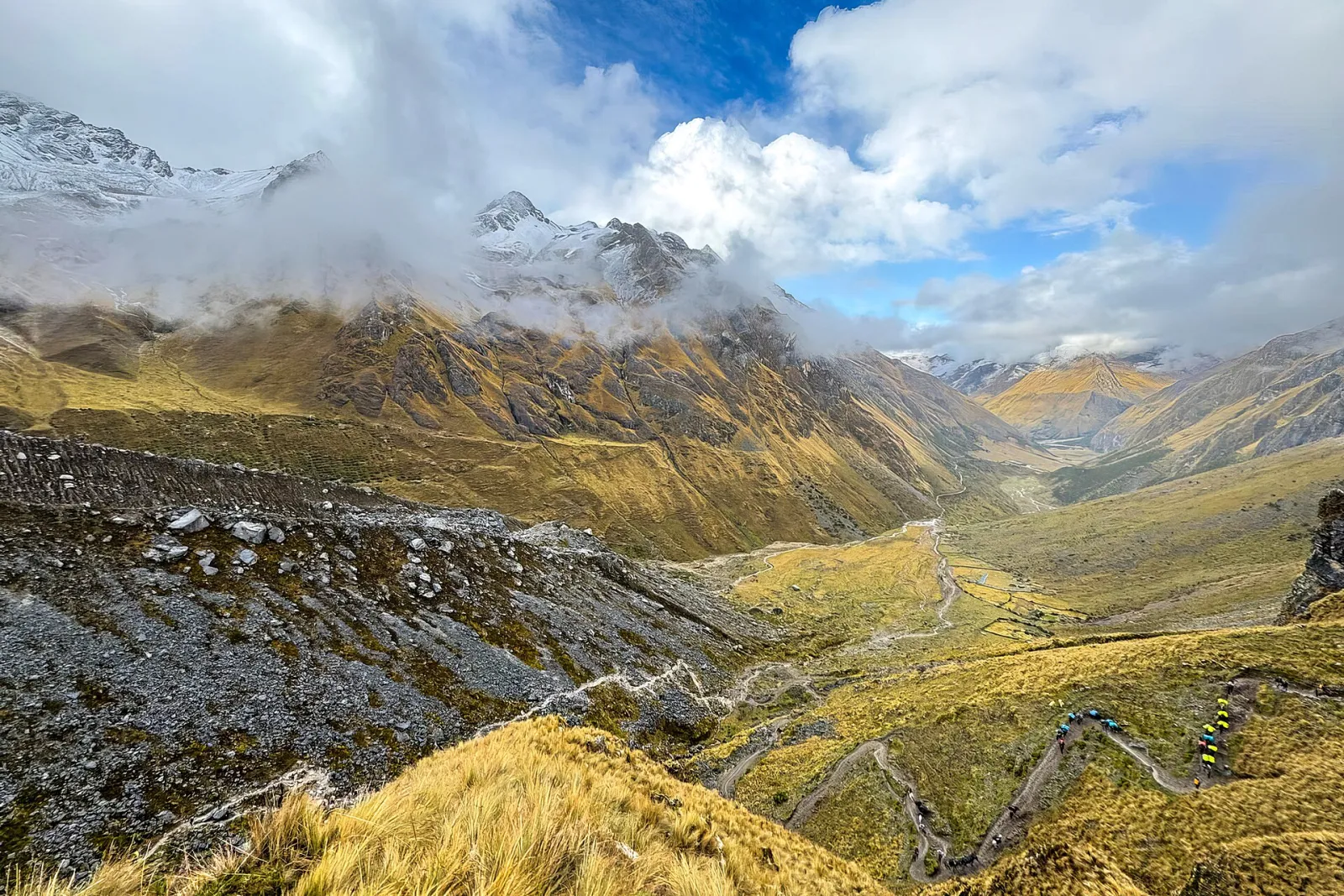
The switchbacks below the Salkantay Pass, seen from the high side of the valley above Soraypampa. Photo: Steve FUNG, CC BY-SA 4.0
Quick facts
| Salkantay trek, 5 days | |
|---|---|
| Highest point | Salkantay Pass, 4,600 to 4,650 m (15,100 to 15,260 ft) depending on the source. Our trip page uses 4,630 m (15,190 ft) |
| The mountain | Nevado Salkantay, 6,271 m (20,574 ft) |
| Start | Soraypampa, 3,900 m (12,800 ft), by road from Cusco via Mollepata |
| Finish | Machu Picchu, 2,430 m (7,972 ft), then train to Ollantaytambo and road to Cusco |
| Walking distance | about 68 km (42 mi) over four trekking days |
| Permit | none for the trek. Machu Picchu needs a timed ticket |
| Best months | May to September (dry). December to March is the wet season |
| Sleeping | tents on nights 1 to 3, a hostel or hotel in Aguas Calientes on night 4 |
Altitudes from our trip page, El Peruano (2018) and Andina (2025). Checked October 20, 2026.
The short version
- Day 2 is the hard one: up to the pass, then down about 1,700 m (5,600 ft) to Chaullay.
- You sleep high on night one. Soraypampa is about 500 m above Cusco. Spend two nights in Cusco first.
- Humantay Lake is part of the trek. It sits 1 to 1.5 hours above the first camp.
- Horses carry the camp. You carry a daypack.
- Bring or rent a sleeping bag rated to about -10 °C (14 °F). It is not included.
- Dry season means freezing nights and clear views. Wet season means mud and cloud.
Where is the Salkantay trek and why is it famous?
The trek crosses the Vilcabamba range west of Cusco, around the flanks of Nevado Salkantay, which rises to 6,271 m. It is famous for two reasons: it reaches Machu Picchu without an Inca Trail permit, and it goes from glaciers to coffee farms in two days.
Salkantay is an apu, a protective mountain in Andean belief. The stacked stones on the pass are apachetas, small offerings left by people who cross. Leave them as they are. The ice is also shrinking: El Peruano, Peru's official newspaper, reported in 2018 that Salkantay had lost around 60 percent of its glacier surface in four decades.
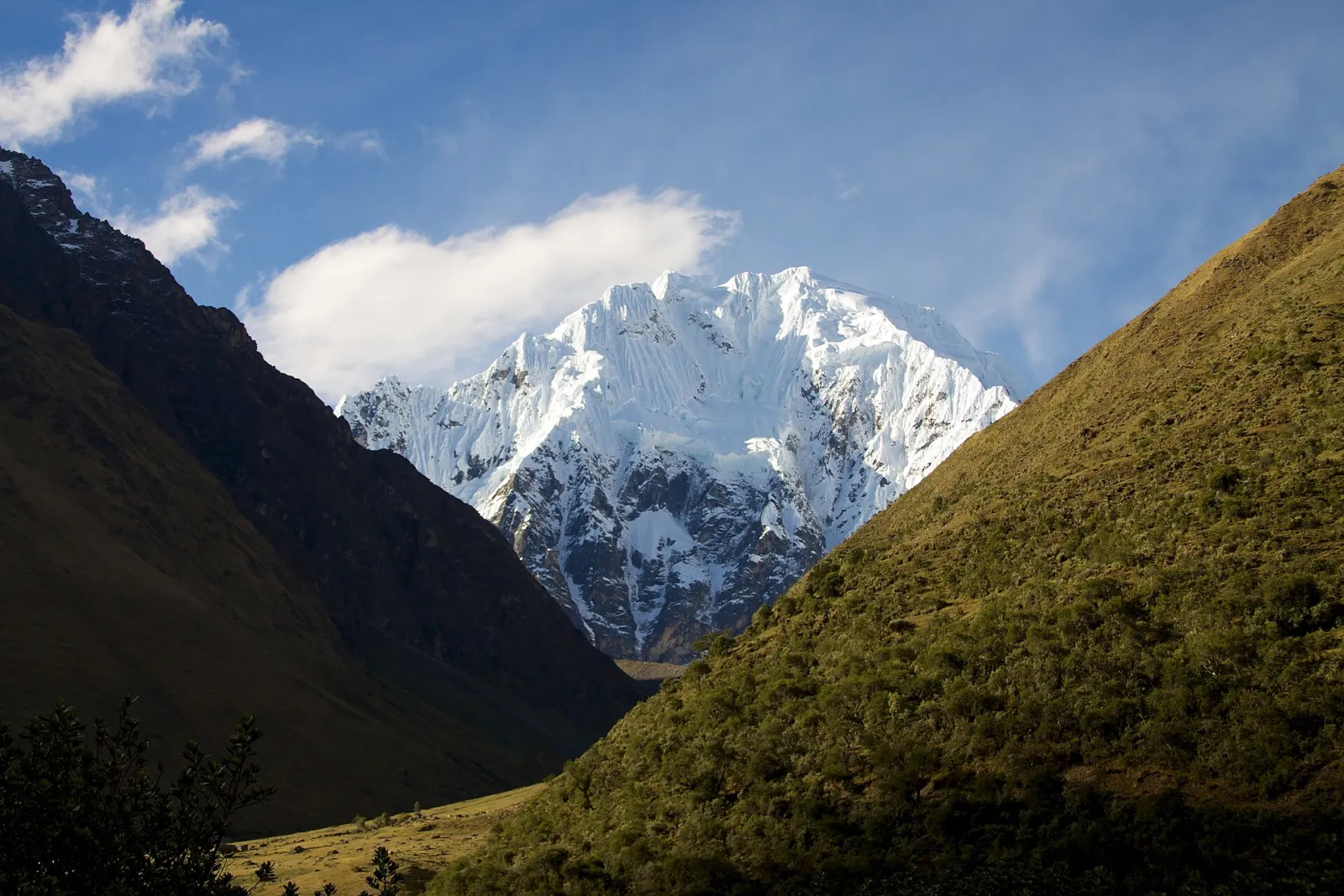
Nevado Salkantay at the head of the valley as you approach the Soraypampa camp. Photo: McKay Savage, CC BY 2.0
What happens each day on the 5-day Salkantay trek?
Day 2 is the big one: the Salkantay Pass at 4,630 m. After that the trail only goes down. Infographic: Viajes Cusco Perú
Each day has its own climate. This follows our Salkantay trek 5 days itinerary, with the distances and times we publish there.
| Day | Route | Distance | Walking time | High point | Night |
|---|---|---|---|---|---|
| 1 | Cusco, Mollepata, Soraypampa | about 12 km (7.5 mi) | 5 to 6 h | 3,900 m (12,800 ft) | Camp, Soraypampa, 3,900 m |
| 2 | Soraypampa, Salkantay Pass, Chaullay | about 22 km (13.7 mi) | 8 to 9 h | 4,630 m (15,190 ft) | Camp or basic lodging, Chaullay, 2,900 m (9,514 ft) |
| 3 | Chaullay, La Playa, Lucmabamba | about 16 km (10 mi) | 5 to 6 h | 2,900 m (9,514 ft) | Camp or eco-lodging, Lucmabamba, about 2,450 m (8,040 ft) |
| 4 | Lucmabamba, Llactapata, Aguas Calientes | about 18 km (11 mi) | 6 to 7 h | 2,800 m (9,186 ft) | Hostel or hotel, Aguas Calientes, 2,040 m (6,693 ft) |
| 5 | Machu Picchu, train, Cusco | guided visit | 2 to 3 h at the site | 2,430 m (7,972 ft) | Back in Cusco at night |
Day 1: Cusco to Soraypampa, with Humantay above camp
The van picks you up between 4:30 and 5:00 a.m., in the dark. Breakfast is in Mollepata, then the road climbs to Soraypampa. From there you walk about 12 km over wide valleys, with Salkantay filling the head of the valley.
Our trip page lists Humantay Lake among the trek's highlights, with free time for photos. Soraypampa is its trailhead: Peru's official tourism inventory puts the lake at about 4,200 m (13,780 ft), a steep 1 to 1.5 hour climb above camp. That makes it the highest point of day 1 and a good test of how your body handles altitude before the pass. Our Humantay Lake guide describes the climb.
Dinner is hot and early, and the cold arrives the moment the sun drops behind the ridge. El Peruano gives a range of -5 °C (23 °F) to 26 °C (79 °F) along the route, and the low end is a dry-season night at Soraypampa.
Day 2: over the Salkantay Pass to Chaullay
The climb from Soraypampa to the pass is about 7 km and takes around four hours, according to El Peruano. The trail zigzags up moraine and scree, and every switchback feels shorter of air than the last. Walk slowly and drink at every stop.
At the top there is a sign, a field of apachetas and, on a clear morning, the ice wall of Salkantay so close it seems to fill half the sky. Our trip page puts the pass at 4,630 m. El Peruano printed both 4,600 and 4,650 m in the same article, so count on roughly 4,600 m (15,100 ft).
Then comes the descent: about 1,700 m down to Chaullay, for a day of about 22 km and 8 to 9 hours. Grass turns to shrubs, shrubs to mossy trees. Your knees will feel it, and poles help.
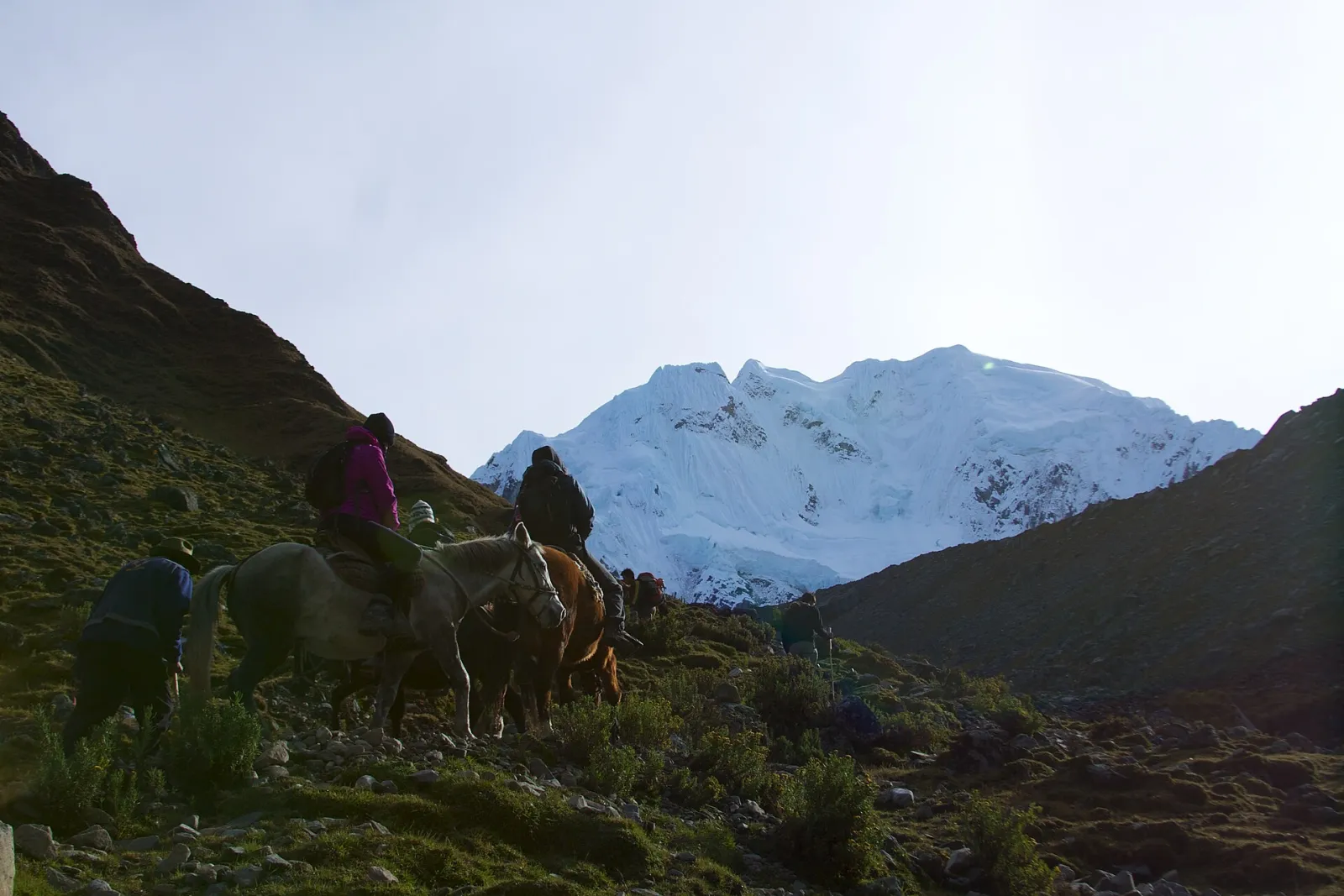
Horses on the early climb to the pass. On our trek, horses and muleteers carry the camp equipment. Photo: McKay Savage, CC BY 2.0
Day 3: Chaullay to Lucmabamba, into the high jungle
The trail follows the river past waterfalls and small farms to La Playa, then on to Lucmabamba, about 16 km and 5 to 6 hours. You swap the fleece for a T-shirt and insect repellent. This is coffee country, and the route stops at plantations where you see how local families live and work.
Day 4: Llactapata and the first view of Machu Picchu
You climb in the morning to Llactapata, an Inca site on the ridge facing Machu Picchu, and see the citadel for the first time across the valley, small and gray on its saddle of rock. Then you drop to Hidroeléctrica and continue to Aguas Calientes, about 18 km and 6 to 7 hours. Tonight is a bed and a shower. Dinner is on your own in town.
Day 5: Machu Picchu and back to Cusco
An early bus takes you up for a guided visit of 2 to 3 hours on Circuit 2, the classic route past the Guardian's House viewpoint. Huayna Picchu or Machu Picchu Mountain can be added if booked months ahead, at US$75 per person each according to our trip page. In the afternoon you take the train to Ollantaytambo, and our van brings you to Cusco at night. To pick a circuit, see our guide to choosing the best Machu Picchu circuit.
When is the best time to hike Salkantay?
May to September, the dry season, when Cusco gets one or two rainy days a month. The price is cold: dry nights are the coldest of the year. April and October are shoulder months, and December to March brings daily rain and muddy descents.
There is no weather station on the pass, so the table uses the two nearest: Cusco airport (3,249 m) for the high half of the route and SENAMHI's Machu Picchu station (2,399 m) for the jungle half.
| Month | Cusco rain | Rainy days, Cusco | Cusco night low | Machu Picchu rain | On the trail |
|---|---|---|---|---|---|
| January | 153 mm (6.0 in) | 20 | 8.0 °C (46 °F) | 341 mm (13.4 in) | Wet, cloudy pass |
| February | 132 mm (5.2 in) | 17 | 8.0 °C (46 °F) | 325 mm (12.8 in) | Wet |
| March | 106 mm (4.2 in) | 16 | 7.8 °C (46 °F) | 341 mm (13.4 in) | Wet, green |
| April | 38 mm (1.5 in) | 7 | 6.2 °C (43 °F) | 184 mm (7.2 in) | Drying out |
| May | 7 mm (0.3 in) | 2 | 3.6 °C (38 °F) | 73 mm (2.9 in) | Dry, clear |
| June | 3 mm (0.1 in) | 1 | 1.9 °C (35 °F) | 51 mm (2.0 in) | Dry, coldest nights |
| July | 6 mm (0.2 in) | 1 | 1.2 °C (34 °F) | 54 mm (2.1 in) | Dry, coldest nights |
| August | 7 mm (0.3 in) | 2 | 2.8 °C (37 °F) | 61 mm (2.4 in) | Dry, clear |
| September | 18 mm (0.7 in) | 4 | 5.0 °C (41 °F) | 76 mm (3.0 in) | Dry, milder |
| October | 55 mm (2.1 in) | 9 | 6.8 °C (44 °F) | 163 mm (6.4 in) | Showers return |
| November | 77 mm (3.0 in) | 10 | 7.6 °C (46 °F) | 173 mm (6.8 in) | Rainy afternoons |
| December | 125 mm (4.9 in) | 17 | 7.8 °C (46 °F) | 275 mm (10.8 in) | Wet |
Cusco figures are NOAA normals. Machu Picchu figures are SENAMHI's 1991 to 2020 normals. Soraypampa, 650 m above Cusco airport, is colder every night of the year. More in our best time to visit Machu Picchu guide.
How hard is the Salkantay trek?
Hard for a fit beginner, moderate for an experienced hiker. Nothing is technical. What makes it hard is altitude on days 1 and 2, a 22 km second day and the long downhill. Most people who struggle arrived in Cusco the day before. A simple test: if you can hike 15 km (9 mi) with 800 m (2,600 ft) of climbing at home and feel fine the next day, distance will not be your problem.
| Salkantay, 5 days | Inca Jungle, 4 days | Classic Inca Trail, 4 days | |
|---|---|---|---|
| Highest point | 4,630 m (15,190 ft), on foot | 4,300 m (14,108 ft), by van before biking down | 4,215 m (13,829 ft), on foot |
| Permit | not needed | not needed | needed, limited daily quota |
| Style | trekking, mountains to jungle | biking, zipline, trekking | Inca road and ruins |
| From | US$707 | US$607 | US$797 |
Figures from our trip pages. If you are torn between Salkantay and the Inca Trail, read our Salkantay vs Inca Trail comparison and the Inca Trail permits guide.
How do you avoid altitude sickness on Salkantay?
Sleep at least two nights in Cusco, at about 3,400 m (11,150 ft), before day 1, and walk slowly on the first two days. The CDC's travel health guide, quoting the Wilderness Medical Society, advises going up no more than 500 m (1,650 ft) per night in sleeping altitude above 3,000 m (9,800 ft). Cusco to Soraypampa fits that rule. The CDC adds that oxygen levels drop most during sleep, which is why where you sleep matters more than where you walk. You climb to 4,200 m at Humantay and sleep at 3,900 m, then cross the pass and sleep at 2,900 m.
The CDC describes acute mountain sickness as a headache plus loss of appetite, dizziness, fatigue or nausea, "like an alcohol hangover." Never go up to sleep higher with symptoms, and descend if they get worse despite rest. Confusion, stumbling or breathlessness at rest are emergencies. Acetazolamide helps prevent it but needs a prescription, so ask your doctor. Our guides carry emergency oxygen. More in our Cusco altitude tips.
What should you pack, and who carries it?
Horses and muleteers carry the tents, mattresses and kitchen, and a cook makes the meals on the trail. You carry a 30 to 40 liter daypack with water, layers and snacks. Pack for freezing nights and humid afternoons in the same bag:
- Sleeping bag rated to about -10 °C (14 °F) and trekking poles. Neither is included. Bring or rent them in Cusco. Leave the poles in Aguas Calientes on day 5: the Machu Picchu code of conduct bans walking sticks.
- Layers: thermal base, fleece, insulated jacket, rain jacket, hat and gloves.
- Broken-in boots, wool socks and camp sandals.
- SPF 50+ sunscreen and sunglasses, plus insect repellent for days 3 and 4.
- Headlamp, water bottle, purification tablets, a basic first aid kit and your passport (needed for the Machu Picchu ticket and the train).
Bags over 40 x 35 x 20 cm (16 x 14 x 8 in) are not allowed inside Machu Picchu. Our Peru packing list covers the rest of the trip.
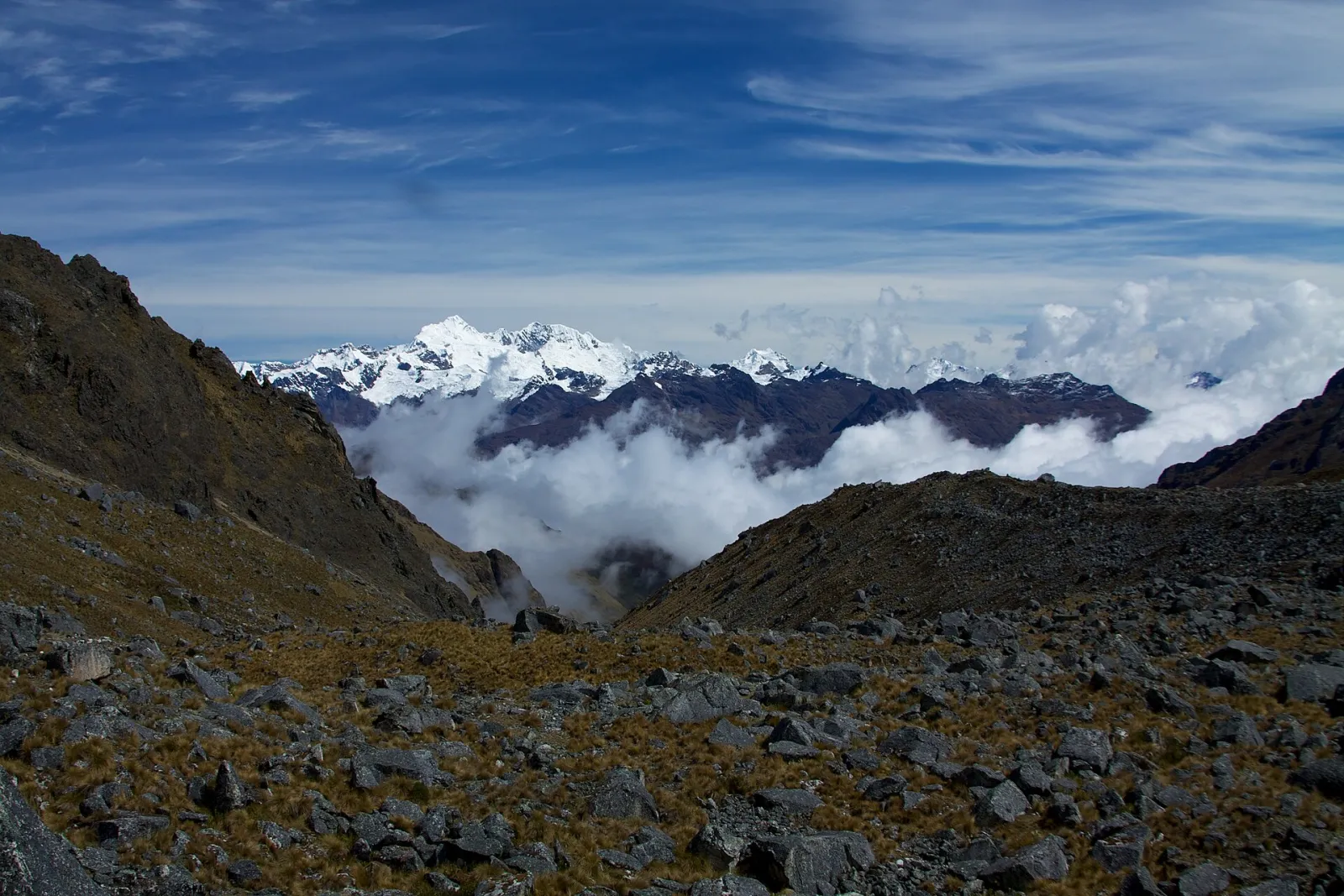
Beyond the pass, the trail drops into valleys full of cloud. Photo: McKay Savage, CC BY 2.0
What we include and what we do not
We are Viajes Cusco Perú, a tour operator based in Cusco. This is a camping trek with one night in town, not a lodge or glass-dome trek. We provide a briefing before departure, a bilingual guide trained in mountain trekking and first aid, emergency oxygen, tents, mattresses, a cook, horses and muleteers, the transfer to Mollepata, the night in Aguas Calientes, the Machu Picchu ticket for Circuit 2, the bus up, the train to Ollantaytambo and the transfer to Cusco.
We do not include the sleeping bag, poles, breakfast on day 1, dinner on day 4, lunch and dinner on day 5, Huayna Picchu, travel insurance or tips. Landslides, weather and strikes can change the route, and then safety decides.
Frequently asked questions
How long is the Salkantay trek? About 68 km (42 mi) of walking over four days on our route, from Soraypampa to Aguas Calientes, plus a fifth day at Machu Picchu.
How high is the Salkantay Pass? About 4,600 m (15,100 ft). Sources range from 4,600 to 4,650 m, and our trip page uses 4,630 m (15,190 ft).
Do you need a permit for the Salkantay trek? No. Only the Machu Picchu ticket is required, and our package includes it.
Is the Salkantay trek harder than the Inca Trail? On altitude, yes. The Salkantay Pass is about 400 m higher than the Inca Trail's 4,215 m pass, and the route is a day longer.
Do you visit Humantay Lake on the Salkantay trek? Yes. Our trip page lists it as a highlight, and the lake is a 1 to 1.5 hour climb above the first camp at Soraypampa.
What is the best month for the Salkantay trek? May to September. June and July are the driest months in Cusco and also have the coldest nights.
Can I do the Salkantay trek in the rainy season? Yes, but from December to March expect rain most days, mud on the descent and clouds over the pass.
Do mules carry my bag? Horses and muleteers carry the camp equipment on our trek. You carry a daypack.
Where do you sleep on the Salkantay trek? In tents for three nights, with basic or eco-lodging possible at Chaullay and Lucmabamba, then a hostel or hotel in Aguas Calientes.
How much does the Salkantay trek cost? Our 5-day trek starts from US$707 per person, with the Machu Picchu ticket, train and most meals included.
Walk Salkantay with us
The Salkantay trek in 5 days is our classic route, from US$707 per person. For the lake alone, the Humantay Lake day tour starts from US$137, or combine it with the citadel on Machu Picchu and Humantay Lake in 6 days, from US$1,028. For Inca ruins on the trail, take the Classic Inca Trail in 4 days, from US$797, and for bikes and ziplines, the Inca Jungle Trail in 4 days, from US$607. All routes are on our Cusco trekking page, and for your free days, see the best things to do in Cusco.
Updated October 2026. Facts checked on October 20, 2026, against our Salkantay trip page, El Peruano's 2018 report on the route, Andina, the MINCETUR inventory record for Laguna de Humantay, SENAMHI and NOAA climate normals, the CDC Yellow Book 2026 chapter on altitude illness and the Machu Picchu code of conduct. Trail conditions change, so confirm details before you travel.