Why Is Rainbow Mountain Colored? The Real Geology Explained
Vinicunca's stripes are rock layers stained by iron oxides, not 14 minerals. Every color explained, the ice story and how to spot fake photos.
Rainbow Mountain (Vinicunca) is colored by its rocks, not by paint, filters or a single mineral. Its slopes are layers of clay, mudstone, sandstone, marl and limestone, laid down in the sea, lakes and rivers, then folded up by the Andes and stained by iron oxides as they weathered. Red and pink come from iron, green from iron-magnesium clays, mustard from limonite and sulfur-bearing sandstone, white from quartz. The top stands at 5,036 m (16,522 ft), and the rocks are dated at roughly 75 to 63 million years by one study and 65 to 2 million years by another.
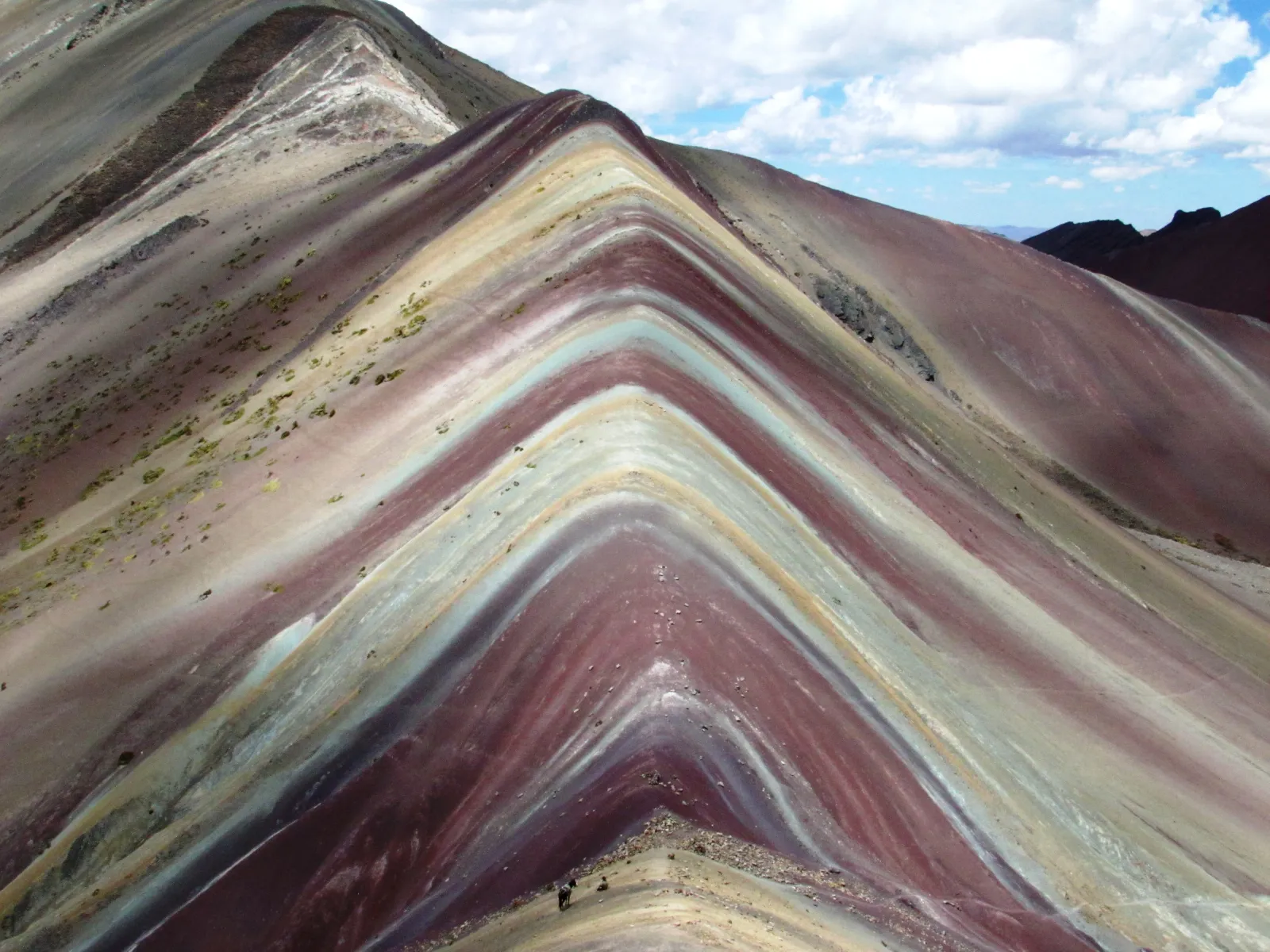
The bands of Vinicunca bend over the ridge like the pages of a folded book. The camera dated this photo to October 15, 2012, and the slope is already bare of snow. Photo: José Carlos Rozas Carazas, CC BY-SA 4.0
The short version
- What colors it: layers of different sedimentary rock, each with its own mix of minerals. Iron oxides give the reds and pinks.
- How it formed: sediment settled in water, turned to rock, was lifted and folded by the Andes, then oxidized and eroded.
- How old: about 75 to 63 million years according to a sedimentology study of the site, or 65 to 2 million years according to the version published by Peru's state news agency. The two disagree.
- "14 minerals": we found no geological source for that number. Geologists describe six color groups.
- The ice story: sources give 2012, 2013, 2015 and 2016 for when snow "revealed" it. Peruvian scientists are more cautious.
- The photos: many viral images are boosted or not Vinicunca at all. In person the colors are softer, and brightest under clear sun in the dry season, May to October.
What is Rainbow Mountain made of?
Stand at the lookout and look at the slope in front of you. What you see is a stack of rock layers, tilted and bent so that their edges run across the hillside as stripes. The mountain is a cross-section of an old basin floor.
According to the Geological Society of Peru, quoted by Andina in 2020, the colors come from "a complex geological history of marine, lake and river sediments." In 2018 BBC Mundo published the same explanation from a study by the Cultural Landscape Office of Cusco's regional Culture directorate, and added the voice of César Muñoz, a member of the Geological Society: the striking colors are due to the oxidation of the minerals by the area's humidity, and to erosion.
The story runs in four steps:
- Deposition. Mud, clay, sand and lime settled in shallow water. A 2017 sedimentology study by geologists from Cusco (Alarcón Laime, Huallpa Laura and Barazorda Paredes) places the colored beds in the lower Vilquechico Formation and describes a shallow marine setting.
- Burial. Under the weight of new layers, the soft sediment hardened into mudstone, claystone, sandstone, marl and limestone.
- Uplift and folding. The movement of tectonic plates raised these layers into mountains, as Andina and the Geological Society explain. That is why the stripes are not flat: they bend in a fold over the ridge, which you can see in the photo above.
- Oxidation and erosion. Once exposed at more than 5,000 m, the rock met air, water, frost and sun. Iron in the minerals oxidized and rain and wind stripped away the surface. NASA, captioning an astronaut photo of the area in 2023, put it in one line: the varying hues result from millions of years of erosion and weathering.
Nothing is painted and nothing is volcanic in this story: every source we read describes sedimentary rock, made from mud, sand and lime that settled in water.
What causes each color?
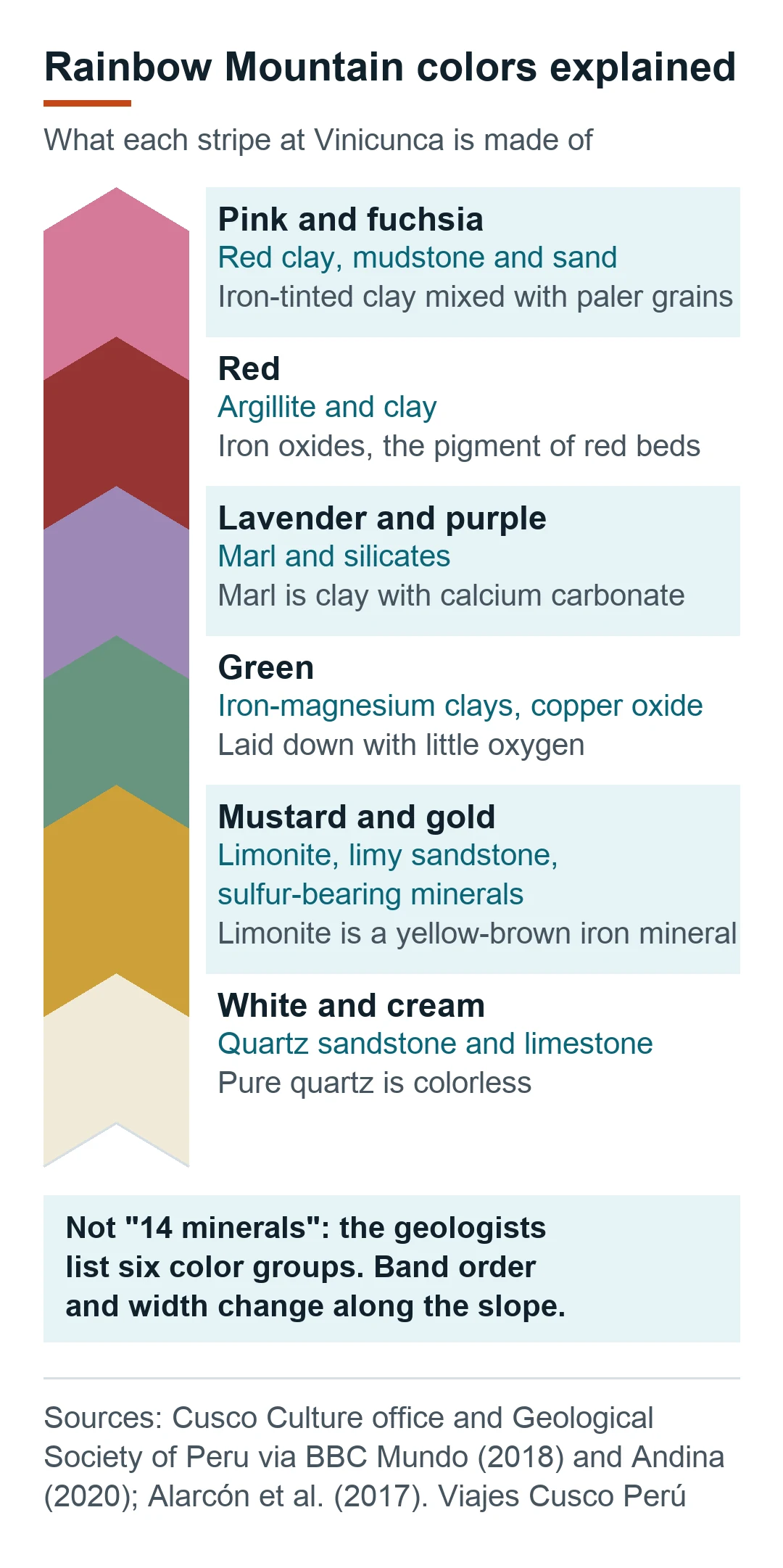
Six color groups, six kinds of rock. Free to share with a link to this page. Infographic: Viajes Cusco Perú
Each color matches a different rock. The list below follows the Cusco Culture office study and the Geological Society of Peru as published by BBC Mundo (2018) and Andina (2020). The "why" column adds the chemistry from the sources listed at the end.
| Color | Rock or mineral | Why it has that color |
|---|---|---|
| Pink and fuchsia | Red clay mixed with mud and sand | Iron oxides tint the clay, and paler mud and sand dilute the red |
| Red | Argillite and clay | Iron oxides. Red beds owe their color to ferric oxides such as hematite coating the grains |
| Lavender and purple | Marl (clay with calcium carbonate) and silicates | The sources name the rock but do not explain the violet tint |
| Green | Iron-magnesium clays and copper oxide | Laid down where there was little oxygen, according to the 2017 study |
| Mustard and gold | Limonite and calcareous sandstone with sulfur-bearing minerals | Limonite is a yellow-brown iron oxide-hydroxide. Oxygen-rich conditions favor yellows |
| White and cream | Quartz sandstone and limestone | Pure quartz is colorless, so sand made of it looks pale |
Fabián Drenkhan, a researcher at the Pontifical Catholic University of Peru, told BBC Mundo that these mixtures also contain iron oxides, which are usually reddish. That is the thread running through the whole mountain: the same element, iron, shows up as red, pink, gold or green depending on how much oxygen was around when each layer formed and weathered. The 2017 study says it directly: the color change follows the environment of formation, with reducing conditions producing greens and oxidizing conditions producing yellows.
How old are the rocks?
There are two dates in print, and we give you both because they do not agree.
- 75 to 63 million years. The 2017 study ties the colored beds to the Vilquechico Formation, from the Campanian stage of the Late Cretaceous to the early Paleocene. That fits the general record of the Vilquechico Formation, which Wikipedia dates to about 76 to 66 million years and describes as mostly sandstone with shale.
- 65 to 2 million years. The Geological Society of Peru, as quoted by Andina and BBC Mundo, dates the sediments to the Tertiary and Quaternary.
Our reading: the rock layers are tens of millions of years old, and the shape you see today is much younger, because uplift and erosion are still working on it. If a page gives you a single precise age with no source, be skeptical. We found no published dating by INGEMMET, Peru's geological survey, specific to Vinicunca.
Is it really "14 minerals"?
You will read on many travel sites that Rainbow Mountain "is made up of 14 different minerals, and each mineral is represented by a different color." We traced that sentence. One widely shared version, on All That's Interesting (2022), cites no source for it and does not name the 14 minerals. Other sites repeat it without a source. TheTravel lists ten minerals, also without a source.
What the geologists actually published is six color groups, each tied to a rock type, not to one mineral: a red stripe is argillite and clay, a white stripe is quartz sandstone and limestone, and so on. Each of those rocks is itself a mix of minerals. So the honest answer is that "14 minerals, one per color" has no primary source we could find, and it gets the idea backwards. Colors come from rocks, and rocks are mixtures.
Was Rainbow Mountain hidden under ice until 2013?
Partly, and the date depends on who you ask. This is what each source says:
| Source | What it says |
|---|---|
| Older residents of Canchis province, quoted in a 2018 article by Ramiro Yanque (journal of retired San Marcos University teachers) | The colored hills were always covered by clouds and snow, and the cold kept people away |
| Santos Machacca, mountain guide, quoted by The New York Times in 2018 | Elders in Pitumarca said the mountain was under snow, and melting ice revealed it |
| Juan Carlos Gómez, Geophysical Institute of Peru, in BBC Mundo, 2018 | The hill was only partially covered by ice and had temporary snow until the early 1990s |
| Fabián Drenkhan, PUCP, in BBC Mundo, 2018 | He would not claim climate change uncovered it without evidence, though glaciers around it have melted strongly |
| Wikipedia, citing The Weather Channel | Glacier caps melted in 2013 |
| TheTravel and Spanish Academy | Around 2012 |
| Africa Check and Factly | Popular since 2015, when melting snow revealed it |
| Appalachia journal, 2020 | A melting glacier revealed it "four years ago" |
What is solid: the Vilcanota range around it has lost a lot of ice, and its neighbor, the Quelccaya Ice Cap, is the largest tropical ice cap in the world, according to NASA. What is shaky: the idea that the stripes were sealed under a glacier until one specific year. The photo at the top of this page, which the camera dated to October 2012, already shows bare bands. Scientists interviewed by the BBC talk about partial ice and seasonal snow.
The tourism date is clearer. BBC Mundo reports that visitors began arriving in early 2016, as tourists on their way to Ausangate, the sacred snow peak next door, spread the word, and that daily visitors grew from a few dozen to about 1,000 in roughly two years. Andina dates its international fame to around 2016, when photos spread on social media, and reports peaks of up to 2,000 visitors a day.
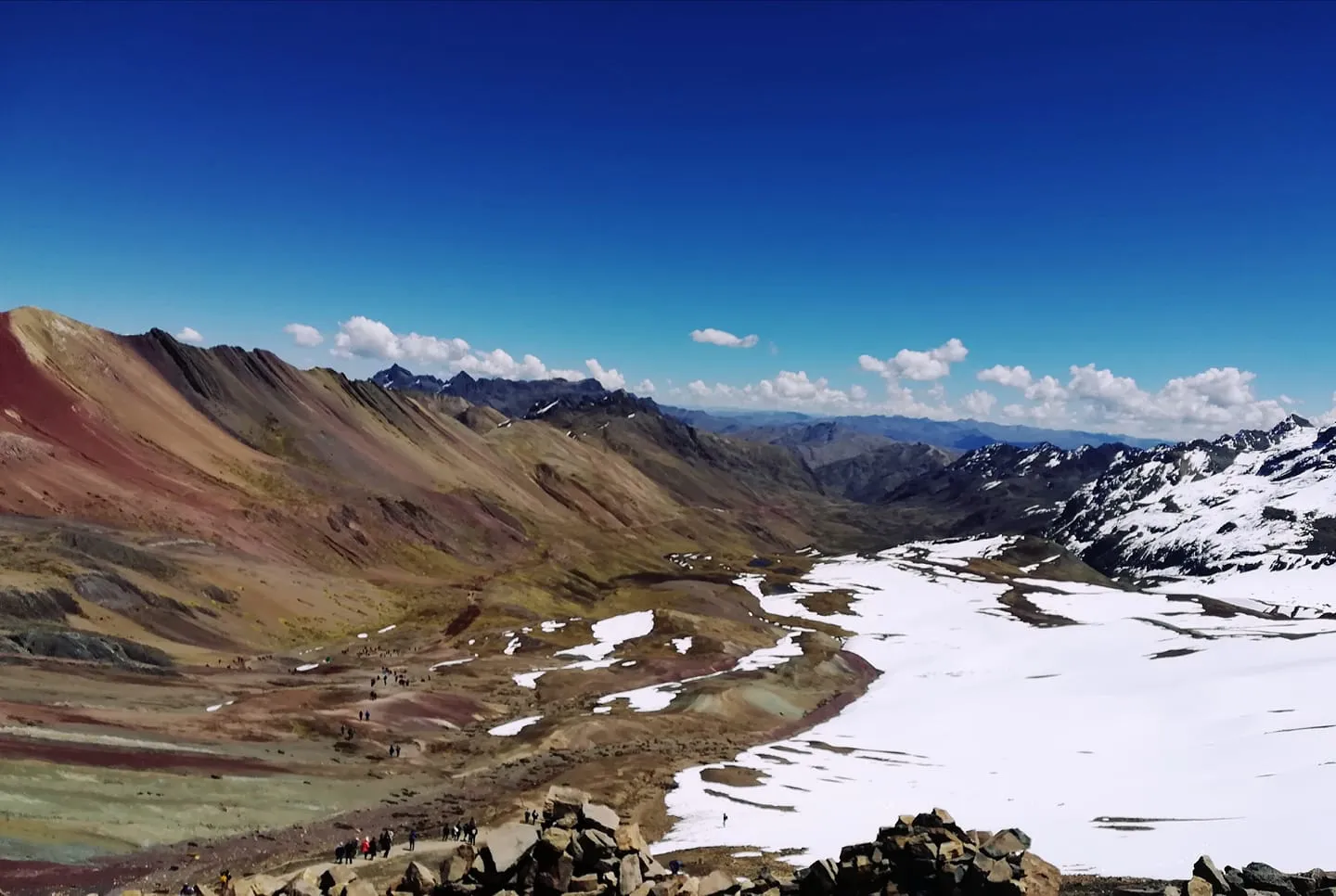
Snow is not history yet. On August 23, 2018, in the middle of the dry season, the valley below the summit was still white. Photo: Karinact, CC BY-SA 4.0
Are the photos real?
The mountain is real. Many of the photos are not, or not quite.
Why it looks softer in person. Most of the famous shots are taken in hard sun under a deep blue sky, often with saturation pushed up afterwards. On the day, cloud flattens the colors, and the stripes read as dusty rose, khaki and gray green. Snow can hide them completely: Andina warns that from November to April the mountain may be covered. Eugene Kaspersky, who hiked it and wrote about it in March 2025, found that most of the top image results were heavily edited, and that on his visit, under a gray sky, the colors were far weaker.
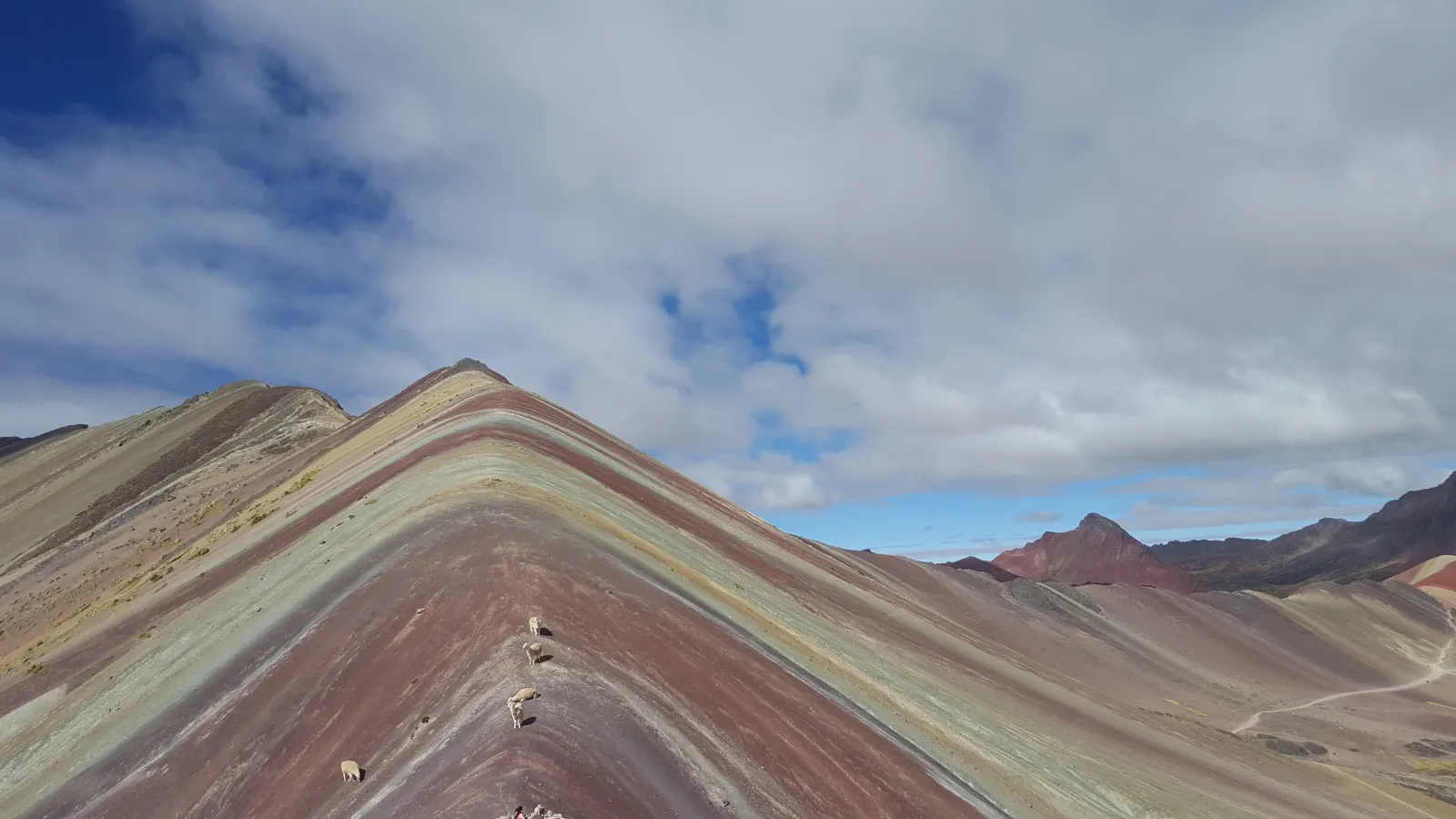
The same stripes on a cloudy morning, June 28, 2019, at 9:28 a.m. No editing, no sun: this is how many visitors see it. Photo: Jhonatan David Reategui Sifuentes, CC BY-SA 4.0
The fakes that went viral. The best-known case is a striped cliff above the sea shared as "Rainbow Mountain, Peru." Africa Check found that the image was digitally altered and that the place is Scala dei Turchi, a pale cliff in Sicily. Factly reached the same conclusion. Check Your Fact, the Daily Caller's fact-checking site, reviewed a similar image in March 2022 and noted that it did not match news agency photos of the site and that Vinicunca is nowhere near a body of water. Kaspersky also flagged an edited picture that looked more like Zhangye, in China, than Peru.
How to spot an edited Rainbow Mountain photo:
- Water in the frame. Vinicunca is high puna, with no sea or lake at its feet.
- Neon stripes on a flat slope. The real bands bend in a fold over the ridge and fade into brown at the edges.
- Clean, even colors. Real stripes are patchy, with dust, grass and loose stones on them.
- No people, no trail. The lookout has a path, a fence and, most mornings, a crowd.
- Run a reverse image search, the same method the fact-checkers used. The original often turns up with duller colors or another location.
Other colored mountains: Palcoyo, Pallay Punchu and Zhangye
Vinicunca is not the only striped mountain near Cusco. Andina applies the same Geological Society explanation to Palcoyo, and describes Pallay Punchu as the product of sedimentation and mineral oxidation. In May 2026 Andina reported that the Spanish edition of National Geographic Travel put Pallay Punchu and Vinicunca among the six most spectacular rainbow mountains in the world, alongside Zhangye Danxia in China, Hornocal in Argentina and Landmannalaugar in Iceland.
| Vinicunca | Palcoyo | Pallay Punchu | Zhangye Danxia (China) | |
|---|---|---|---|---|
| Height | 5,036 m (Wikipedia), 5,200 m (Andina) | 4,971 m | over 4,700 m | 1,500 to 2,500 m (Binggou area) |
| Rocks | Marine, lake and river sediments | Same as Vinicunca, per Andina | Sediments and oxidized minerals | Sandstone and other sedimentary rocks |
| Age given | 75 to 63 or 65 to 2 million years | Not published | About 250 million years, an Andina estimate | Cretaceous |
| Open to visitors | Around 2016 | 2018 | One of the newest, in Layo, Canas province | UNESCO Global Geopark since July 2020 |
| Walk to the view | 90 to 120 min | 45 to 60 min | 45 to 60 min | Not in our sources |
Zhangye shows the same principle on a bigger scale. NASA explains that iron oxide colored its sandstone deep red as it formed, that other oxides gave browns, yellows and greens, and that the collision of India and Eurasia, about 50 million years ago, did much of the folding. Same recipe: layers, iron, uplift, erosion. For the practical side of choosing between the three Peruvian mountains, read our comparison of Vinicunca, Palcoyo and Pallay Punchu.
When do the colors look best?
Go in the dry season, May to October, when Andina says rain is scarce and the contrast with the blue sky is clearest. From November to April snow can cover the stripes and make the summit harder to reach. On our Vinicunca tour you reach the lookout around 9:30 to 10:00 a.m., with the sun already high enough to light the slope. Cloud can still roll in at any hour, and we cannot promise the colors.
Our Rainbow Mountain hike guide covers the day hour by hour, the horses, the weather by month and the climb. The altitude is serious, so spend two or three days in Cusco first: our acclimatization guide explains how. Pack layers, sunglasses and sunscreen from the Peru packing list.
Frequently asked questions
Why is Rainbow Mountain in Peru so colorful? Because its slopes are layers of different sedimentary rock, and iron oxides and other minerals in each layer weathered into red, pink, gold, green, lavender and white.
What minerals give Rainbow Mountain its colors? Iron oxides in clay and argillite for red and pink, iron-magnesium clays and copper oxide for green, limonite and sulfur-bearing sandstone for mustard, marl for lavender and quartz for white.
Is Rainbow Mountain made of 14 minerals? We found no geological source for that number. Peruvian geologists describe six color groups, each a mix of several minerals.
How old is Rainbow Mountain? One study dates the colored layers to about 75 to 63 million years, while the Geological Society of Peru, quoted by Andina, gives 65 to 2 million years.
Was Rainbow Mountain covered in ice? Partly. Sources give 2012 to 2016 for its uncovering, but a Geophysical Institute of Peru scientist told the BBC it was only partially iced, with temporary snow until the early 1990s.
Is Rainbow Mountain really that colorful in person? Yes, but softer than most online photos. Under clear sun in the dry season the stripes are vivid, while cloud and snow mute or hide them.
When did Rainbow Mountain open to tourists? Visitors began arriving in early 2016, according to BBC Mundo, and Andina dates its international fame to the same year.
See the colors with us
The geology makes more sense when you are standing in front of it. Our Rainbow Mountain Vinicunca tour runs from US$137 per person with pickup, guide, breakfast and lunch. For the same striped rock with a shorter walk, take the Palcoyo Rainbow Mountain tour, also from US$137, or head for the quieter Pallay Punchu trek from US$147. Want it inside a longer trip? The Machu Picchu and Cusco tour in 5 days includes a Rainbow Mountain day. All our day trips are on the Cusco day trips page, and for your other days there are things to do in Cusco.
Updated November 2026. Geology, colors, dates and fact-checks reviewed on November 3, 2026, against Andina (2020, 2025 and 2026), BBC Mundo (2018), the 2017 sedimentology study of Vinicunca by Alarcón Laime, Huallpa Laura and Barazorda Paredes, NASA Earth Observatory, Africa Check, Check Your Fact, Factly and Wikipedia.