Paracas, Peru: 2026 Guide to the Reserve and Ballestas Islands
Paracas National Reserve, 272 km from Lima: S/11 entry, the Ballestas Islands boat, rules, and adding Huacachina and Nazca to the trip.
Paracas National Reserve is a 335,000-hectare desert peninsula and stretch of ocean about 272 kilometers south of Lima, roughly four hours by road on the Panamericana Sur. Entry costs S/11 per adult per day, the reserve is open from 9:00 to 16:00, and the boat trip to the Ballestas Islands, the part most visitors come for, takes about two hours and leaves in the morning. It is open all year, with temperatures between 15.5 and 32 °C. This guide covers what you see on land and at sea, the rules on the boats, how to fit in Huacachina and the Nazca Lines, and which months work best.
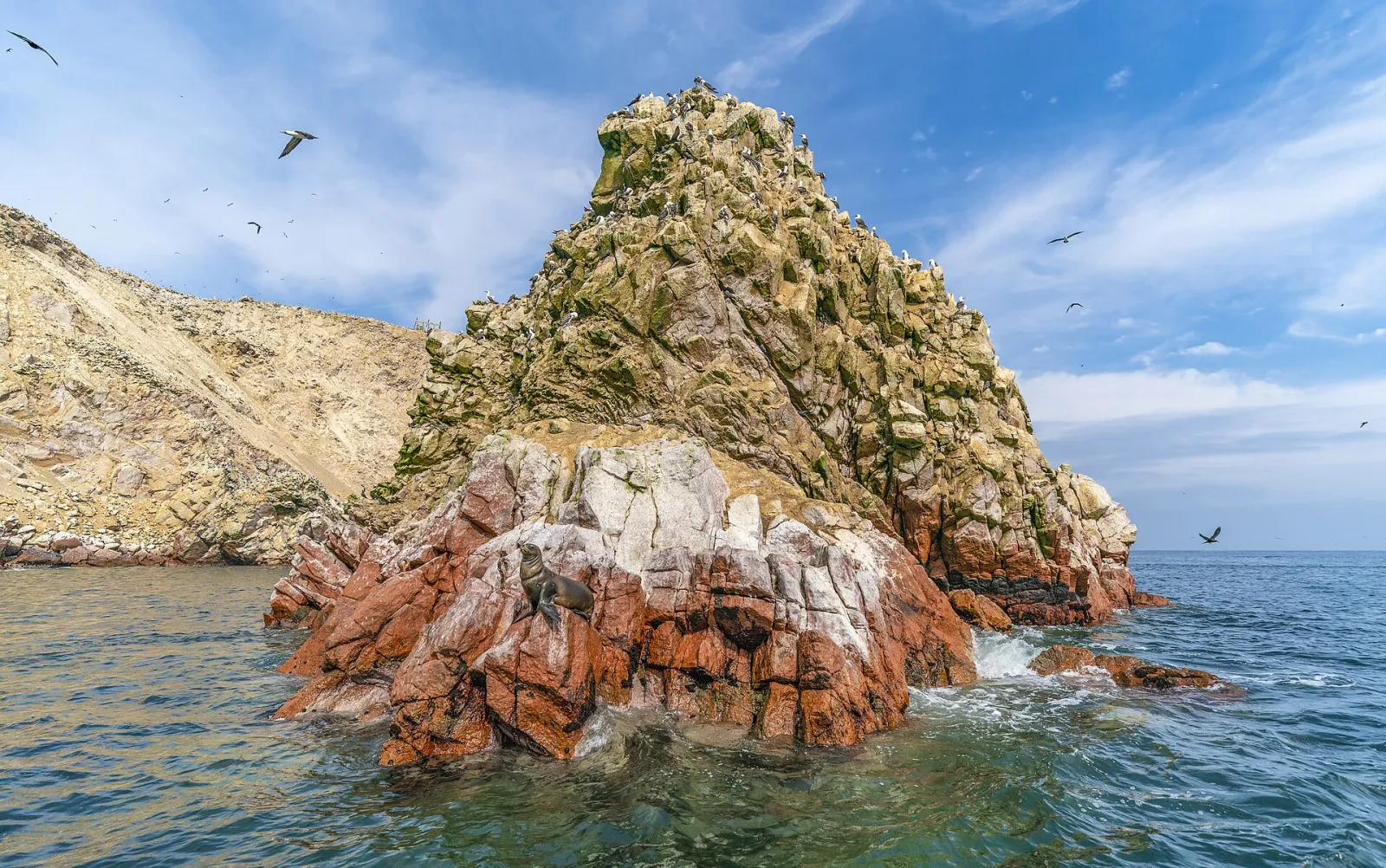
One of the rocks of the Ballestas Islands, white with guano and busy with seabirds. Photo: 威廉·佩雷斯·利马, CC BY-SA 4.0
The short version
- What it is: a protected area run by SERNANP, Peru's national parks service, created in 1975 and listed as a Ramsar wetland in 1992. About 65% of it is sea.
- From Lima: 272 km, about 4 hours by bus or car. Turn off the Panamericana Sur at kilometer 245.
- Reserve entry: S/11 per adult for one day, S/3 for children aged 5 to 16, free under 5. A combined promotional ticket for the reserve and the Ballestas sector costs S/17.
- Ballestas Islands: a boat tour of about two hours. Boats circle the islands; nobody lands.
- Wildlife: sea lions, Humboldt penguins, Peruvian boobies, pelicans, cormorants and Inca terns. SERNANP counts 216 bird species in the reserve.
- Best time: any month. Go in the morning, when the sea is calmer than in the windy afternoons.
What Paracas National Reserve is
Paracas is where Peru's coastal desert runs straight into the Pacific. On land there is almost nothing: sand, wind-cut cliffs, red and ochre rock, no trees and no shade. Offshore, the water is full of fish, birds and sea lions. SERNANP calls it the "Galapagos of this part of the South American Pacific".
The reserve was created on September 25, 1975, by Supreme Decree 1281-75-AG, and in 1992 it was added to the Ramsar list of wetlands of international importance. It covers 335,000 hectares, and roughly two thirds of that is marine water. SERNANP's inventory lists 216 bird species, 36 mammals, 10 reptiles, 168 fish and 317 kinds of algae. It is busy: SERNANP counted 730,655 visitors in 2025.
What you see on land
You enter by the Santo Domingo checkpoint, where tickets are sold. From there, roads spread out to the viewpoints:
- La Catedral: a rock formation on a cliff, carved by wind and sea, about 10 km from the main entrance.
- Playa Roja: a beach whose sand is red because of the nearby Punta Santa María massif, made of rock with solidified red magma.
- Lagunillas: a small cove with fishing boats, a viewpoint, a camping area near the checkpoint and craft stalls.
The drive between them is slow and very open. Bring water, because the only shade is the one you bring.
Reserve fees and hours
These are SERNANP's published rates for the reserve, in soles. Tickets are sold at the Santo Domingo checkpoint.
| Ticket | General visitor | Peruvian adult | Local resident |
|---|---|---|---|
| 1 day | S/11 | S/11 (minors S/3) | S/5 (minors S/3) |
| 2 to 3 days | S/60 | S/30 (minors S/15) | S/15 |
| 4 to 30 days | S/150 | S/75 (minors S/35) | S/35 |
| Paracas + Ballestas sector, promotional 2x1 | S/17 per adult |
Minors are children aged 5 to 16, and children under 5 enter free. The reserve is open every day from 9:00 to 16:00; entering earlier needs prior coordination with the reserve office. Alcohol and pets are not allowed. The boat itself is a separate charge, paid to the operator, and it is included when you go with an agency.
The Ballestas Islands
The islands are a group of small rock outcrops off the Paracas peninsula, covering only about 0.12 square kilometers. They belong to a different protected area, the Guano Islands, Islets and Capes National Reserve System, also managed by SERNANP. According to Andina, Peru's state news agency, they receive more than 400,000 visitors a year, and in November 2024 SERNANP opened a new surveillance post on the islands to control fishing and tourism.
The boats leave from the piers of Paracas bay. On the way out you pass the Candelabro, a geoglyph about 180 meters long cut into a sandy hillside facing the sea. Nobody knows for certain who made it or why. It is best seen from the water.
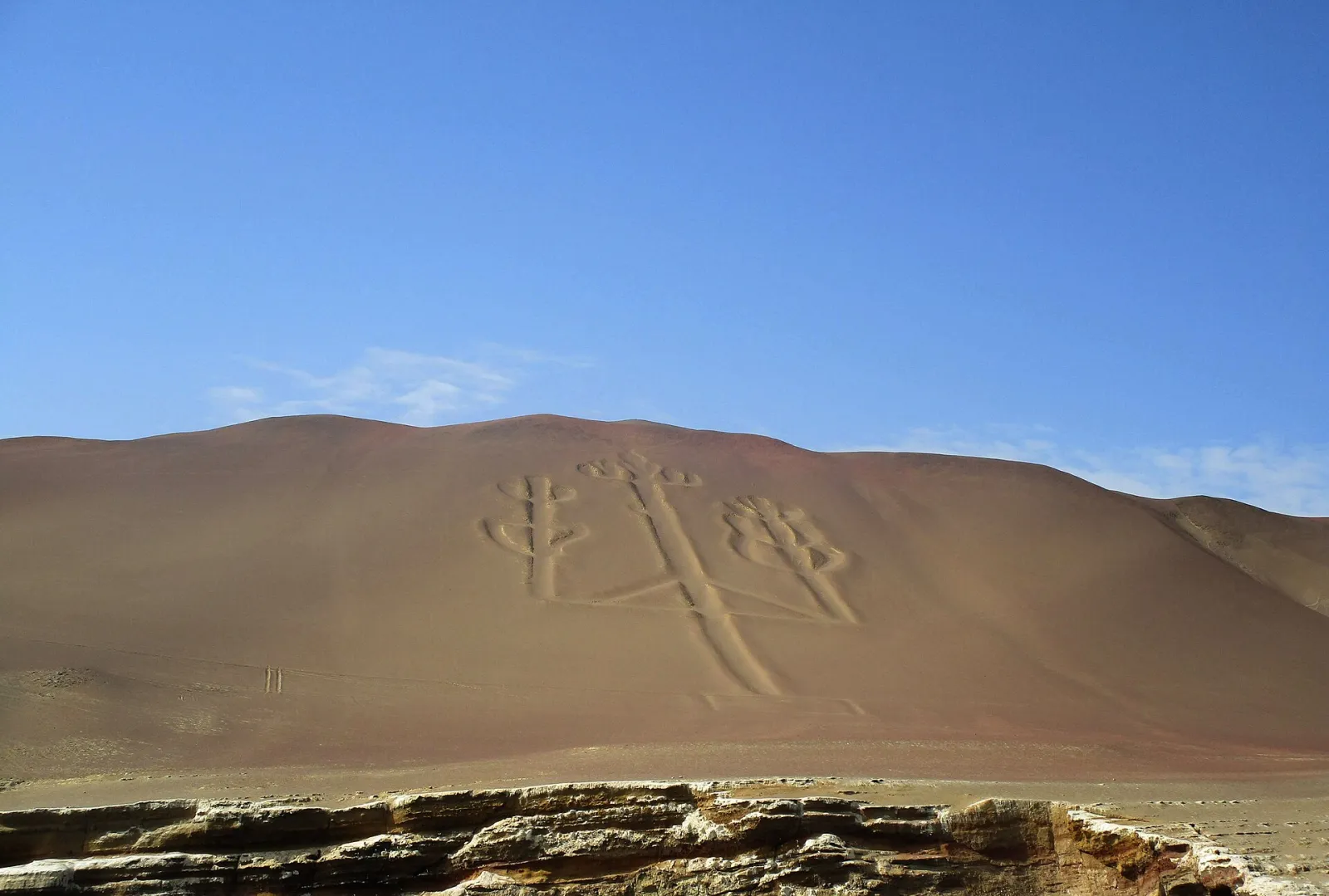
El Candelabro, about 180 meters long, seen from the boat on the way to the islands. Photo: ACris97, CC BY-SA 4.0
Then the islands come into view: arches and caves in pale rock, the tops white with guano, and a smell that reaches you before the birds do. The boat slows down and moves along the cliffs. On the ledges you see Peruvian boobies and guanay cormorants in large numbers, pelicans, Inca terns with their white mustaches and, if you are lucky, small groups of Humboldt penguins. On the pebble beaches at the waterline, sea lions lie in piles, bark at each other and sometimes swim out to look at the boat.
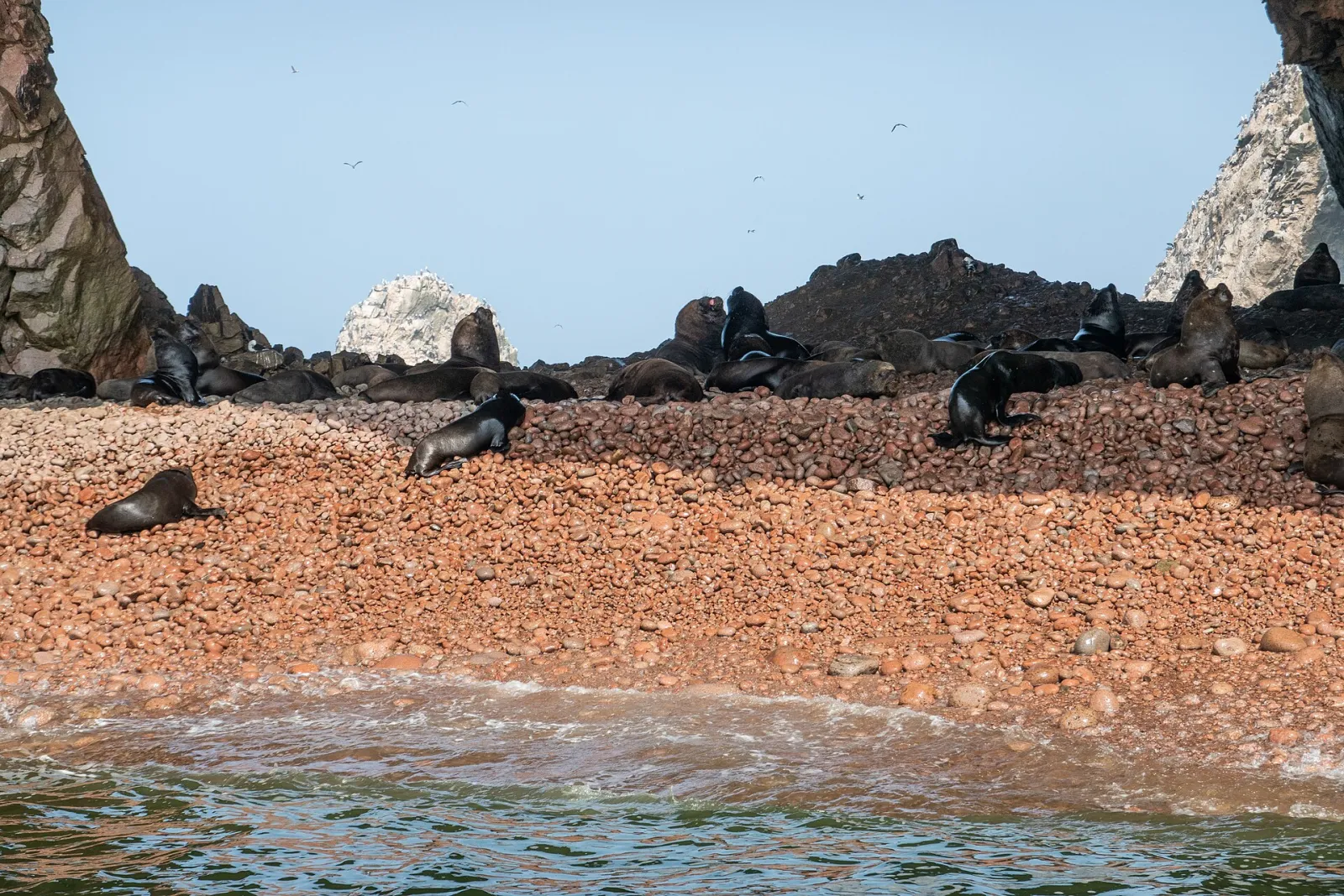
Sea lions on one of the beaches of the Ballestas Islands, seen from the boat. Photo: PsamatheM, CC BY-SA 4.0
Rules and what to expect on the boat
- No landing. The islands are protected for their wildlife, so boats only circle them. The whole trip, including the Candelabro, takes about two hours.
- Morning departures. The wind picks up in the afternoon, so operators run the boats early. Peru's weather service, SENAMHI, has recorded the strong coastal winds known as "vientos Paracas" at about 50 km/h at Pisco airport on an afternoon in July 2026.
- Weather closures happen. When there are abnormal swells, the Pisco Port Authority can close the bay to tourist boats. Boat trips were suspended for this reason in January 2024 and again in June 2026. If that happens, the boat trip is cancelled for the day and there is nothing to do but wait.
- SERNANP's rules: follow the ranger's instructions, do not disturb the animals, avoid single-use plastic and take your rubbish with you.
- What to wear: a windproof layer, a hat with a strap, sunscreen and sunglasses. Boats are open, the sun is strong, and the spray reaches the front seats.
Getting there from Lima
The reserve is 272 km south of Lima. SERNANP gives about four hours by bus or car on the Panamericana Sur, turning toward Paracas at kilometer 245. Organized tours leave Lima before dawn so they can reach the bay in time for the morning boats. On our trips, pickup at your Lima hotel is between 4:40 and 5:00 a.m.
Huacachina and Nazca in the same trip
Paracas sits on the same stretch of coast as two other famous stops, and most travelers combine them.
Huacachina is a small oasis with a green lagoon surrounded by tall sand dunes, next to the city of Ica. Dune buggies and sandboarding are the reason people go. Our Huacachina oasis guide covers the buggy ride, sunset and safety in detail.
The Nazca Lines, the giant figures drawn on the desert floor, are a UNESCO World Heritage Site since 1994, about 400 kilometers south of Lima. The figures date from roughly the 8th century BC to the 8th century AD and are best seen from a small plane.
| Tour | Days | What it includes | Back in Lima | From |
|---|---|---|---|---|
| Paracas, Ica and Huacachina full day | 1 | Ballestas boat, pisco winery, Huacachina buggy and sandboarding | Same night, about 10 to 11 p.m. | US$207 |
| Paracas, Huacachina and Nazca | 2 | Ballestas, Huacachina, night in Nazca, flight of about 45 minutes over the lines | Day 2, about 11 p.m. by bus | US$307 |
| Paracas, Pisco, Huacachina and Nazca | 2 | Ballestas, Huacachina, night in Paracas, Nazca flight of about 1 h 40 from Pisco airport | Day 2, afternoon (about 4 h by road) | US$607 |
The full day is long: 15 to 16 hours door to door, with about nine hours on the road. It works if you have one spare day in Lima. The two-day versions give the dunes and the lines more time. The Pisco version costs more because the flight starts at Pisco airport, about 25 minutes from Paracas, which saves the long drive back from Nazca, a road trip of around nine hours.
If you are planning the rest of the country, our guides to things to do in Peru and to getting from Lima to Cusco show how the coast fits before the Andes.
Best time to visit Paracas
SERNANP recommends the reserve all year. The coast is a desert, so rain is not the issue. What changes is heat, wind and crowds.
| Months | What to expect |
|---|---|
| December to March | Summer. The hottest and sunniest months and the busiest with Peruvian holidaymakers. SERNANP counted 51,276 visitors in just the first four days of January 2026. |
| April to November | Milder, with a grey coastal mist that our guides see burn off by midday on most days. |
| August to October | Inside the cooler period, the months when the strong "vientos Paracas" are most frequent. |
Whatever the month, plan the boat for the morning and the reserve or the dunes for later.
What to bring: sunscreen, a hat, sunglasses, a windbreaker, closed shoes for the dunes, a little cash in soles and a bag to keep sand out of your phone. Our Peru packing list covers the coast and the Andes in one bag, and our guide on whether Peru is safe for tourists covers road travel.
Frequently asked questions
How far is Paracas from Lima? About 272 kilometers, roughly four hours by bus or car on the Panamericana Sur.
How much is the entrance to Paracas National Reserve? S/11 per adult for one day, S/3 for children aged 5 to 16 and free for children under 5, according to SERNANP; a promotional ticket for the reserve and the Ballestas sector costs S/17.
Can you land on the Ballestas Islands? No. The islands are a protected area, so the boats circle them and nobody goes ashore.
Will I see penguins at the Ballestas Islands? Humboldt penguins live on the islands, but sightings depend on the day; sea lions and seabirds are far easier to spot.
Is Paracas worth it if I only have a few days in Peru? If your trip is short and centered on Cusco and Machu Picchu, it is a long detour; it works best with a spare day in Lima or a coastal leg of two days.
What is the best time of day for the Ballestas boat? The morning, because the wind and the swell tend to rise in the afternoon and boats can be suspended.
Can I visit Paracas, Huacachina and Nazca in one day? Paracas and Huacachina fit in a long day from Lima, but the Nazca Lines need a second day.
Visit Paracas with us
At Viajes Cusco Perú we run the south coast from Lima with hotel pickup, boats, buggies and guides arranged. The Paracas, Ica and Huacachina full day is the one-day option. The two-day Paracas, Huacachina and Nazca tour adds the lines, and the Pisco version shortens the road back. If you have a free half day in the capital, try the Lima city tour or Pachacamac. Everything we run from the capital is on the Lima day trips page, and if you want the coast and the Andes in one plan, see the six-day Lima and Cusco tour.
Facts checked on October 15, 2026, against SERNANP's Paracas National Reserve page (visitaareasnaturales.sernanp.gob.pe), Supreme Decree 1281-75-AG, the UNESCO World Heritage list, SENAMHI data reported by RPP and Agencia Andina. Fees and port closures change, so confirm before you travel.