Peru Food Tours and Cooking Classes in Cusco and Lima
San Pedro Market, 4 to 6 hour cooking classes from US$70, Barranco food tours, pachamanca, picanterías, diets and safe water. How to choose well.
A food experience in Peru usually means one of four things: a market visit, a cooking class, a guided tasting walk or a countryside meal. In Cusco, cooking classes that begin at San Pedro Market last 4 to 6 hours and were listed from US$70 to US$89 per person in October 2026. Lima's Barranco food tours take about 4 hours, from US$89. Below: how each one works, where our own guides take travelers, how to pick a good option and how to eat safely with any diet.
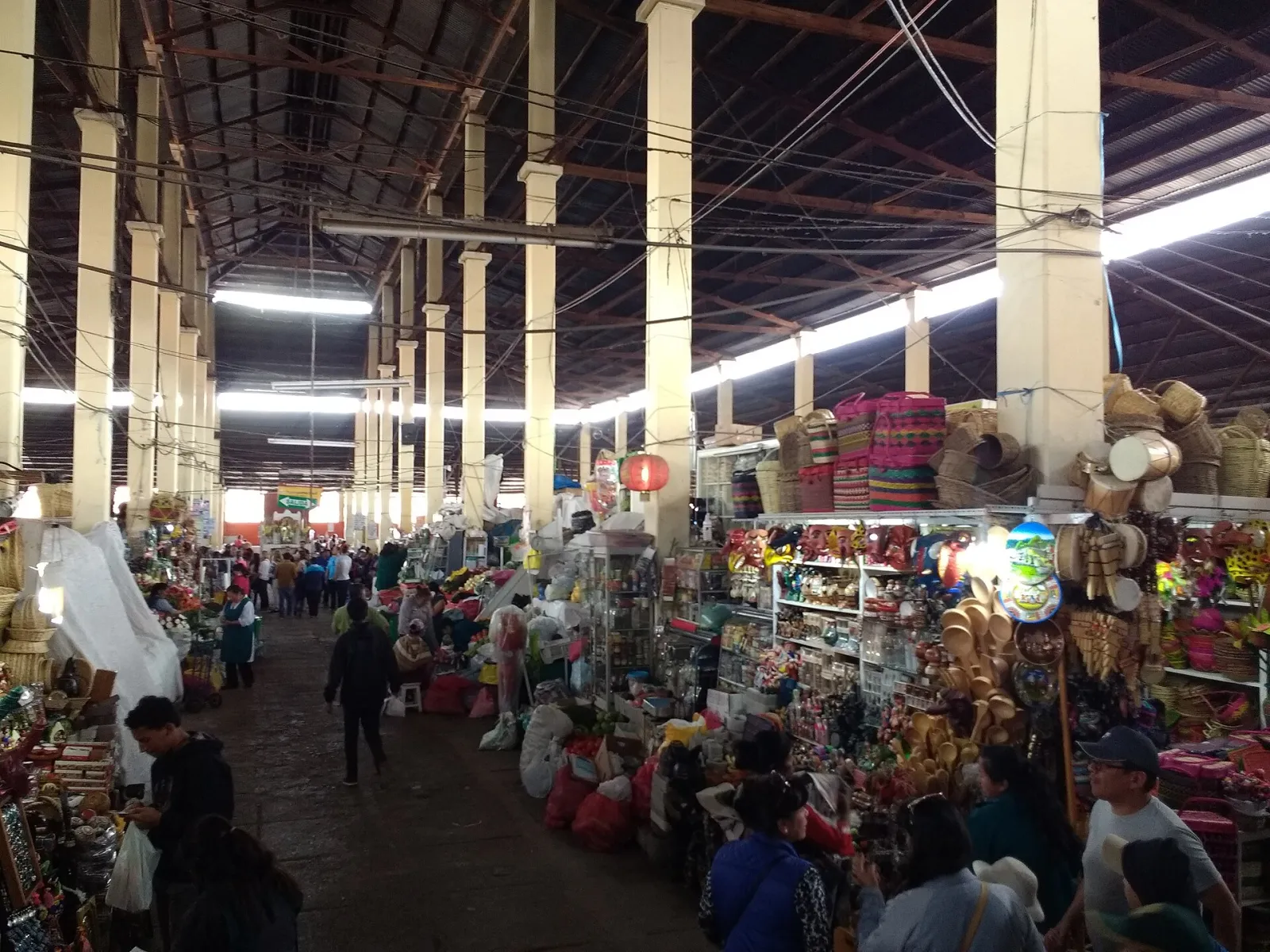
The central aisle of San Pedro Market in Cusco, a 1920s building declared a national monument in 2024. Photo: Mx. Granger, CC0
The short version
- Start with a market. San Pedro in Cusco and Surquillo in Lima show you the raw ingredients before you taste the dishes.
- Cooking classes in Cusco run about 4 to 6 hours, usually with a market walk, three or four courses and a pisco sour.
- Lima food tours focus on Barranco and on markets such as Surquillo, Mercado Central and Chinatown.
- Countryside meals (pachamanca, chicherías, Arequipa picanterías) are the most local experiences and the hardest to book online.
- A private route with us. On request, our guides lead a 4-hour food route in Cusco, around US$65 per person, for 2 to 12 people, booked 72 hours ahead.
- Diets are manageable. Ask for vegetarian or gluten-free when you book, not at the table.
- Water: drink only sealed bottles and skip ice, as the CDC advises.
Quick facts
| Experience | Length | Listed price | Source, checked October 2026 |
|---|---|---|---|
| Cusco cooking class with San Pedro Market | About 4 h | From US$70 | As Peru Tours Adventure, operator page |
| Cusco cooking class with market and pickup | 6 h, up to 10 people | From US$89 | The Abroad Guide listing |
| Barranco food tour, Lima | 4 h, more than 14 tastings | US$89 to US$99 | Nomades, operator page |
| Vegan food tour, Barranco | Half day, 14 tastings in 8 places | From US$119 | The Abroad Guide listing |
| Lima market tour (Surquillo, Mercado Central, Chinatown) | 3 h | See the listing | Civitatis listing |
| Cusco walking tour starting at San Pedro Market | 3 to 4 h | From US$27 | Viajes Cusco Perú |
| Private food route in Cusco (market, coffee, lunch) | 4 h, 2 to 12 people | Around US$65 | Viajes Cusco Perú, on request |
Which food experience fits your trip?
The right food experience depends on your time and on what you want to do: cook, taste or watch.
| Cooking class | Food tour | Market on your own | Countryside meal | |
|---|---|---|---|---|
| Best for | Hands-on travelers, couples | First day in a city | Budget travelers, photographers | Slow travelers |
| Time | 4 to 6 h | 3 to 4 h | 1 to 2 h | Most of a day |
| Where | Cusco, Lima | Lima (Barranco), Cusco | San Pedro, Surquillo | Sacred Valley, Arequipa |
| What you take home | Recipes | A map of where to eat | Fruit you have never seen | A story |
| Booking | Online, a day ahead | Online | None | Through locals or a lodge |
With one free afternoon in Cusco, a cooking class gives the most for the hours. In Lima, a food tour teaches you the neighborhoods fastest. To understand the dishes before you go, read our guide to Peruvian food and traditional dishes.
How do you visit San Pedro Market?
You visit San Pedro Market by walking in, at your own pace or with a guide, and eating at the counters inside. On our Cusco walking tour it is the first stop.
The building matters as much as the food. On November 22, 2024, Peru's Ministry of Culture declared the Mercado Central San Pedro, also known as the old Frisancho Market, a monument of the nation's cultural heritage (Resolución Viceministerial 000331-2024-VMPCIC/MC). The resolution dates it to the 1920s and describes a building that was modern for Cusco at the time: reinforced concrete strengthened with rail, corrugated iron roofs and a large covered hall unlike anything in the city's colonial streets.
Inside, juice stalls line up blenders and pyramids of papaya, pineapple and passion fruit, and the women behind the counters call to every passerby. Deeper in come the potato and corn aisles, cheese, bread, dried herbs and the soup counters where Cusqueños eat breakfast on long benches. Point at your neighbor's bowl and you will get one.
Three habits help: carry small bills (our guide to money and tipping in Peru covers soles and change), ask before you photograph a vendor and keep your bag in front of you in the crowded aisles.
When do our guides take travelers to Cusco's markets?
Our guides go in the morning, when the stalls are full and the soup counters are busy. This is the calendar they work with, taken from the agency's answers to our October 2026 questionnaire.
| Market | Best time, according to our guides | What to look for |
|---|---|---|
| San Pedro, Cusco | Any day, 8:00 a.m. to 1:00 p.m. | Fresh juice, giant loaves of pan chuta, the stalls of herbs and remedies |
| San Blas, Cusco | Any day, 8:00 a.m. to 1:00 p.m. | A small, quiet market with vegetarian and vegan set lunches and juice stalls |
| Wanchaq, Cusco | Saturday morning | The market where Cusqueños shop: rows of native potatoes, Andean cheese, cut flowers |
| Pisac, Sacred Valley | Sunday morning | The Sunday fair, when farmers come down to trade produce |
| Chinchero, Sacred Valley | Sunday morning | Corn, potatoes and herbs laid out on cloths, with weavers at work nearby |
| Urubamba, Sacred Valley | Morning | Farm produce and the giant white corn of Cusco |
That corn has carried a denomination of origin since 2005 and grows in the provinces of Calca and Urubamba, according to Andina.
What happens in a Cusco cooking class?
A Cusco cooking class usually starts with a guided walk through San Pedro Market, continues in a kitchen where you cook three or four courses, and ends with you eating what you made. The two listings we checked follow that pattern.
The As Peru Tours Adventure class lasts about 4 hours, collects you from your hotel around 9:00 a.m., starts with the chef explaining ingredients in the market and covers an appetizer, a main course and a dessert, with a pisco sour tasting and chicha morada. It lists a vegetarian option. The class on The Abroad Guide lasts 6 hours, caps the group at 10, includes hotel pickup, fruit tasting at San Pedro and a four-course meal that counts the pisco sour as a course.
In the kitchen you slice red onion paper thin for ceviche and whisk egg white into the pisco sour until your arm aches. Often the best moment comes earlier, in the market, when the chef hands you a fruit you have never seen and tells you its Quechua name.
Book a morning class on a day when you are already acclimatized. A big lunch on your first afternoon at 3,399 m (11,152 ft) is not a good idea, and our own itineraries recommend a light lunch and plenty of fluids on arrival day. Our altitude guide explains why.
How do you choose a cooking class or a food tour?
Choose by checking six things before you pay: group size, what is included, the menu, diet handling, language and the cancellation policy.
- Group size. Ten people or fewer means you cook instead of watching.
- Market included? A class without the market visit loses half its value. Both Cusco listings we checked include it.
- Menu. Ceviche and lomo saltado are standard, so ask what else is on the list.
- Diet and allergies. One listing says its class is not suitable for people with food allergies, while another offers a vegetarian option. Ask in writing before booking.
- Pickup and language. Hotel pickup saves time, and check the class is taught in English.
- Cancellation. The Abroad Guide's vegan Lima tour allows free cancellation up to 24 hours before. Not every operator does.
What is a Lima food tour like?
A Lima food tour is a 3 to 4 hour walk with stops for small plates, usually in Barranco or around the markets.
In Barranco, the Nomades tour starts at Plaza San Francisco at 9:30 a.m. or 3:00 p.m., lasts 4 hours and promises more than 14 flavors in several local restaurants, with an English-speaking guide. Its page shows US$89 in the description and US$99 at checkout, so confirm the final figure. A vegan version on The Abroad Guide covers 14 tastings at 8 eateries in Barranco from US$119.
Market tours take a different route. A Civitatis listing describes a 3-hour tour that begins at the Surquillo market with native fruit, rides the Metropolitano bus downtown to the Mercado Central and Chinatown for Chinese and Peruvian snacks, picarones and anticuchos, and ends with arroz con leche and mazamorra morada near the Plaza Mayor.
Our Lima city tour includes no meals, but it passes through Miraflores and Barranco, so you can come back to eat there on your own.
What does our private food route in Cusco include?
Viajes Cusco Perú does not sell cooking classes, but on request our guides lead a private food route through Cusco. It is not a fixed tour with its own page on this site: you ask for it by WhatsApp, at least 72 hours ahead, and the guide shapes it around your group. These are the terms the agency gave us in October 2026.
| Private food route in Cusco | |
|---|---|
| Length | About 4 hours |
| Stops | A market with tastings, a specialty coffee tasting and a traditional lunch |
| Average price | Around US$65 per person |
| Group | 2 to 12 people |
| Notice | At least 72 hours |
| Languages | Spanish, English, French or German |
| Included | Guided tastings, transport and entrance fees |
| Not included | Extra alcoholic drinks |
| Diets | Vegetarian, vegan and celiac menus, with allergies noted at booking |
A typical morning starts with a juice at a market counter, moves on to a cup of coffee from the Cusco region brewed slowly in front of you, and ends at a shared table over a traditional Cusco lunch.
For a full day, the guides take the same idea into the Sacred Valley: pan chuta from Oropesa, a glass of chicha de jora and a countryside lunch. If you want a pachamanca instead, the agency prepares it with partner communities in the valley and needs 48 hours' notice, because the earth pit and the volcanic stones have to be readied for your group.
Where can you share a pachamanca?
You can share a pachamanca in Andean towns on weekends, at festivals and in rural lodges that prepare one for groups, always ordered ahead because the earth oven is built for the occasion.
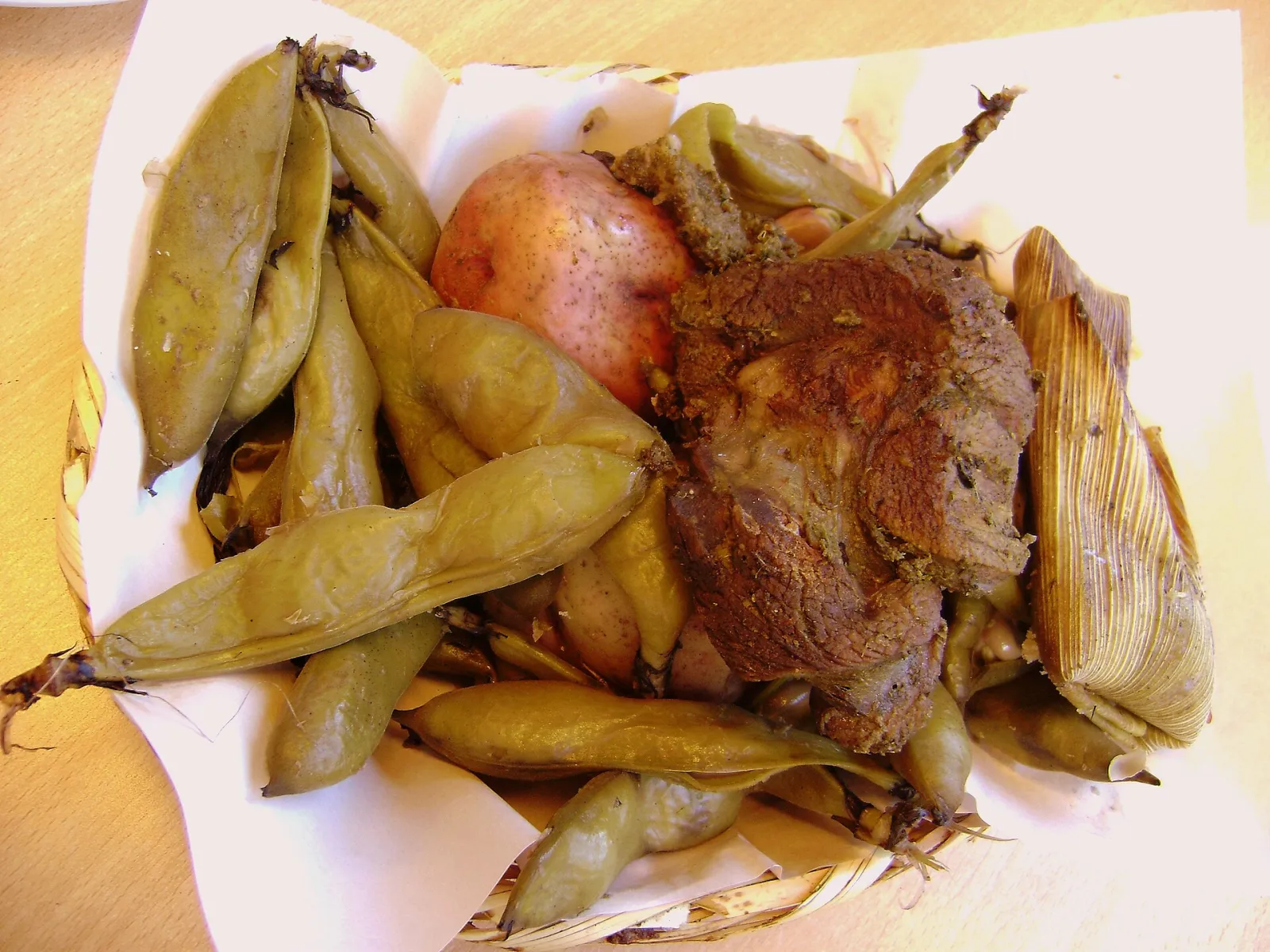
Beef pachamanca with broad beans, potato and a humita wrapped in corn husk, as served in Huancayo. Photo: Dtarazona, public domain
The ritual is the experience. Stones are heated in a fire until they glow. The meat, seasoned with herbs such as chincho and huacatay, goes in with potatoes, sweet potatoes, broad beans and corn, the stones go on top and the whole thing is covered with earth. When it is opened, the steam smells of herbs and smoke, and everyone eats from the same pile. Andina notes that the ingredients change by region: in Junín the oven can hold cuy, alpaca, lamb and humitas, in Ayacucho chicha de jora goes into the seasoning.
Peru celebrates National Pachamanca Day on the first Sunday of February, set by the Ministry of Agriculture in 2015, and pachamanca has been part of the nation's cultural heritage since 2003. In the Sacred Valley, ask your lodge or a local guide where one is being prepared. Our Sacred Valley full-day tour does not include a pachamanca. Its lunch is a buffet in Urubamba with Andean dishes and vegetarian options. If you would rather not hunt for one, we arrange a private pachamanca with partner communities in the valley, with at least 48 hours' notice.
What are chicherías and picanterías?
A chichería is a place where the drink comes first: chicha, usually corn beer, with a little food on the side. A picantería is the reverse, a traditional restaurant where regional dishes come first and chicha comes with them. That is how Andina distinguishes the two.
Peru's Ministry of Culture declared the picanterías of Arequipa part of the nation's cultural heritage in April 2014, and in November 2015 extended the distinction to the picanterías of Cusco, Lambayeque, Piura, Tumbes and La Libertad. In Cusco, Andina names La Chomba and La Chola as legendary picanterías. Our guides send travelers to La Chomba, on Avenida Tullumayo, for its roast lamb and mushroom capchi, a stew of cheese and chili, and to Quinta Eulalia, on Calle Choquechaca, a courtyard restaurant dating back to 1941, for cuy and chicharrón. Expect long shared tables, large glasses of chicha de jora and plates designed for a long lunch, not a quick meal.
Chicha de jora is fermented and does contain alcohol, so pace yourself, especially at altitude. If you prefer none, order chicha morada, the purple corn drink.
Why plan a lunch in an Arequipa picantería?
Arequipa is worth a lunch because its picanterías are the most documented food tradition in southern Peru. UNESCO added Arequipa to its Creative Cities Network for gastronomy in 2019.
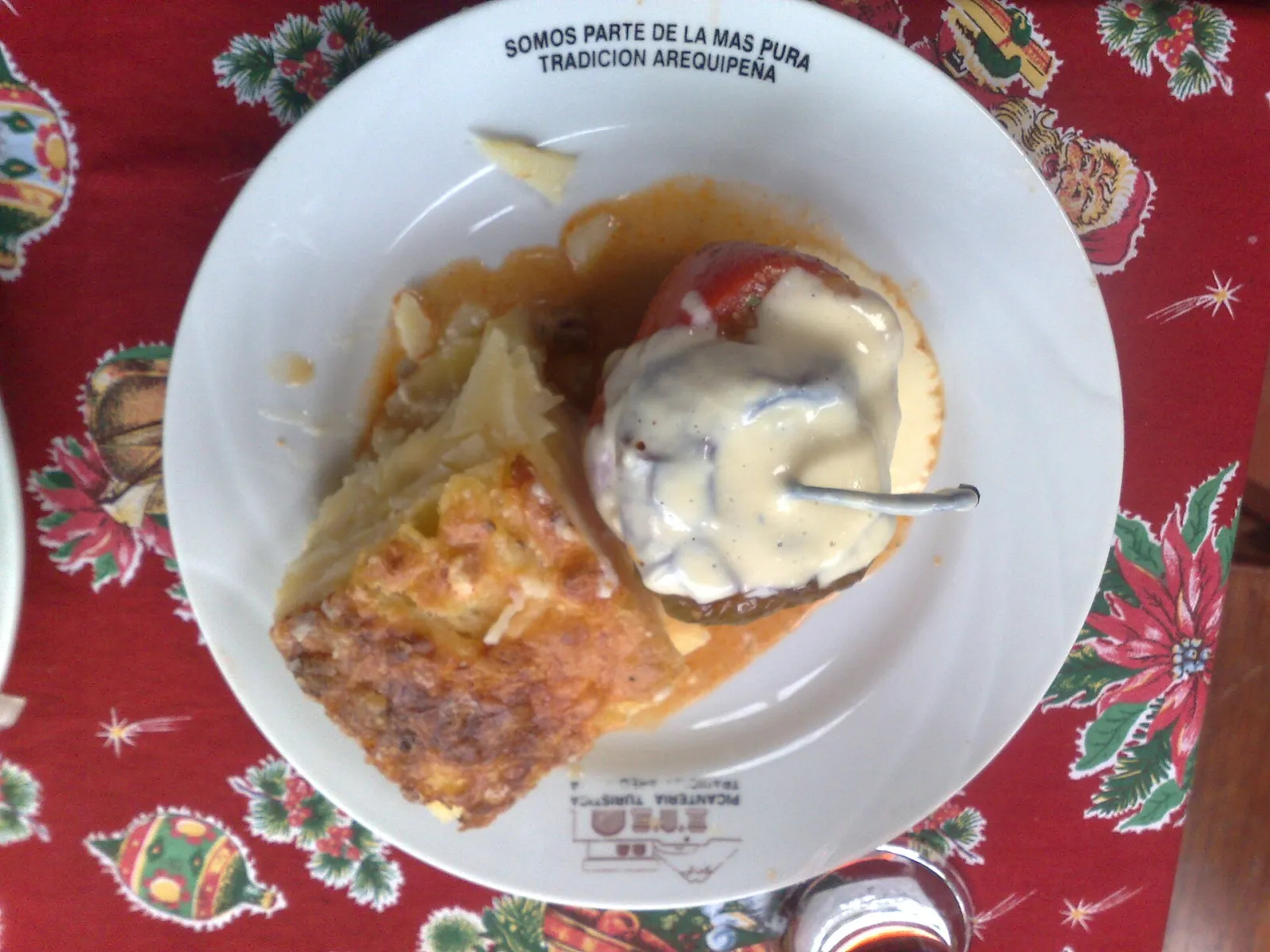
Rocoto relleno under melted cheese, with a slice of pastel de papa, in an Arequipa picantería. Photo: Angel Olin, CC BY 2.0
Andina describes the classics. Rocoto relleno, the stuffed hot pepper, is the starter. Chupe de camarones, a soup of river shrimp with potato, corn and egg, is a main course. Adobo, pork marinated with garlic, chili and vinegar or chicha, is eaten at breakfast, and caldo blanco is the soup of Holy Week. To drink there is chicha de guiñapo, made from a maize variety native to the Arequipa area, with about 2 to 3 percent alcohol. Our guides recommend La Nueva Palomino, in Yanahuara, and La Benita, on the main square of Characato. Viajes Cusco Perú has no fixed Arequipa tour in its catalog, so plan this stop on your own.
Where do coffee and cacao fit into a Cusco trip?
Coffee and cacao grow in the warm valleys of La Convención province, on the jungle side of Cusco, and you can see them if your route to Machu Picchu passes through Santa Teresa.
Peru has two coffee denominations of origin, and one of them is Café Machu Picchu-Huadquiña, grown in the hamlet of Huadquiña, Santa Teresa district, La Convención. Andina explains that the nearby snow peaks of Salkantay and Humantay create a microclimate that slows the ripening of the coffee cherry. Peru celebrates National Coffee Day on the fourth Friday of August. The same valleys produce chuncho cacao, which the agricultural news site Agraria describes as born in the valleys of La Convención.
Back in Cusco you can taste that coffee without leaving the center. Our guides recommend Three Monkeys Coffee Company, which began as a coffee cart in San Blas and now brews single origins in its own café, and Florencia y Fortunata, in a colonial house a few steps from the Plaza de Armas, a café led by women that buys from coffee farms, many of them run by women. Both made The World's 100 Best Coffee Shops list, according to PromPerú. For chocolate, our guides send travelers to the ChocoMuseo, on Calle Garcilaso facing Plaza Regocijo, where a 2-hour bean to bar workshop takes you from roasting cacao beans to pouring your own bar.
Our Inca Jungle Trail in 4 days, from US$607, walks through coffee plantations on day two and spends that night in Santa Teresa.
How do you eat well with a vegetarian, vegan or gluten-free diet?
You eat well with a special diet in Peru by asking clearly, early and in Spanish. Cusco and Lima are easier than rural towns.
- Vegetarian: "Soy vegetariano" (or vegetariana). Many Andean dishes rest on potatoes, corn, quinoa and broad beans, but soups are often made with meat stock, so ask "¿tiene caldo de carne?".
- Vegan: "Soy vegano, sin leche, sin huevo, sin queso". Expect cheese on many Andean plates.
- Gluten-free: "Sin gluten, soy celíaco". Potatoes, quinoa, corn and rice are naturally gluten free, but soy sauce in lomo saltado and chifa usually contains wheat.
- On our tours: the Sacred Valley buffet includes vegetarian options, and the tour notes ask guests who are vegetarian, vegan or celiac to tell us when booking. The agency told us it adapts menus with Andean staples that are naturally gluten free, such as quinoa, native potatoes and corn, and keeps track of every allergy declared at booking.
How do you stay safe with food and water in Peru?
Stay safe by drinking only sealed bottled drinks and eating food that is cooked and served hot. These are the CDC's general rules for travelers.
The CDC advises avoiding tap water and ice where water may be contaminated, brushing your teeth with bottled or treated water, and eating raw fruit only if you peel it yourself. It notes that hot coffee or tea is safe when served steaming. Its list of foods to avoid includes raw or ceviche-style seafood and food from street vendors, which is worth knowing before a market crawl. If you decide to try ceviche, choose a busy place at lunchtime, when the fish has arrived the same morning. The CDC also recommends the hepatitis A vaccine for unvaccinated travelers to Peru.
Our guides add a few rules of their own. Drink only bottled water, and if your stomach is sensitive, brush your teeth with it too. Skip ice in places you do not know and food from unregulated street stalls. On arrival day in Cusco, rest at the hotel for 2 to 3 hours before any big meal. We offer a hot coca or muña tea on arrival, at no charge. If a traveler falls seriously ill with a stomach problem during a tour, the guide follows the agency's protocol and connects them at once with the medical assistance of their travel insurance, for care at the hotel or a local clinic. That is one more reason to travel with insurance that covers medical care in Peru.
For broader advice, read is Peru safe for tourists.
Frequently asked questions
How much is a cooking class in Cusco? Listings checked in October 2026 started at US$70 for a 4-hour class and US$89 for a 6-hour class, both with a San Pedro Market visit.
How long is a cooking class in Cusco? Between 4 and 6 hours, including the market walk, the cooking and the meal.
How much does a food tour in Lima cost? Barranco food tours were listed from US$89 to US$119 per person in October 2026, depending on the operator and the menu.
Which neighborhood is best for a Lima food tour? Barranco for restaurant tastings, and Surquillo and the Mercado Central for markets.
Is San Pedro Market worth visiting? Yes. It is a working 1920s market declared a national monument in 2024, with juice stalls, soup counters and Andean produce.
Are cooking classes in Cusco suitable for vegetarians? Many are. One class we checked lists a vegetarian option. Confirm in writing when you book.
Can I drink tap water in Cusco or Lima? No. The CDC advises sealed bottled drinks and avoiding ice where water may be contaminated.
Where can I try pachamanca near Cusco? In Andean towns on weekends, at festivals and in rural lodges. Order ahead, because the earth oven is built for each meal. We arrange private ones in the Sacred Valley with 48 hours' notice.
Does Viajes Cusco Perú sell cooking classes or food tours? Not cooking classes. On request we run a private 4-hour food route in Cusco and a food day in the Sacred Valley, booked by WhatsApp.
How much is a private food tour in Cusco with Viajes Cusco Perú? Around US$65 per person on average for 4 hours, with tastings, transport and entrance fees, for 2 to 12 people booked 72 hours ahead.
When is the best time to visit San Pedro Market? In the morning. Our guides go between 8:00 a.m. and 1:00 p.m., when the stalls are fullest.
What we offer, and what we do not
At Viajes Cusco Perú, a Cusco tour operator, we do not sell cooking classes or restaurant bookings, and we have no agreement with the class and tour operators named above, which appear only because their public pages give the prices quoted. What we do offer, on request by WhatsApp, is a private food route in Cusco and a food day in the Sacred Valley, with a pachamanca if you book 48 hours ahead. What our regular tours include is listed in each itinerary. The Cusco walking tour, from US$27 per person, begins at San Pedro Market. The Sacred Valley full-day tour, from US$127, stops at the Pisac artisan market and includes a buffet lunch in Urubamba. The Maras and Moray tour, from US$167, lets you buy salt from the producers and includes a buffet lunch. In Lima, the half-day city tour, from US$97, passes through Barranco. To plan the rest, see our Cusco, Sacred Valley and Lake Titicaca itinerary and the best things to do in Cusco.
Updated October 2026. Facts checked on October 20, 2026, against El Peruano (Resolución Viceministerial 000331-2024-VMPCIC/MC), Andina on picanterías, pachamanca, Arequipa cooking and Peruvian coffee, Agraria, the CDC, and the public pages of As Peru Tours Adventure, The Abroad Guide, Nomades and Civitatis. Prices are third-party listings and change often. Market times, our guides' recommendations, the private food route and the safety rules come from the agency's answers to our October 2026 questionnaire, with each place checked on October 21, 2026.