Peru Entry Requirements for US Citizens: Visa and Passport 2026
No visa, a passport valid 6 months and an onward ticket. How long you can stay, the TAM Virtual, CDC vaccine advice and the land border from Bolivia.
US citizens do not need a visa to visit Peru as tourists. You need a US passport valid for at least six months from the day you land, proof of a return or onward ticket, and nothing else on paper. The immigration officer sets your stay on arrival, usually 90 days, and that number lives on a free digital card called the TAM Virtual, not on a stamp. No vaccine is required to enter, and yellow fever is only recommended if you are heading to the Amazon lowlands. This guide walks through every step, from the passport check at home to the immigration desk in Lima and the land crossing from Bolivia.

Inside Jorge Chávez International Airport in Lima, where international flights to Peru land. Photo: Entorpeditt, CC0
The short version
- Visa: not required for US citizens traveling as tourists. Peru's Foreign Ministry lists the United States as visa exempt for tourism.
- Passport: valid for at least six months on arrival. Peru's immigration agency says travelers who fall short will not be admitted.
- Return ticket: the US Embassy in Lima says tourists must show proof of return or onward travel.
- Length of stay: decided by the officer at the desk, usually 90 days. Check the exact number on your TAM Virtual.
- No passport stamp: since May 29, 2023, Peru records entries electronically on international flights.
- Vaccines: none required for entry. The CDC recommends yellow fever only for parts of the Amazon basin below 2,300 m (7,550 ft), not for Lima, Cusco or Machu Picchu.
- Cash: declare more than US$10,000 at customs. Carrying more than US$30,000 in cash is not allowed.
Do US citizens need a visa for Peru?
No. Peru's Ministry of Foreign Affairs publishes a table of visa exemptions by nationality, last updated in July 2026, and the United States appears as exempt for tourism under Supreme Decree 23-95-RE. The same table lists a period of 90 days for US travelers.
The exemption covers tourism. The table does not list US citizens as exempt in the business category, so if your trip involves signing contracts or paid work, ask a Peruvian consulate before you fly. Migraciones, Peru's immigration agency, also says that a tourist who needs to sign commercial or legal documents in the country can request a special permit through its digital agency.
There is no e-visa or online authorization to buy. A website selling a "Peru tourist visa" for a US passport is selling something you do not need.
Passport rules: the six-month line
This is the requirement that actually turns people around at the airport. Migraciones states it plainly on its page for tourists: a passport with a minimum validity of six months is mandatory, and without it you will not be able to enter the country. The US Embassy in Lima says the same thing.
Count from your arrival date, not your departure. If you land in Lima on June 1, your passport has to be valid until at least December 1. If it expires sooner, renew it before you book anything. A traveler refused at the desk goes back on a plane, not into the city.
If you renew it after booking, update the number everywhere, because the Machu Picchu entrance is tied to it. Our Machu Picchu tickets guide explains why.
What happens at immigration in Lima
International flights from the US land at Jorge Chávez International Airport in Lima. The sequence is short: you walk to the immigration hall, hand your passport to the officer, answer a question or two about the purpose and length of your trip, and look at the camera. Have your return flight and first hotel address ready on your phone.
What you will not get is a stamp. Migraciones stopped stamping passports on international flights on May 29, 2023 (Superintendency Resolution 00119-2023-MIGRACIONES). Your entry is recorded electronically on the Tarjeta Andina de Migración, or TAM Virtual. Nobody hands you a paper card.
Then customs. If you are not carrying goods that pay duty, restricted items or more than US$10,000 in cash, SUNAT, the customs authority, says you do not need to fill in the baggage declaration. You walk through the exit control. If you carry more than US$10,000, declare it. Peru prohibits entering or leaving with more than US$30,000 in cash or bearer instruments, and SUNAT can hold the excess and fine 30% of the undeclared amount.
The TAM Virtual: your proof of legal entry
The TAM Virtual is free and you download it yourself. Migraciones describes it as the record of your entry, with your personal data, the date, time and checkpoint where you entered, and the number of days you are authorized to stay.
How to get it:
- Go to the official page at cel.migraciones.gob.pe/ConsultaTAMVirtual/VerificarTAM.
- Fill in the form with your passport data. Migraciones recommends typing only letters and numbers, with no dots, dashes or spaces.
- Type the captcha code and download the PDF.
Do it on your first evening, on the hotel Wi-Fi, and save the PDF on your phone. Migraciones says the TAM Virtual can be shown, together with your passport, if police or immigration officers check documents.
How long can you stay in Peru?
The officer at the desk decides. The US Embassy says the approved stay is usually 90 days and that extensions are not available. The Foreign Ministry's 2026 table also shows 90 days for US citizens. Andina, Peru's state news agency, quoting Migraciones, puts the ceiling for tourists at 183 days, which is the maximum the law allows, not what you will normally receive.
The practical rule: read the number of days on your TAM Virtual, and plan to leave before it runs out.
| Situation | What applies |
|---|---|
| Tourist visit, US passport | No visa, stay set at the desk, usually 90 days |
| Proof required at entry | Passport valid 6+ months, return or onward ticket |
| Overstay fine | 0.1% of the UIT per extra day (S/5.50 per day in 2026, with the UIT at S/5,500) |
| Business trip | Not listed as visa exempt; check with a Peruvian consulate |
| Cash over US$10,000 | Declare to SUNAT |
| Cash over US$30,000 | Not allowed |
The fine is small per day, but the US Embassy notes that Peruvian immigration does not let you depart until fines and overstays are resolved, and Migraciones guidance warns that it can also order a mandatory exit or expulsion. Do not test it.
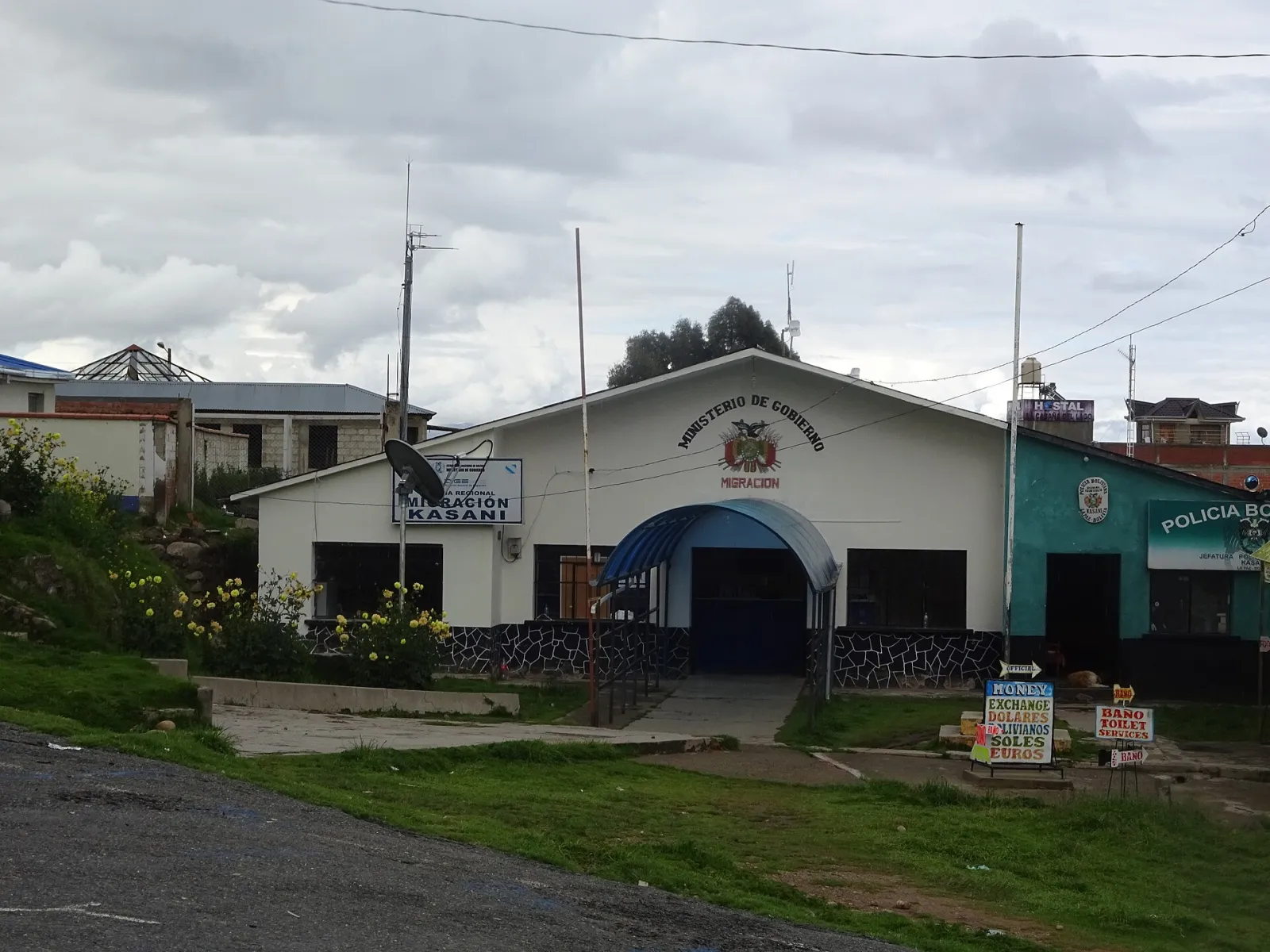
Bolivia's immigration post at Kasani, on the Titicaca shore. You check out of one country and into the other at separate desks. Photo: Carlillasa, CC BY-SA 4.0
Entering Peru by land from Bolivia
Coming overland from La Paz or Copacabana, the two usual crossings are Kasani, near Copacabana, and Desaguadero, on the road from La Paz to Puno. Migraciones runs border control posts at both.
The rule that matters here comes from Migraciones itself: whenever you leave Peru for a neighboring country, or come back, you must go through an immigration control post to register the movement. Skip it and you break immigration law, and Migraciones warns that you may not be able to enter Peru again or board a flight out of Peruvian territory. On a bus, that means getting off at both posts, Bolivian exit first, then Peruvian entry.
The same documents apply as at the airport: passport valid six months, proof of onward travel. Download a fresh TAM Virtual after the crossing, because your authorized days start from the new entry.
Bolivia sets its own entry rules for US citizens, separate from Peru's. Check them before you plan the Bolivian half of the trip. If you would rather leave the logistics to someone else, our Peru and Bolivia tours handle both borders, and the Aymara route from Puno is a one-day taste of the lake.
Vaccines and health: what the CDC says
Peru does not require any vaccine to enter, according to both the CDC and the US Embassy. What the CDC recommends depends on where you go.
- Yellow fever: recommended for travelers aged 9 months or older going to areas below 2,300 m (7,550 ft) in regions that include Amazonas, Cusco, Loreto, Madre de Dios, Puno and San Martín. The CDC says it is not recommended for travel limited to Lima, the city of Cusco, the Inca Trail and Machu Picchu. The Cusco region includes lowland jungle, which is why it appears on both lists.
- Malaria: the CDC lists transmission in areas below 2,500 m east of the Andes, including Iquitos and Puerto Maldonado. A highland trip does not need it. A trip to the jungle lodges does, so talk to your doctor.
- Routine and travel vaccines: the CDC advises being up to date on routine shots, including measles, and lists hepatitis A and typhoid for most travelers.
- Altitude: the CDC notes that places like Machu Picchu sit at high altitude and that altitude sickness is a real risk. Our guide on how to acclimatize in Cusco explains the first 48 hours.
The CDC suggests seeing a doctor at least a month before the trip.
Travel insurance
Peru does not ask for proof of insurance at the border. The CDC suggests considering medical evacuation insurance, and on a trip with high passes and remote lakes that is the part that matters. Check that your policy covers the altitude of your hikes. If you plan Humantay Lake or Rainbow Mountain, you will be well above 4,000 m.
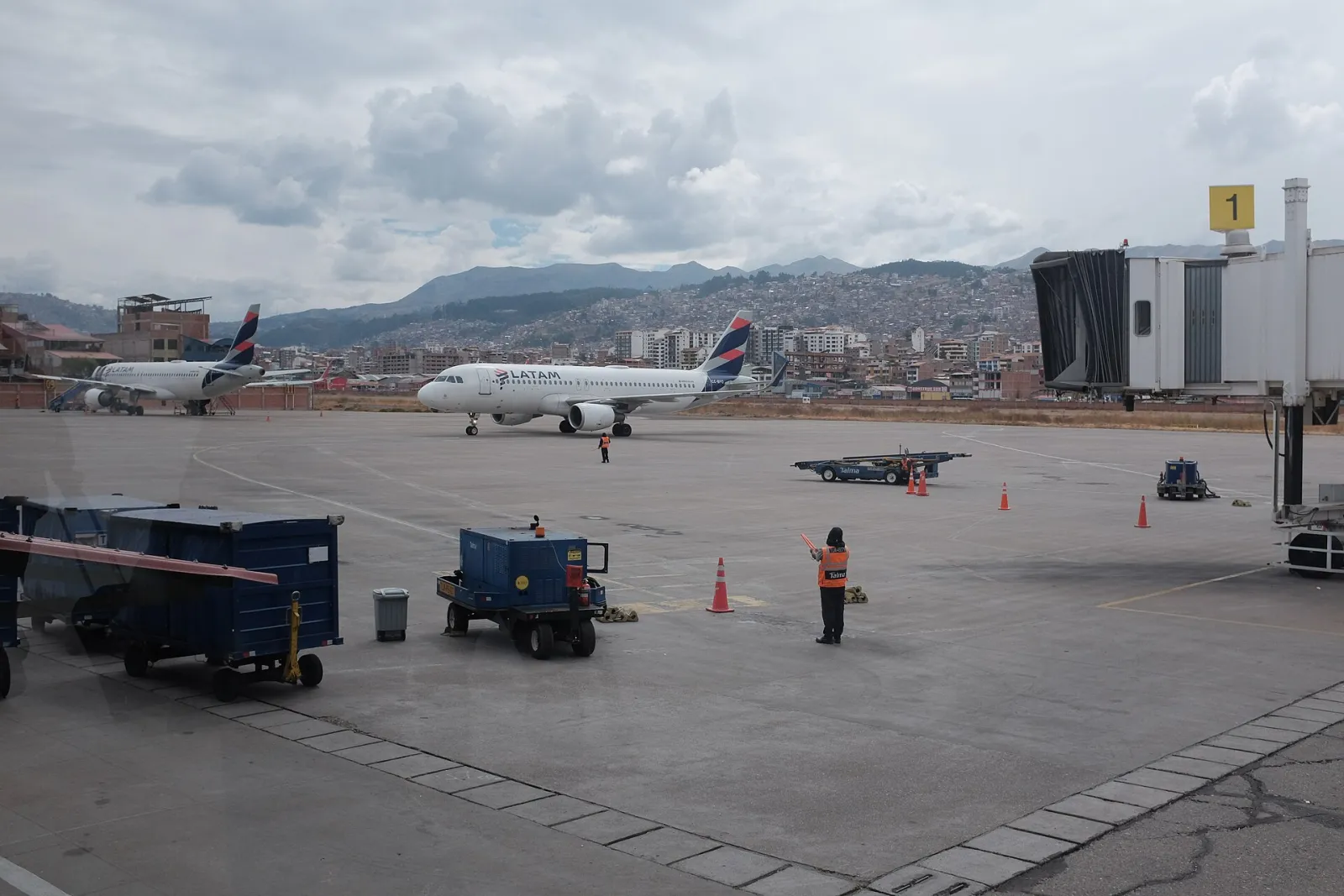
Cusco's Alejandro Velasco Astete airport. Keep the passport in your hand luggage: you will show it again on the domestic flight, at hotels and at Machu Picchu. Photo: tomislav medak, CC BY-SA 4.0
What to carry through immigration
Keep one folder, paper or digital, with everything the officer or the airline might ask for:
- Passport, valid six months from arrival, plus a photo of the data page saved offline.
- Return or onward flight confirmation.
- First hotel address and phone number.
- The TAM Virtual PDF, once you have downloaded it.
- Your travel insurance policy number and emergency line.
- Any prescription medicines in their original packaging. The CDC suggests calling Peru's embassy to confirm your prescriptions are legal to bring in.
Everything else about what goes in the suitcase is in our Peru packing list.
Traveling with children
US-citizen children follow the same rules as adults: their own passport, valid six months. The special permit you may read about, the Permiso Notarial de Viaje, applies to minors who hold Peruvian citizenship and travel with only one parent or with neither. The US Embassy says Peruvian immigration will not let such a child, even a dual US-Peruvian citizen, leave Peru without it. If your child has a Peruvian parent, sort this out at a Peruvian consulate in the US before the trip.
If something goes wrong
Lost or stolen passport: Migraciones tells tourists to go straight to their consulate. For US citizens that is the US Embassy in Lima, emergency line +51 1 618 2000, or the Consular Agency in Cusco at +51 84 231 474. The embassy also recommends enrolling in STEP, the State Department's Smart Traveler Enrollment Program, so it can reach you in an emergency. For a broader look at street safety, transport and scams, read is Peru safe for tourists.
Frequently asked questions
Do US citizens need a visa for Peru? No. US citizens traveling as tourists are visa exempt, according to Peru's Foreign Ministry. You only need a passport valid six months and a return or onward ticket.
How long can a US citizen stay in Peru? The officer decides at entry, usually 90 days. Check the exact number on your TAM Virtual and leave before it runs out.
Does my passport need six months of validity for Peru? Yes. Migraciones says passports must be valid for at least six months, and travelers who do not meet this are not admitted.
Will I get a stamp in my passport in Peru? Not on international flights. Since May 2023 Peru records entries electronically, and you download the TAM Virtual as proof.
Do I need a yellow fever vaccine for Peru? It is not required for entry. The CDC recommends it only for areas below 2,300 m in the Amazon basin, not for Lima, Cusco or Machu Picchu.
Can I enter Peru by land from Bolivia with a US passport? Yes, through posts such as Kasani or Desaguadero. Go through both the Bolivian exit and the Peruvian entry control, and download a new TAM Virtual afterward.
Do I need travel insurance to enter Peru? It is not checked at the border. The CDC suggests considering medical evacuation coverage, which matters on high-altitude hikes.
Plan the rest of the trip
With the paperwork sorted, the real planning is about time and altitude. At Viajes Cusco Perú, the Cusco tour operator behind this blog, we build trips that start in Lima and climb gradually. The Lima and Cusco tour in 7 days, from US$900 per person, covers both cities, the Sacred Valley and Machu Picchu. The four-day Cusco and Machu Picchu tour suits a shorter visit, and the 10-day Peru and Bolivia trip includes the land crossing between the two countries. Browse all our multi-day tours in the Andes and Machu Picchu options, check what a Machu Picchu trip really costs, and pick your season with our guide to the best time to visit Machu Picchu.
Requirements checked on October 15, 2026, against Peru's Foreign Ministry visa exemption table (July 2026), migraciones and gob.pe pages for tourists, SUNAT customs guidance, the US Embassy in Lima and the CDC's Peru destination page. Rules can change without notice, so confirm with official sources before you fly.