Community Tourism in Peru: Amantaní Homestay, Taquile, Llachón
What a night with a family on Amantaní or Llachón is like, Taquile's UNESCO weaving, gifts and etiquette, and weaving communities near Cusco.
Community tourism in Peru means sleeping, eating and working alongside a rural community that runs the visit itself. The classic stay is Amantaní Island on Lake Titicaca: 40 km (25 mi) and about 3.5 hours by boat from Puno, at 3,817 m (12,523 ft), with a S/8 fee (about US$2.30). Rain falls mostly from January to April.
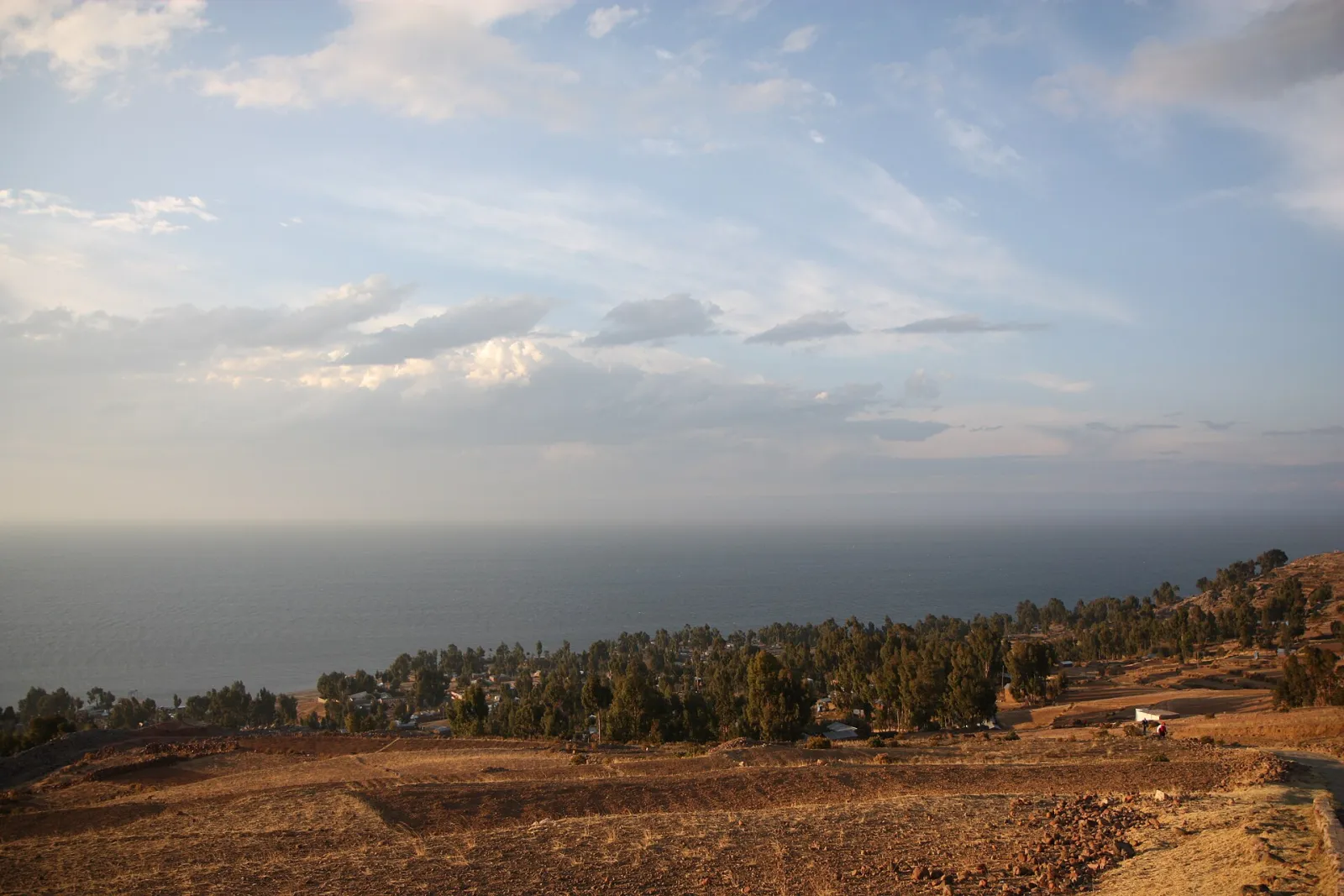
Fields and family houses on Amantaní. Most of the island's families have adapted their homes to host visitors. Photo: Olivier Issaly, CC BY-SA 2.0
Quick facts
| Fact | Detail | Source |
|---|---|---|
| What it is | Tourism led by community-based organizations: associations, cooperatives or communal companies | MINCETUR, January 2026 |
| Legal frame | Law 31797 on community tourism. Its regulation was put out for public comment in January 2026 | MINCETUR, January 2026 |
| Amantaní | 3,817 m (12,523 ft), 40 km (25 mi) from Puno, about 3 h 30 min by boat, S/8 fee | MINCETUR inventory |
| Amantaní population | 3,577 people in ten communities (2017 census) | Ministry of Culture, 2020 |
| Taquile | 36 km (22 mi) from Puno, about 3 h by boat, S/8 fee, children free | MINCETUR inventory |
| Taquile textiles | UNESCO masterpiece in 2005, Representative List in 2008 | UNESCO |
| Taquile award | Best Tourism Villages by UN Tourism, 2023 | Andina, December 2023 |
The short version
- Amantaní is where you sleep with a family. Taquile is mostly a day visit for its weaving. Llachón, on the Capachica peninsula, is where Puno's community tourism began.
- Expect a simple room, meals made from what the island grows and a cold night above 3,800 m (12,500 ft).
- The evening often ends with music and dancing, with your hosts lending you their clothes.
- Bring practical gifts, ask before photos and do not hand money or sweets to children.
- Near Cusco, weaving communities such as Huilloc and Chinchero receive visitors by day.
- We do not sell homestays on their own. Our programs include them inside complete trips.
What is community tourism in Peru?
It is tourism where the community, not an outside company, runs the lodging, food and activities. MINCETUR, Peru's Ministry of Foreign Trade and Tourism, defines it as a practice led by community-based organizations, formalized as associations, cooperatives or communal companies, that offer "living culture, nature and adventure" while protecting their natural and cultural heritage.
The idea has a long history in Peru. In 2017 MINCETUR listed 48 rural community tourism packages in nine regions, built by local entrepreneurs with technical help from its Rural Community Tourism Strategy. Six were in Puno: Amantaní, Llachón, Taquile, Uros, Atuncolla and Ccotos. In 2023 the tourism minister told Andina that 12% of Peru's rural population depends on community tourism and that 70% of the projects shown at that year's national meeting were led by women.
The rules are changing. Law 31797 promotes community tourism, and in January 2026 MINCETUR published the draft regulation for comment. The draft creates the figure of a community tourism interpreter, a guide accredited by the community itself, and aims for the money to be shared collectively.
You will see the Spanish names on signs: turismo rural comunitario (TRC) and turismo vivencial, "living tourism", the word most families use for a homestay.
What is a night with a family on Amantaní like?
Quiet, cold and very early to bed, with a party in between. The boat from Puno lands at one of the island's docks after about three and a half hours. MINCETUR lists four: Cancollo, Tocosi, Capillano and Orcosuyo. From the dock you walk uphill to the houses. Go slowly: you are already above 3,800 m.
The room. MINCETUR notes that most families on the island have adapted their houses to receive visitors and share their customs. Rooms are simple family rooms, not hotel rooms, so the warmth comes from the layers you bring.
The food. You eat what the island grows. The Ministry of Culture lists potatoes, oca, broad beans, maize and barley as the main crops, grown on terraces that go back to pre-Hispanic times. Our itineraries describe dinner and breakfast with the family as typical home meals, and you will see muña, a wild Andean mint the inventory lists among the island's plants, growing along the paths.
The afternoon. Many visitors climb one of the two summits, Pachatata at 4,115 m (13,501 ft) or Pachamama at 4,130 m (13,550 ft), for sunset over the lake. Both hold ceremonial centers that stay closed except for the community's ritual in January. Our guide to Andean spiritual experiences explains that ritual.
The night. In our experience on these trips, guests help with small household tasks, and in the evening the family dresses them in its traditional clothes and takes them out to dance to Andean music. You will feel a little clumsy in a borrowed skirt or poncho, and nobody minds. Then the temperature drops hard. The MINCETUR record describes a cold climate, with the lowest temperatures from May to July.
The morning. After breakfast the boat leaves for the next stop. On our programs that is the Uros, on the way back to Puno.
What is Llachón, and how is it different?
Llachón is a Quechua-speaking community on the Capachica peninsula, about an hour and a half by road from Puno according to the provincial municipality, or reached by boat, that Andina calls "the cradle of rural community tourism" in Puno. A few families started hosting visitors, and today dozens of community members take part and tourism has become their main income, Andina reported in 2022.
The houses are built of stone with thatched ichu roofs. The rooms are "warm and austere", with shelves of wood, curtains of totora reed and blankets woven by the families. Families still farm and fish, and MINCETUR mentions kayaking on the lake among the activities. Llachón suits travelers who want a calmer stay and the lake at their door.
Taquile: why is its weaving on UNESCO's list?
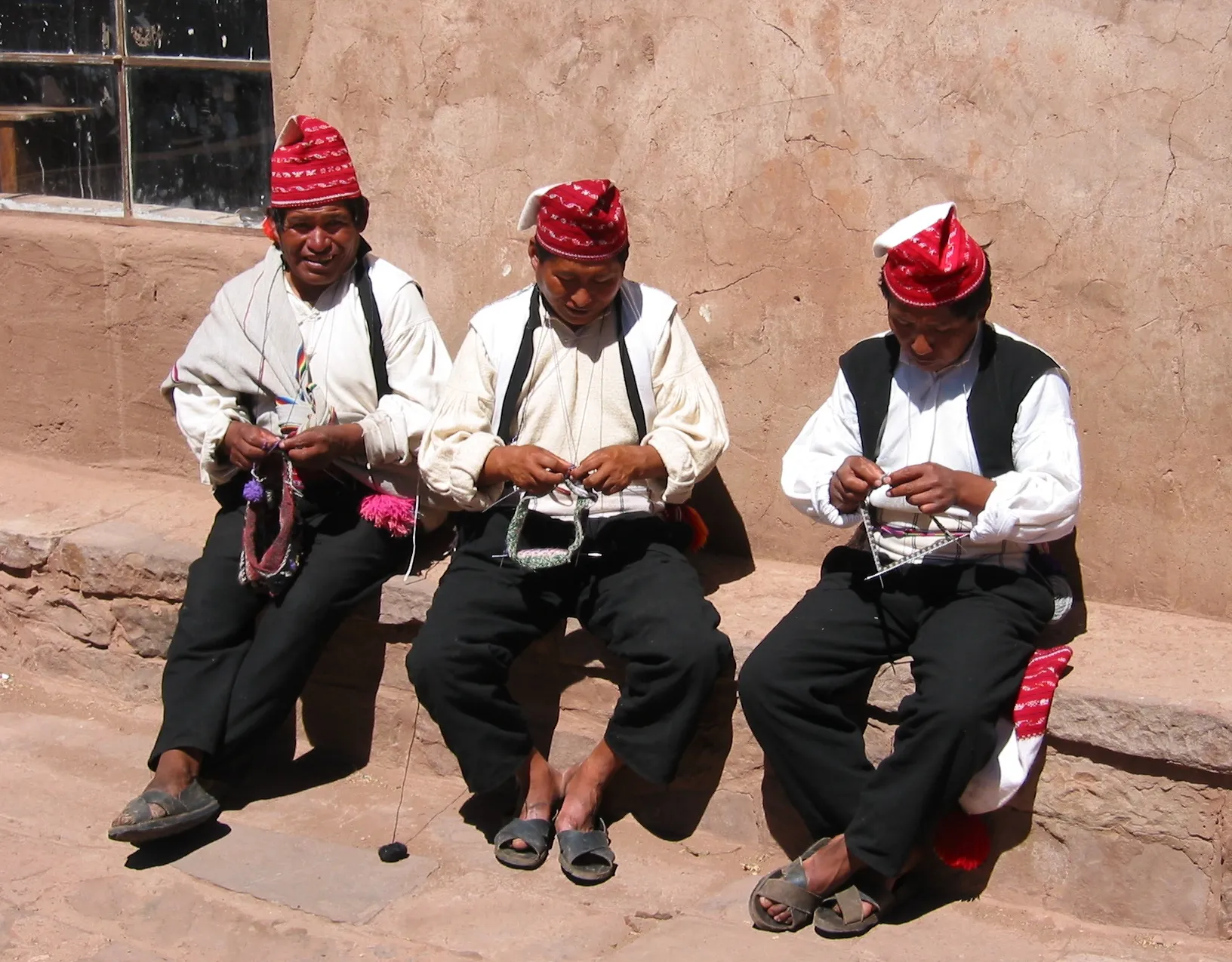
Men knitting on Taquile, where UNESCO notes that men and women of all ages make textiles every day. Photo: Bcasterline, public domain
Because weaving there is everyday life. UNESCO proclaimed "Taquile and its textile art" a masterpiece of humanity's oral and intangible heritage in 2005 and inscribed it on the Representative List in 2008. It notes that both men and women of all ages weave, and singles out the chullo, a knitted hat with earflaps, and a wide calendar belt that records the ritual and farming year. UNESCO also notes that tourism has helped the communal economy and changed materials and meanings.
MINCETUR's record adds the practical side. The island has been owned by the Taquileños since 1942. From Chilcano port on the west side a zigzag climb of 540 steps leads to the square. Women and young people are the main actors of its community tourism, and lodging, meals and crafts are provided by the families. In 2023 UN Tourism named Taquile one of the Best Tourism Villages in the world, Andina reported.
Most visitors see Taquile on a day trip, sometimes after a night on Amantaní. Lodging, meals and crafts are provided by the families themselves, so buying a piece on the island pays the people who made it. Our Lake Titicaca guide covers the boat day and the Uros.
Amantaní, Llachón or a day trip: which one fits you?
| Amantaní homestay | Llachón homestay | Uros and Taquile day trip | |
|---|---|---|---|
| Time from Puno | About 3 h 30 min by boat | By road or boat | Full day, back in Puno at night |
| Sleep | Family home on the island | Stone house on the peninsula | Your Puno hotel |
| Best for | Sunset hills, a full night with a family | Quiet, lake views, kayaking | Weaving, short on time |
| Visitors | 13,128 foreigners in 2025 | Not published | Taquile had 48,257 foreigners in 2025 |
| Altitude | 3,817 m (12,523 ft), hills to 4,130 m | On the lakeshore | Taquile 3,950 m (12,959 ft) |
Visitor figures come from MINCETUR's inventory records. Taquile receives almost four times as many foreign visitors as Amantaní, which is why the night on Amantaní feels so much quieter.
What should you bring as a gift, and what should you avoid?
Bring things a family can use, give them to the adults and let them decide. Ask your guide the day before, since each community has its own habits.
Good gifts: fruit, rice, cooking oil, sugar or bread bought in Puno, and notebooks or pencils for the school, handed to a parent or teacher.
Avoid: sweets and money handed to children, used clothes nobody asked for, and anything that will end up as plastic rubbish on the island.
Etiquette that matters:
- Ask before photographing people, and accept a no.
- Eat what you are served, or explain kindly. Tell your operator about allergies ahead of time.
- Join the dance even if you are shy. Refusing everything reads as rude.
- Dress modestly and keep your voice down at night.
- Leave stone piles and altars alone.
What to pack: a warm hat, gloves, thermal layers, a headlamp, wet wipes, a water bottle and sunscreen. Our Peru packing list has the full highland list. Carry small bills in soles for the fees and crafts. Our guide to money and tipping in Peru explains what is normal.
How much stays with the family? We could not find an official figure for the share of a homestay price that reaches the host family, and we would rather not guess. MINCETUR's new rules aim for benefits to be shared collectively. When you book, ask your operator how the family is paid.
Which communities can you visit near Cusco?
Mostly day visits built around weaving and farming, a short ride from the city.
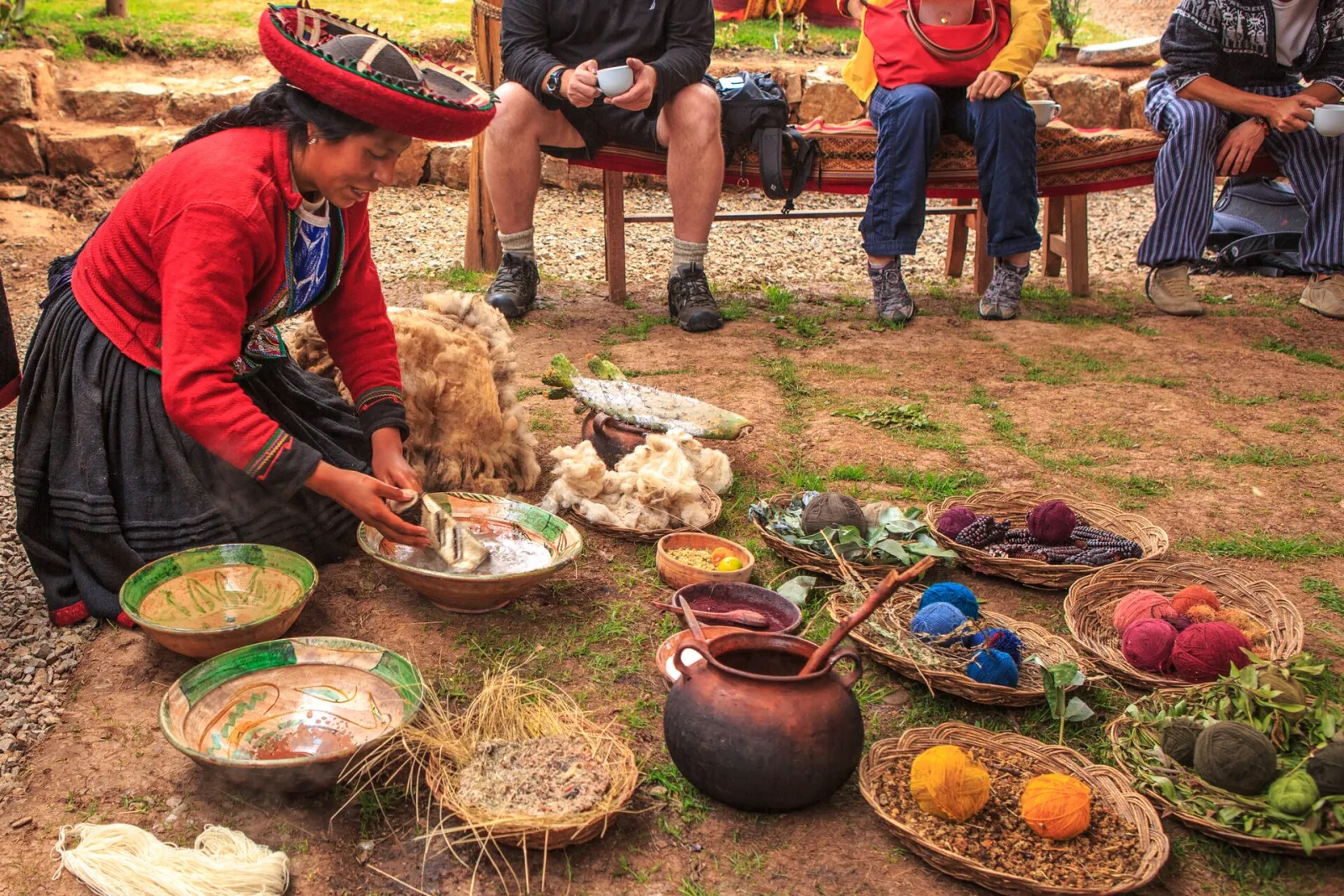
A textile demonstration near Chinchero, with bowls of plants and dyed wool laid out on the ground. Photo: Murray Foubister, CC BY-SA 2.0
Chinchero. Peru's Ministry of Culture describes Chinchero's textile art as knowledge rooted in every family, known for designs that keep Inca symbols and for natural dyes. Our Sacred Valley full-day tour ends at a textile center where women show the whole process, from shearing to dyeing with plants to weaving on traditional looms.
Huilloc. A Quechua farming community 19 km (12 mi) above Ollantaytambo, at 3,525 m (11,565 ft). MINCETUR's record calls it "the community of weavers": about 200 families who dress in red and black, practice ayni and minka, host visitors in family lodgings and run weaving workshops. They have also restored more than 680 hectares of native queuña forest.
Patabamba. The district of Coya, in the province of Calca, promotes "turismo vivencial" in this farming community, with local food, customs and a walk to the Qoricocha lagoon, which the municipality calls the balcony of the Sacred Valley.
Hatun Q'ero. In July 2026 the Ministry of Culture launched a cultural and spiritual route here, in Paucartambo, with an offering to the Pachamama, textile demonstrations and traditional food led by the community itself.
For more on the valley itself, read our Sacred Valley guide.
Frequently asked questions
What is community tourism in Peru? Tourism run by an organized rural community, which provides the lodging, meals and activities. MINCETUR calls it turismo comunitario, and many families say turismo vivencial.
How do you get to Amantaní Island? By boat from the port of Puno: about 40 km (25 mi) and 3 hours 30 minutes. Our programs add the Uros on the way back.
Is staying on Amantaní Island worth it? Yes, if you want a quiet night with a family, a sunset hill and simple food. It is cold and simple, so pack warm layers.
Where do you sleep on Amantaní? In a family home. Most families on the island have adapted their houses to host visitors.
How much is the Amantaní entrance fee? S/8 per person, about US$2.30, according to MINCETUR's inventory. Taquile charges the same, with children free.
Can you stay overnight on Taquile Island? Yes, families there provide lodging, but most visitors see Taquile on a day trip. Amantaní is the usual island for overnight stays.
Why is Taquile famous? For its textile art, on UNESCO's intangible heritage list since 2008. Men and women of all ages weave and knit every day, including the chullo hat and the calendar belt.
What gifts should I bring to a homestay? Fruit, rice, oil or school supplies for the family, given to the adults. Avoid sweets or money for children.
How much of the money goes to the family? We found no official figure. MINCETUR's new rules aim for collective sharing, so ask your operator how the family is paid.
Do you sell homestays on their own? No. Our Amantaní night is part of complete programs from Cusco or Lima.
Stay with a community on our trips
At Viajes Cusco Perú, the Cusco tour operator behind this blog, we include community stays inside complete trips rather than selling homestays on their own. What we include is written in each itinerary, and we do not promise visits to communities that are not on it.
Every Aymara Baptism program spends a night with a family on Amantaní: start with the 5-day trip from Cusco to Puno, from US$917 per person. The 10-day version, from US$1,347, and the complete 12-day trip, from US$1,377, also add a day in a Sacred Valley community: a brief ceremony for the Pachamama, harvesting Andean grains, a huatia earth oven, an adobe workshop and quena and charango music. On foot, the Lares Trek in 4 days, from US$787, camps at Sondor, where a local family shares its daily life and alpaca weaving. For the lake by day, our Peru and Bolivia tour in 10 days, from US$1,817, sails to the Uros and Taquile. See all our mystical activities and our Peru and Bolivia tours.
Updated October 2026. Facts checked on October 20, 2026, against MINCETUR (inventory records for Isla Amantaní, Isla Taquile and Huilloc, and its 2017, 2025 and 2026 notes on community tourism), Peru's Ministry of Culture (Resolution 000099-2020-VMPCIC/MC, the Chinchero archaeological park record and the July 2026 Hatun Q'ero note), UNESCO's page on Taquile and its textile art, the Coya district and Puno provincial municipalities, and Andina (2022, 2023 and 2026). The soles to dollar conversion uses the Central Reserve Bank rate of S/3.439 from October 14, 2026. Package details come from our own itineraries.