Arequipa, Peru: Things to Do, Altitude and How to Get There
At 2,335 m and 1 hour by air from Cusco: Santa Catalina (S/50), Juanita, Yanahuara and El Misti, picanterías, and the altitude step before Colca and Puno.
Arequipa, Peru's White City, sits at 2,335 m (7,661 ft) in the southern Andes, about 1 hour 15 minutes by air from Lima and 1 hour from Cusco. Its center, built of pale volcanic sillar, has been a UNESCO World Heritage Site since 2000. Give it at least three days: Santa Catalina, Yanahuara, the Misti and a picantería lunch. Here is what to see, what it costs and how the altitude works before Colca and Puno.
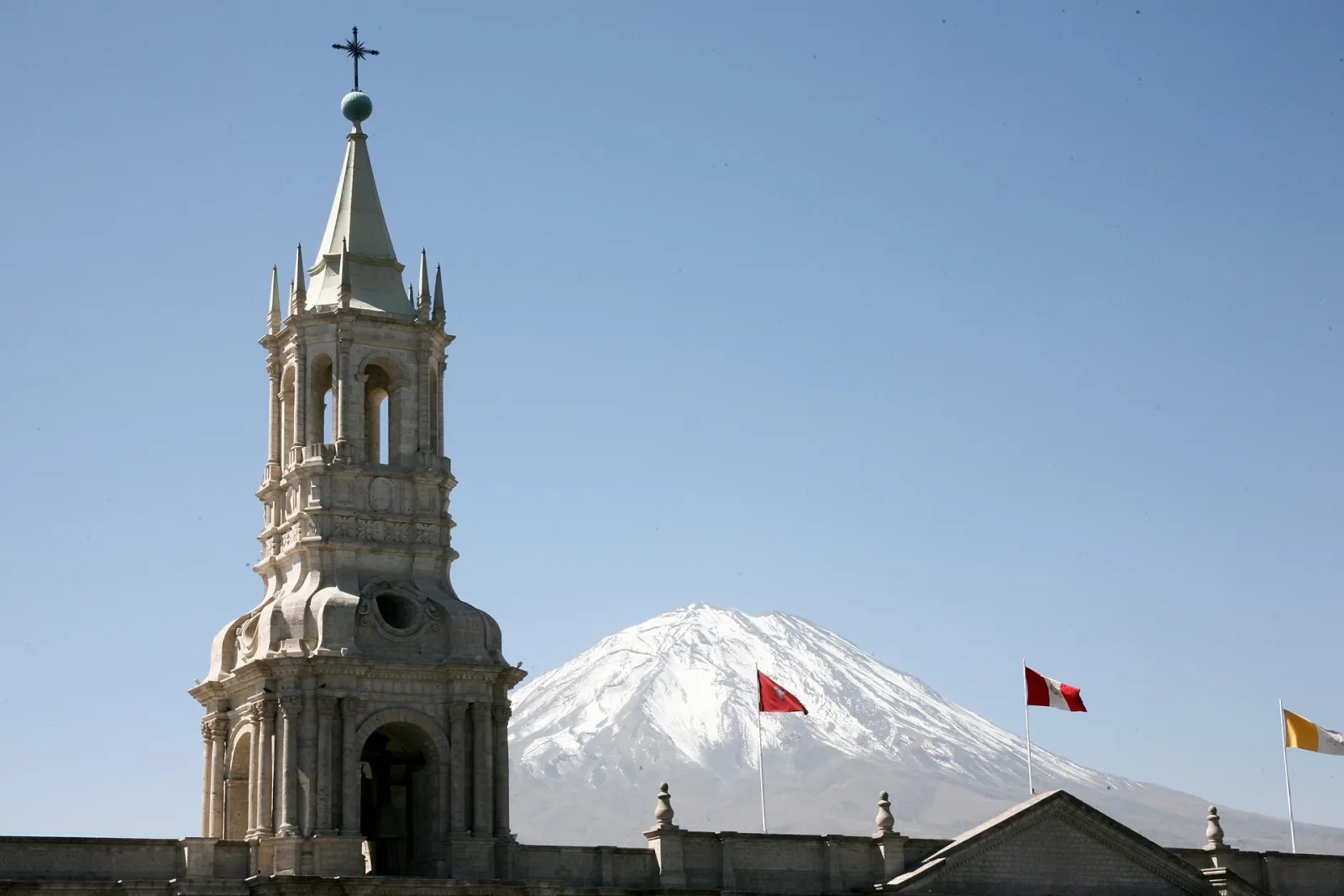
The cathedral tower on the Plaza de Armas, carved in sillar, with El Misti rising behind the rooftops on a clear August afternoon. Photo: FotosATP-Pe, CC BY-SA 4.0
Quick facts
| Arequipa | Source | |
|---|---|---|
| Altitude | 2,335 m (7,661 ft) | DIRESA Arequipa, PromPerú |
| Founded | August 15, 1540 | DIRESA Arequipa |
| UNESCO | Historical Centre inscribed in 2000, 166.52 ha (411 acres) plus a buffer zone of 165.47 ha | UNESCO World Heritage Centre |
| Volcano | El Misti, 5,822 m (19,101 ft), summit 17 km (11 mi) from the center | IGP, 2022 |
| Temperature | 9.2 °C to 22.7 °C (49 °F to 73 °F) | PromPerú, 2023 |
| Flight from Lima / Cusco | about 1 h 15 min / about 1 h | PromPerú, 2023 |
| Road from Lima / Cusco / Puno | 1,009 km (627 mi), 16 h / 515 km (320 mi), 10 h / 325 km (202 mi), 6 h | PromPerú, 2023 |
| Minimum stay suggested | 3 days | PromPerú, 2023 |
The short version
- Arequipa is the gentle first step up. You sleep below the height where the CDC says altitude sickness starts to become a risk, then climb to Colca and Puno.
- The center is walkable. The Plaza de Armas, the cathedral, Santa Catalina and the Juanita museum are a few blocks apart.
- Santa Catalina costs S/50 (about US$15) for a foreign adult and stays open until 8:00 p.m. on Tuesdays and Wednesdays.
- The best Misti view is from Yanahuara, 2 km (1.2 mi) north of the plaza, through a row of carved stone arches.
- Eat lunch in a picantería. The Ministry of Culture declared them national heritage in 2014.
- The Colca Canyon is 151 km (94 mi) away, about 3 hours by road, so it pairs naturally with the city. Our Colca Canyon guide covers it.
Why is Arequipa called the White City?
Because most of its historic center is built of sillar, a white or pinkish volcanic stone. UNESCO's description of the site says the buildings were made "mostly in white or pink volcanic rock," and that the look of the city comes from European and native building traditions worked together by colonial masters and by Criollo and Indian masons.
Touch any wall off the plaza: the stone is porous and light, and it warms up in the afternoon sun. UNESCO links those robust walls, arches and courtyards to the earthquakes that keep shaking the region. The facades carry dense Baroque carving, with flowers, faces and figures that UNESCO reads as a strong indigenous influence.
The stone itself comes from the slopes of Chachani, the volcano just north of the city. PromPerú's 2023 travel guide explains that the sillar is ignimbrite, the product of an enormous eruption millions of years ago, and points to the quarries of the Añashuayco ravine, 12 km (7.5 mi) northwest of the city, about 40 minutes by car. The stonecutters' craft there has been declared Intangible Cultural Heritage of the Nation.
How high is Arequipa, and does it help with the altitude?
Arequipa stands at 2,335 m (7,661 ft), according to the regional health directorate and PromPerú. That matters more than it seems. The CDC Yellow Book says travelers who are not acclimatized start to be at risk of altitude illness when they sleep at about 2,450 m (8,000 ft) or higher, and that two or three nights at 2,450 to 2,750 m before going higher are strongly protective.
So Arequipa sits just under that line. It is a soft first rung, not full acclimatization, and the next steps are bigger:
| Stop on a southern Peru route | Altitude | Source |
|---|---|---|
| Arequipa (sleep) | 2,335 m (7,661 ft) | DIRESA Arequipa |
| Patapampa pass, on the road to Colca (short stop) | 4,910 m (16,109 ft) | MINCETUR, PromPerú |
| Chivay, Colca valley (sleep) | 3,635 to 3,651 m (11,926 to 11,978 ft) | Andina |
| Puno, Lake Titicaca (sleep) | 3,827 m (12,556 ft) | PromPerú |
The jump from Arequipa to Chivay is about 1,300 m (4,300 ft) in one day, and the bus crosses the 4,910 m pass on the way. Above 3,000 m (9,800 ft) the CDC advises raising your sleeping altitude by no more than 500 m (1,650 ft) per night. Two nights in Arequipa, a slow first evening in Chivay and plenty of water make the climb easier. If you are flying straight into Cusco instead, read our Cusco altitude and acclimatization guide.
What can you see in the historic center in one day?
Start at the Plaza de Armas and you can do the essentials on foot in a day: the cathedral, Santa Catalina and the Museo Santuarios Andinos, all within a few blocks.
Plaza de Armas. Three sides are lined with double arcades of granite, lime and sillar, and the cathedral fills the fourth. In the middle stands a bronze fountain topped by the Tuturutu, a figure PromPerú describes as a 16th-century soldier who carried royal messages. On a clear morning Misti and Chachani close the view behind the cathedral towers.
The cathedral. It was built between 1621 and 1656 and rebuilt in neoclassical style, in sillar, by Lucas Poblete after a fire in 1844. Inside you will find a Belgian organ 12 m (39 ft) tall and a carved wooden pulpit held up by a devil with a serpent's body. It opens for visits only in short morning and late-afternoon slots, so check the hours posted at the door.
Santa Catalina Monastery. Two blocks from the plaza, at Calle Santa Catalina 301, this is the visit people remember. Founded in 1579, it covers 20,000 m² (about 5 acres) and worked as a fully cloistered convent until 1970. Inside you walk narrow lanes with walls painted deep red, past the nuns' cells, kitchens and cloisters. The largest, the Claustro Mayor, covers 753 m² (8,100 sq ft). PromPerú calls it a city within the city. It received 233,000 visitors in 2025, 63 percent of them from abroad, according to Andina.
| Santa Catalina | Details |
|---|---|
| Hours | Every day 9:00 a.m. to 5:00 p.m. Tuesday and Wednesday until 8:00 p.m. (last entry 7:00 p.m.) |
| Foreign adult | S/50 (about US$15) |
| Foreign visitor aged 7 to 18 | S/30 (about US$9) |
| Under 7 | Free with an adult |
| Closed | Good Friday, December 25, January 1 |
| Time needed | 1 hour with a guide, 1.5 to 2 hours on your own |
The late opening on Tuesdays and Wednesdays is worth planning around: the walls change color as the light drops and the lanes get quieter.
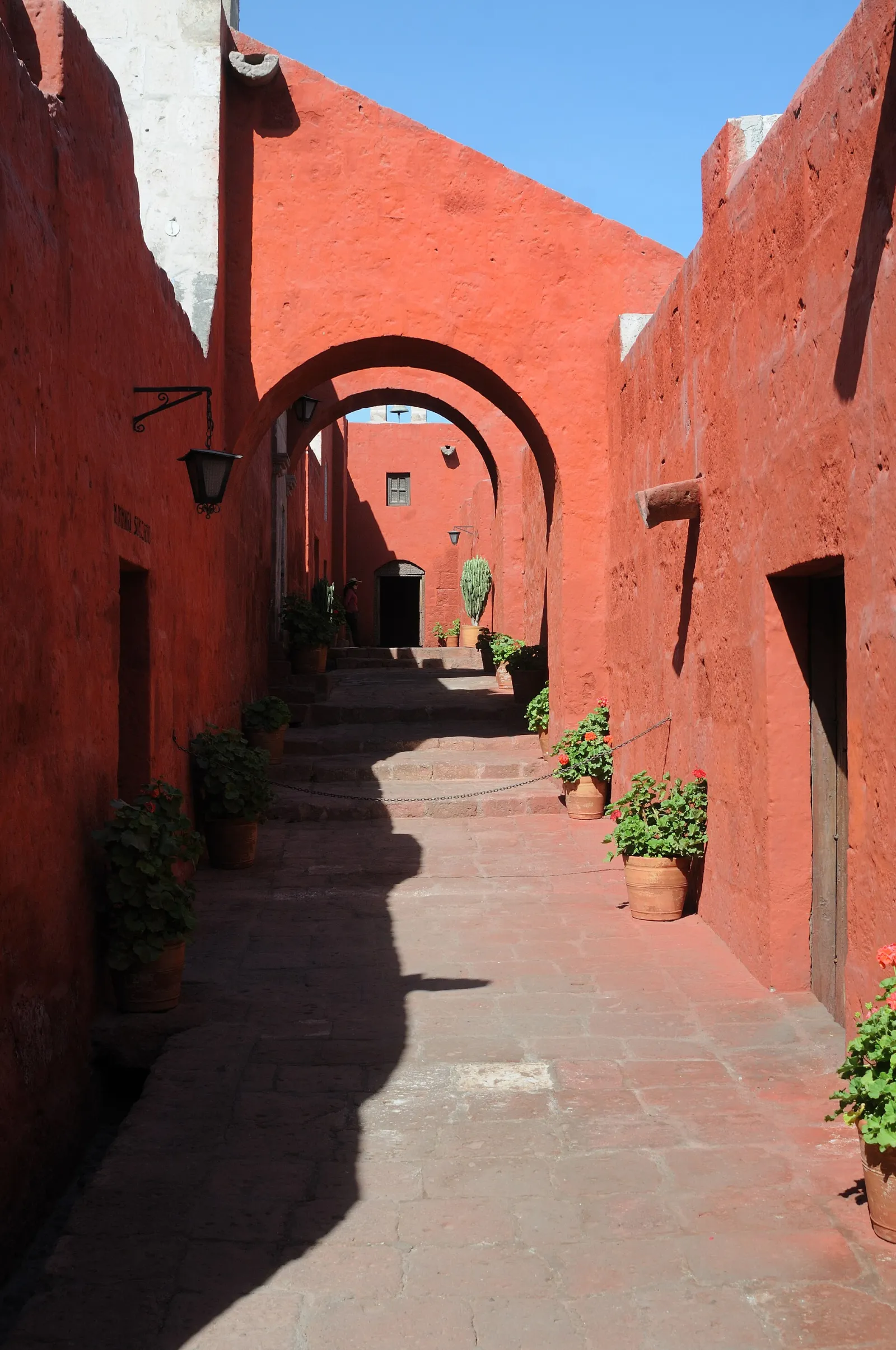
One of the red-walled lanes inside Santa Catalina, with geraniums along the steps. The monastery was closed to the outside world until 1970. Photo: Josep M. Gracia, CC BY-SA 4.0
Museo Santuarios Andinos and Juanita. The museum of the Universidad Católica de Santa María, at La Merced 110, keeps Juanita, the Inca girl found in 1995 on the snow-capped Ampato volcano. Andina explains that she was part of a capacocha, a ritual offering made by Inca priests more than 500 years ago, and the cold preserved her. PromPerú's 2023 guide says she is on display from May to December and lists hours of 9:00 a.m. to 6:00 p.m. Tuesday to Saturday and 9:00 a.m. to 2:00 p.m. on Sunday. Entry is by ticket. Check the dates before you plan around her, because she is not on show all year.
Where is the best view of El Misti?
From the Yanahuara viewpoint, 2 km (1.2 mi) north of the city center. PromPerú describes it as a 19th-century structure of sillar arches engraved with the words of well-known Arequipeños, and the arches frame the city with El Misti standing behind it.
El Misti rises to 5,822 m (19,101 ft), according to the Geophysical Institute of Peru (IGP), which monitors it. PromPerú's guide gives 5,825 m. Its summit is only 17 km (11 mi) from the center, which is why it seems to hang over every street. Chachani and Pichu Pichu complete the trio of volcanoes around the city.
Two more viewpoints are close by. Cayma, 4 km (2.5 mi) northwest and about 10 minutes by car, is known as the balcony of Arequipa, and its church of San Miguel Arcángel, built in 1730, has a mestizo facade. PromPerú also points to the Sachaca and Carmen Alto viewpoints, which look out over the farmland around the city, the campiña.
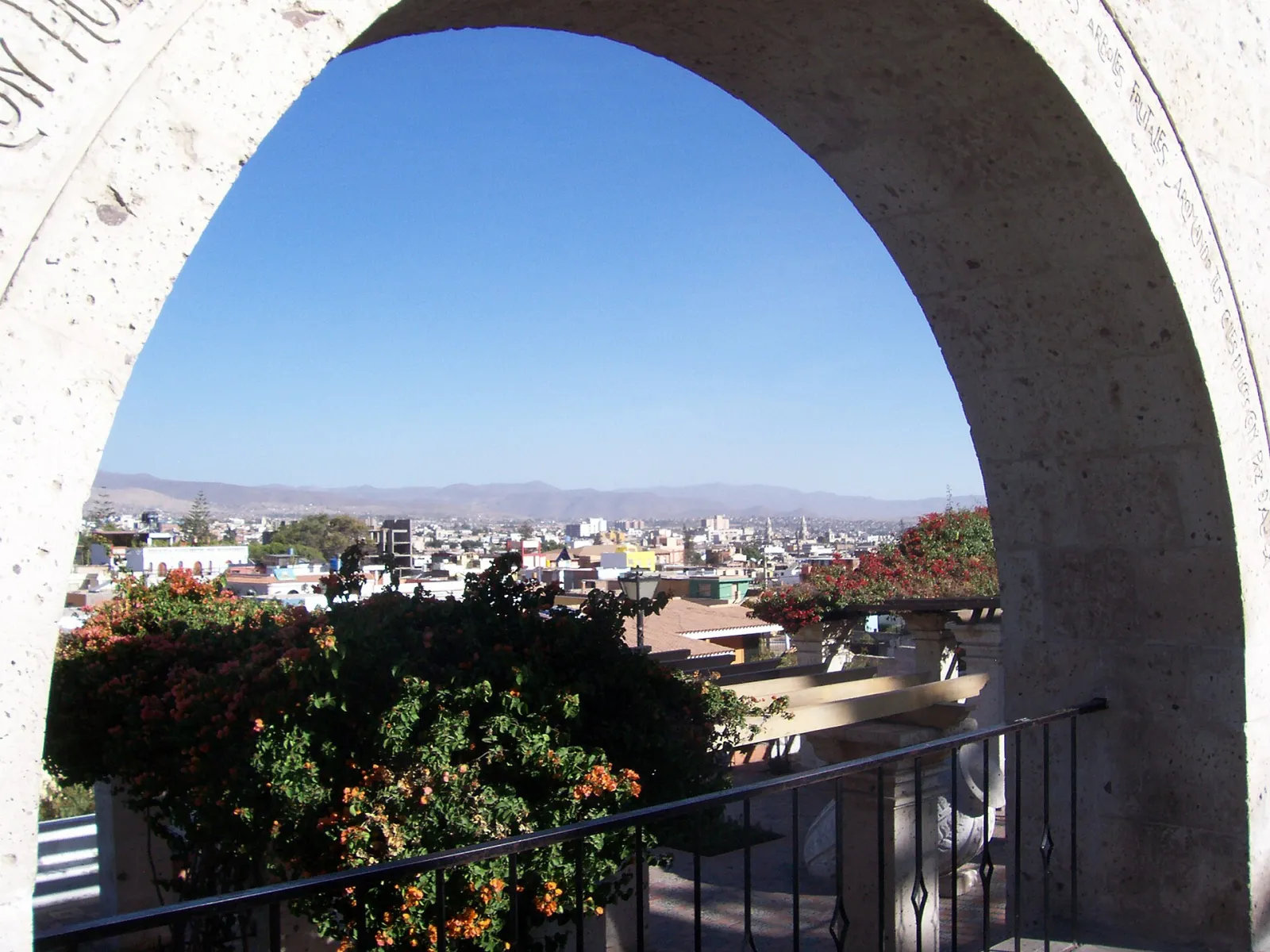
The city seen through one of the carved sillar arches at Yanahuara. Look closely at the stone and you can read the engraved lines. Photo: Gustavo Muñoz Clos, CC BY-SA 3.0
What should you eat in Arequipa?
Eat in a picantería, the traditional lunch house of the city. The Ministry of Culture declared Arequipa's picanterías Cultural Heritage of the Nation in April 2014, and in 2019 UNESCO added Arequipa to its network of Creative Cities of Gastronomy, Andina reports.
- Rocoto relleno. The signature dish. A red rocoto pepper stuffed with minced meat, topped with cheese and baked for about half an hour, usually served with a slice of pastel de papa, a layered potato cake. It is spicy, so taste before you commit.
- Adobo arequipeño. Pork marinated in chicha de güiñapo (a corn drink), ají panca and garlic, cooked slowly in a clay pot. PromPerú notes it is a Sunday breakfast, eaten with pan de tres puntas, a three-cornered bread for dipping.
- Chupe de camarones. A thick river-shrimp soup with potatoes, corn, broad beans, milk, egg and cheese, served as a main course.
- Queso helado. Despite the name, there is no cheese in it. It is a frozen dessert of condensed milk, coconut, vanilla and cinnamon. The city has celebrated a Queso Helado Day on the fourth Sunday of January since 2012.
PromPerú also recommends the San Camilo market for local cheeses and breads. For the rest of the country's dishes, see our Peruvian food guide.
How do you get to Arequipa from Lima, Cusco or Puno?
Fly from Lima or Cusco, or go by road from Puno. These are PromPerú's official times:
| From | By air | By road |
|---|---|---|
| Lima | about 1 h 15 min | 1,009 km (627 mi), about 16 h |
| Cusco | about 1 h | 515 km (320 mi), about 10 h |
| Puno | not listed | 325 km (202 mi), about 6 h |
In our 15-day tour, travelers reach Arequipa by bus from Nazca after the overflight of the lines, a ride of about 9 hours, and leave for Puno from the Colca valley. If you start in Lima and need to choose between flying and the bus, our Lima to Cusco guide compares the options, and our Nazca Lines guide covers the stop before Arequipa.
Should you start in Arequipa or fly straight to Cusco?
Start in Arequipa if you have about two weeks and want a gradual climb. Fly straight to Cusco if you have a week or less.
| Lima, Arequipa, Colca, Puno, Cusco | Lima straight to Cusco | |
|---|---|---|
| Altitude profile | Step by step: 2,335 m, then 3,635 m, then 3,827 m | One jump from sea level |
| What you add | White City, Colca Canyon, condors, Lake Titicaca | More days around Cusco and the Sacred Valley |
| Time needed | About two weeks | One week can work |
| Road time | Long days: Nazca to Arequipa about 9 h, Colca to Puno about 6 h | Short transfers, one flight |
| Our package | Complete Peru 15 Days | Lima and Cusco in 6 days |
What Viajes Cusco Perú does and does not do in Arequipa
We are a tour operator based in Cusco. To be clear about what we sell:
- We do not sell a standalone Arequipa city tour or a Colca tour. Arequipa and the Colca Canyon are part of one package, the Complete Peru 15 Days, from US$2,084 per person.
- In that package, day 3 ends with the bus from Nazca to Arequipa, day 4 is a countryside city tour with the Sachaca viewpoint, the Founder's Mansion and the Sabandía Mill, built in 1785 of sillar, day 5 crosses the Salinas y Aguada Blanca reserve to Chivay, and day 6 starts early for the Cruz del Cóndor before the road to Puno.
- Santa Catalina and the Juanita museum are not part of that guided tour. Both are a short walk from the plaza if you have free time.
- We do not organize Misti or Chachani climbs or cooking classes in Arequipa.
Frequently asked questions
What is the altitude of Arequipa? 2,335 m (7,661 ft), according to the regional health directorate and PromPerú. That is lower than Cusco and Puno, which is why many routes start there.
Is Arequipa worth visiting? Yes, if you have at least three days. It has a UNESCO-listed center, the Santa Catalina Monastery, the Juanita museum, a volcano skyline and one of Peru's strongest food traditions.
How many days do you need in Arequipa? PromPerú recommends at least three days. One day for the center, one for viewpoints and food, and one or two for the Colca Canyon.
Does Arequipa help you acclimatize? Partly. At 2,335 m it sits just below the 2,450 m where the CDC says the risk begins, so it eases you in but does not replace a slow climb to Colca or Puno.
How much does Santa Catalina Monastery cost? S/50 (about US$15) for a foreign adult and S/30 for foreign visitors aged 7 to 18, according to the monastery's official site in October 2026.
Can you see the Juanita mummy all year? No. PromPerú's 2023 guide says Juanita is on display from May to December at the Museo Santuarios Andinos.
How far is Arequipa from Cusco? 515 km (320 mi), about 10 hours by road, or about 1 hour by air, according to PromPerú.
How far is the Colca Canyon from Arequipa? Chivay, the main town of the Colca valley, is 151 km (94 mi) from Arequipa, about 3 hours by car.
What food is Arequipa famous for? Rocoto relleno, adobo on Sunday mornings, chupe de camarones and queso helado, eaten in picanterías declared national heritage in 2014.
Is El Misti an active volcano? Yes. It is watched by Peru's Geophysical Institute (IGP) and by INGEMMET, which runs a monitoring station near the summit. The summit is 17 km (11 mi) from the city center.
Travel to Arequipa with us
Our route through Arequipa is the Complete Peru 15 Days, from US$2,084 per person, which links Lima, Paracas, Nazca, Arequipa, the Colca Canyon, Lake Titicaca, Cusco and Machu Picchu. If you want the Titicaca leg without the Arequipa days, look at Lima, Cusco and Puno in 10 days, from US$1,720, or the one-day Aymara Route from Puno, from US$127. See every multi-region trip on our Peru tours across the Andes page. For a different number of days, ask for a tailored itinerary through our contact page. Before you go, read our guides to Lake Titicaca, safety in Peru and the Peru packing list.
Updated October 2026. Altitude, hours, prices and distances checked on October 20, 2026, against the UNESCO World Heritage Centre record for the Historical Centre of Arequipa, the DIRESA Arequipa district profile, PromPerú's 2023 practical guide to Arequipa, the official site of the Santa Catalina Monastery, the IGP leaflet on El Misti, the CDC Yellow Book and reports by Andina, Peru's state news agency. Prices and hours can change, so confirm them before you go.